 By David Abel | Globe Staff | 3/09/2003
SOMERVILLE - Under the sallow haze of streetlights, between a frozen river and an empty mall, a few working cars blend in with the rusting wrecks in the parking lot.
Inside these heaps of rubber and metal - the remains of decades-old cars, vans, pickups, and trailers - some huddle under heavy blankets, others hover over propane tanks, and a few live large, watching TV, cooking meals, and keeping warm with help of generator-provided electricity.
The score or more of the homeless people living here in the parking lot behind the old Assembly Square Mall have found what most of them describe as the best possible halfway house - a safer, more peaceful refuge than the shelters and a place of their own that is considerably warmer and more comfortable than sleeping on the streets.
"This roof has probably saved my life," said Siro Lopez Blanco, a 45-year-old father of four, pointing to the porous roof of a broken-down pickup he discovered here last fall after living in a nearby field. "It leaks when it snows and there's no heat, but it blocks the wind and nobody bothers me here."
That may change soon.
In a few weeks, this vast potholed parking lot may become part of a major building project: Last month, after years of wrangling with local activists, Somerville's Planning Board approved permits to allow IKEA, the Scandinavian furniture retailer, to begin building a large store in an adjacent field.
Though the construction could be stalled by appeals, the small homeless community, which has grown and bonded in recent years, is starting to feel the pinch of the coming development.
The owners of the lot, the Assembly Square Limited Partnership, have made it clear to the homeless they aren't wanted. In recent weeks, security guards have told some to leave or risk getting towed. They have recorded license plates, more than a few bearing New Hampshire's "Live Free or Die" motto, and told others that barriers will soon be built where many of the cars and trucks are now parked.
"We're trying to change the landscape there, and obviously, we want our patrons to feel safe and to go to the site," said Natasha Perez, a spokeswoman for the partnership, which owns the old, mostly abandoned mall, now with only two stores, a K Mart and a Building 19. "We're also concerned about the safety of the homeless, and we're working with the city to improve their situation."
But the homeless, many of whom have lived here on and off for years, say they just want to be left alone.
"We're not plotting any bad things, we're just people struggling to survive with nothing in our pockets," said a haggard 39-year-old man named Bill, who said he has been living in his still-mobile Chevy Blazer since he lost a $48,000-a-year job a few days after Sept. 11, 2001.
If crime is a worry of the property's owners, there isn't much evidence it's a problem. A spokesman for the Somerville Police Department said the force hasn't received a complaint from the area in the past two years.
But city officials and property owners are also concerned about the trash. Though the homeless acknowledge they've littered the area with beer cans, they say most of the garbage - the smashed TVs, the burned-out fridge, the old bathtub, and the kitchen sink - were discarded by nonresidents of the parking lot.
"The place has become a dumping ground," said Somerville Mayor Dorothy Kelly Gay, who took part in a homeless census late last year that counted 23 people living in their cars here. "It's becoming a health hazard."
But she and others in the city aren't sure uprooting the homeless is the answer. Local advocates for the homeless argue that people living in the lot - and the census probably missed many, they say - are acting reasonably. The city's homeless shelters, as well as those in Boston, are all already overcrowded.
They're also part of a broader trend: In a survey recently released by the University of Massachusetts at Boston, the number of homeless people who told researchers they were living in cars, among other outdoor locations, increased by 16 percent between 2000 and 2001.
"This is their creative response," said Gordon Calkins, director of First Step, a local outreach program for the homeless. "I recognize the property owners can do what they want, but these people are taking care of themselves - and it's just a car in a parking lot. If they're not hurting anyone, why does it have to be a big deal?"
Alby and Donna, who've been parking their "motor coach" here every day for the past three months, say if cities offered used RVs to the homeless and let them stay in parking lots overnight, there would be less of a homeless problem. "It would be like communes in the '60s," explained Donna, 44, who said she's a waitress and once served in the Navy.
And unlike most Americans, the couple argues, they're completely independent. If they have to, they can pick up all their possessions and move with the flick of the ignition. They also don't worry about having to plug into an electrical grid. For a few dollars, their gas-powered generator provides hours of power for their stove, their shower's hot water heater, a refrigerator, TV, and VCR, and other conveniences.
"The only thing we're missing is a washer and dryer, and maybe delivery of the Globe," said Alby, 43, an ex-convict from East Boston who became homeless after leaving prison.
Despite their mobility, the couple isn't eager to move. It's hard to find places to park their rusting trailer, and they've made friends in their new community. Next door is James Baker, or J.B., a 52-year-old former MBTA bus driver, who now drives a teal 1984 Mercedes and lives in a trailer formerly owned by a restaurant named "Mom's Ribs," which still has its logo on the side of his RV.
The neighbors share the cost of gas to power Alby and Donna's generator and J.B. often drops in to watch movies. Cooking chicken in his trailer this week, J.B. said he started living in his RV three years ago when his landlord began asking $1,200 for his one-bedroom apartment.
"This is one of the only places around where people leave you alone," said J.B., a Dorchester native who now lives off monthly disability payments from the government. "If they tell me to move, I have to move. But the questions is: Where else is there for me to go?"
Among his other parking lot neighbors are Bob and Sally, who found their Assembly Square hideaway after being kicked out of a hotel lot in Woburn.
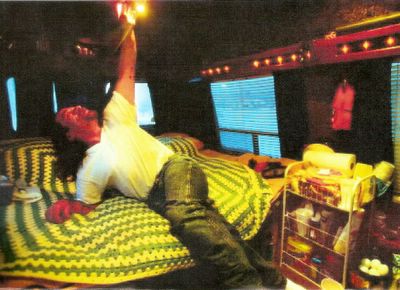
Bob, a 47-year-old former metal worker, said they can't find a better place to park their 1990 Chevy van, which has carried them more than 360,000 miles. The couple has survived the winter by using a propane tank to keep warm at night (keeping the van on, they say, might put them at risk of inhaling carbon monoxide). "When we have propane, it's like Bermuda," Bob said.
They have a TV, a cellphone, and a queen-sized bed, and they bathe by using jugs of store-bought water to fill a kiddie pool.
As plumes of smoke drifted from nearby factories after midnight one recent night, Bob said: "I tell my family I'm having a great time, that it's fun living in the van. You have to fool people, and yourself, sometimes. That's about all you can do when it gets this bad."
David Abel can be reached at dabel@globe.com. Follow him on Twitter @davabel.
Copyright, The Boston Globe
Defiantly, at home on the Eslanade
 By David Abel | Globe Staff | 1/15/2006
David LeRoi isn’t hiding anymore.
The 55-year-old Vietnam vet, by his account, spent much of the last 15 years living everywhere from camouflaged huts in the woods in Franklin Park to crevices hollowed out along the Mass. Turnpike tunnels.
Now, despite cold and snowstorms, the self-described father of four has traded his invisibility for a perch so flagrant he might as well have camped out on City Hall Plaza.
Nearly every day for the past few months, except when briefly rousted by police a few weeks ago, LeRoi has pitched his bright blue tent smack in the open on the Esplanade — just a few feet from the thousands of commuters who pass on Storrow Drive, beside one of the park’s main jogging paths, and well in view of the multimillion-dollar townhouses across the parkway.
‘‘When they ask me to leave, I just say, ‘No — I’m not going,’’’ he says. ‘‘This is going to be the last place anyone’s going to tell me I can’t be. I’m making a stand here. My presence is unmovable.’’
The former electrician’s campsite has become a one-man test of the Department of Conservation and Recreation’s new policy of taking a more aggressive approach with the homeless, made visible in September when the state forced some three dozen people from elaborate shanties they built under the Mass. Ave. Bridge and Park Drive.
Last month, after repeatedly asking him to move, State Police arrested LeRoi for trespassing. But when he appeared in Boston Municipal Court, and the judge learned LeRoi hadn’t been accused of harassing anyone, drinking, or vandalizing, he dismissed the charges.
‘‘I usually deal with murderers, rapists, etc., but here’s a person who’s relatively clean, well-spoken, not causing trouble, and with no criminal history,’’ said Judge Michael F. Flaherty, who cleared LeRoi. ‘‘His behavior was not in question, and he found a place where he feels safe. Is there an appropriate punishment? Jail? A fine? I don’t think so. I told him to relocate, to the other side of the river, to Cambridge,’’ which isn’t state property.
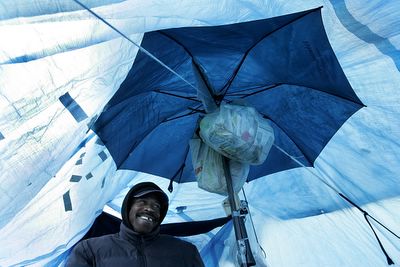
Instead, LeRoi returned to his spot on the banks of the frozen lagoon, this time reinforcing his tarps with rope, cardboard, and an array of duct-taped wood, metal, and large umbrellas.
To endure temperatures that have dropped as low as 10 degrees in recent weeks, the lean man with a gap-toothed grin has hoarded warm clothes from local charities, including a puffy winter jacket, Thinsulate gloves, thermal underwear, and three pairs of socks he wears beneath heavy boots.
At night, he zips himself in two sleeping bags set off the ice-covered ground on a park bench, which his tent surrounds. He uses extra blankets to keep several bottles of water warm enough so they don’t freeze. To avoid attracting wildlife — he once found a rat lounging on a knapsack inside his tent — he seals all his trash in plastic bags and hangs them from the spokes of an opened umbrella that props up his roof.
‘‘I’m really very peaceful here,’’ he says. ‘‘My body has learned to adapt.’’
Of course, sleeping outside — as some 300 of the city’s roughly 6,000 homeless people do every winter — can be risky. Aside from the cold, there’s the crime. Last year, 53 homeless people died on the streets, nine more than in 2004, according to Boston Health Care for the Homeless Program. At least four of those deaths are suspected homicides.
The danger is the principal argument state officials use to justify their efforts to remove the homeless from the parks.
‘‘Public parks just aren’t safe,’’ says Joe Ferson, a spokesman for the Department of Conservation and Recreation. ‘‘It’s not appropriate for him setting up residence. We’ve asked him to move, and we’ve had help from State Police. We may ask them to assist us again in the future.’’
Troopers say they don’t know what else can be done, particularly if LeRoi doesn’t violate laws other than trespassing.
‘‘He seems intent on staying, to the point where we’re going to let him do it,’’ says State Police Trooper Michael F. Rafferty, who oversees the enforcement of trespassing laws on state property in the area. ‘‘The judge laughed it out of court. There’s not much we can do. Our hands are tied.’’
Rafferty, who often deals with the city’s homeless, says troopers have received only a few complaints about LeRoi. ‘‘He’s a gentleman,’’ Rafferty says.
LeRoi has impressed others in the neighborhood.
One man recently brought him a bottle of laundry detergent, though he says he doesn’t really need it. (He usually trashes his old clothes for new ones he picks up at local charities.) Another neighbor slid an envelope with $30 beneath his tarp, which he used to buy toothpicks to clean his yellow teeth, Lysol to kill mold in the tent, a flashlight, and a headset to listen to news on his radio.
‘‘I’m down to $16, but that’s the most I’ve had for a long time,’’ he says.
He also receives help from the outreach workers who ride the Pine Street Inn’s big white van, which roams the streets at night, regularly bring him sandwiches, blankets, and sometimes, new tarps.
‘‘Every time I see that tent, it catches me off guard,’’ says Dr. James O’Connell, president of the Boston Health Care for the Homeless Program, who often rides the van. ‘‘I see him all the time, and I’m always amazed the tent’s still there the next day. It’s very unusual. You never really see tents in the wide open like that.’’
The oddity of such an obvious encampment — the homeless usually prefer less visibility, usually hiding their shanties beneath bridges or in the woods — has created its own camouflage.
Jan Scullin, 64, who lives in the Back Bay and walks past the tent nearly every morning, hasn’t noticed anything strange about the big blue bulge, or LeRoi’s Roadmaster mountain bike, which he locks to the tent.
‘‘I thought it was something to do with grounds keeping, maybe a mini-tractor or leaf collector,’’ she says. ‘‘I had no idea someone was living in there.’’
Other neighbors want LeRoi out.
‘‘His being here really detracts from the beauty of the area,’’ says Norman Priebatsch, 61, who runs past the tent every day. ‘‘There are standards we really must maintain here. It’s not like the city doesn’t provide for the destitute.’’
LeRoi insists he wouldn’t be happier anywhere else, even in the dead of winter, even though he’s reduced to urinating in a container. Shelters are for the ‘‘delinquent,’’ he says.
The oldest of 13 children, LeRoi grew up in Dorchester, graduated Charlestown High School, served in an engineering company in Vietnam, and went on to work as a licensed electrician, he says. He became homeless in 1990 as the result of major ‘‘family problems,’’ he says and records confirm. He has avoided his relatives since, even changing his name, he says, so they can’t find him.
In a recent interview inside his tent, he sits next to the camouflage slicker he uses as a pillow and vents.
‘‘I wanted to be invisible, hidden, but they wouldn’t let me be,’’ he says. ‘‘So, now, here I am, next to all these ivory towers around me. The people are educated and comfortable. They’re going to have to live with me in their presence. They’re going to have to look at themselves by me being here — and if they don’t like what they see, I’m sorry.’’
He shows off his newly acquired toothpicks, which he keeps in a metal Altoids box, and says he has a message for his neighbors.
‘‘When you look at me and think I’m lower than you, you make yourself lower than me,’’ he says. ‘‘You don’t know me ... I’m not an evil guy.’’
As for the future, he plans to reinforce his tent and convert it into something akin to a gazebo.
‘‘My goal is to stand up against authority,’’ he says. ‘‘I’m not afraid.’’
David Abel can be reached at dabel@globe.com. Follow him on Twitter @davabel.
By David Abel | Globe Staff | 7/21/2003
He had no money for his escape, so she gave him everything she had. They were separated by thousands of miles, an authoritarian government, and a maze of bureaucratic obstacles in four countries, but they yearned to live together like an ordinary couple.
It had been nearly a year since the survivor of Angola's brutal civil war and the daughter of a middle-class German family last saw each other in Cuba, where they married. He used her savings to pay for the planes, buses, and horses it would take for them to meet in Boston, a city they heard welcomed immigrants.
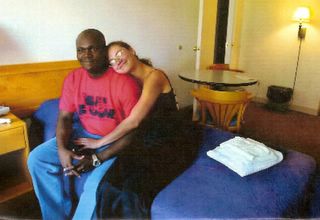
But not long after Nelson Da Costa and Maren Tober were reunited on a blustery day last fall in Copley Square, the young, penniless couple were separated once again. Without a place to stay and lacking visas to work, the two college-educated artists were homeless, forced to sleep apart in shelters that segregate men and women.
"It was horrible we couldn't live together," said Da Costa, who is seeking asylum in the United States. "That was the only reason for us to be here."
One of the few childless, married couples of the thousands of people using the city's shelters, they've spent the past eight months meeting social workers, lawyers, and city officials, hoping to find a place where they could live together.
This week, after he spent months sleeping on a cot in a Dorchester church basement and she in a cramped room at the Pine Street Inn, they're swapping the misery of homelessness for the luxury of being housekeepers.
For the next 16 weeks, they will have the use of an exclusive gym, with a sauna and Olympic-sized swimming pool included, and what amounts to their own two-bedroom apartment, with central air, cable TV, and a view of Boston Harbor.
The couple, each of whom speaks four languages,  required a unique solution to their unique predicament. One day, the city's chief homeless advocate called a hotel in Charlestown, and asked if they had a room to spare. Instead, the hotel provided two rooms, one to be use as an art studio and the other a bedroom, with a full-size kitchen.
For at least the next four months, the couple will live at the hotel, which the manager asked to keep anonymous to avoid a deluge of similar requests. In return, they'll work a combined 40 hours a week, including helping to paint rooms, while housekeepers vacuum their floors and change their sheets.
"They're practically newlyweds, and it's sad a homeless shelter was their starter home," said Eliza Greenberg, the director of the city's Emergency Shelter Commission, who helped reunite the couple. "We wanted to do better by them."
It's been a long trip to find such comfort, though the consolation competes with an unease about the future.
Raised in a small village in the mountains of Angola, Da Costa, 32, watched soldiers murder his family and many of his neighbors during the country's civil war, according to a statement he wrote as part of his asylum application. An orphan, he was shot and left for dead when rebel soldiers attacked his orphanage.
A doctor from Cuba, which sent thousands of troops to support the leftist government in the war-torn African country, found Da Costa, taught him to paint, and after watching him slowly recover from the wound to his shoulder, helped him win a scholarship to study in Havana.
Tober, 24, grew up in a loving family in the formerly communist East Berlin, where teachers once spoke romantically about the Cuban revolution. An aspiring artist who studied Spanish, she decided to travel with a student group to Cuba, where the warm light of the tropics would inspire her painting.
The two met there in 1998, and almost immediately, fell in love. She visited again, and in December 2001, they were married at a small villa in Havana. But marriage to foreigners in Cuba can raise suspicions, and when Da Costa sought a visa to move to Germany, he said, the Cuban government threatened to send him back to Angola, where he feared for his life. Further complicating matters, the German Embassy told him he could only apply for a visa from his homeland.
With pressures increasing on him in Cuba - Da Costa believed he could be sent back to Angola at any time - the couple devised a plan: Tober would return home and earn some money. When she had enough, she would send him the cash needed to escape. Then the two would meet in Boston.
They arrived in Boston this past November, Tober by flying from Germany and Da Costa by a more circuitous route. Using $3,000 she wired him, Da Costa flew to Nicaragua, Belize, and then Mexico, where he followed a group of Guatemalans across the Arizona border, traveling by truck, horse, and at times on foot. From the border, he spent three days in a van before reaching Boston.
Tired and broke when they met each other outside Trinity Church, Da Costa and Tober went to a refugee center and received $20 and directions to the Pine Street Inn. Without children, the couple were not allowed in family shelters. And lacking residency, they were not entitled to public housing.
"All we want to do is be normal people, to use our education, and live together in a free country," Tober said.
Since arriving in Boston, the couple has found an attorney to press Da Costa's asylum case, improved their already proficient English, and spent as much time as possible painting, with supplies donated to city homeless programs. She paints mostly landscapes, places she dreams of going, with warm colors she says symbolizes her hope for a better future. He paints colorful collages of the faces that still haunt him from Angola, a style he calls "figurative expressionism," dreamscapes of suffering and a lust for renewal.
When not painting or working on his asylum - Tober came on a tourist visa - they've been searching for a way to live together.
This week, they finally had that chance for the first time since their wedding.
As they lugged her battered suitcases and his garbage bags filled with clothes to the hotel this week, both had trouble accepting that the spacious room with the private bathroom and the big windows was really theirs, at least for the next four months. Taking it all in, Da Costa said: "It's beautiful. It's perfect. The body is here, but the mind is still in the shelter."
Holding his hand, then hugging him, Tober said, "You see it but you don't believe it."
If they find permanent housing and obtain legal residency, De Costa said, he hopes to work teaching special-needs children, using art as therapy. Tober said she would like to start her own business, selling their paintings, and one day, opening their own gallery.
Until then, without the easy access to food at the shelters, they'll be struggling to find enough to eat.
"There are so many emotions right now," Tober said. "But this is a good start. We'll get by."David Abel can be reached at dabel@globe.com. Follow him on Twitter @davabel.
Copyright, The Boston Globe
 By David Abel | Globe Staff | 9/03/2002
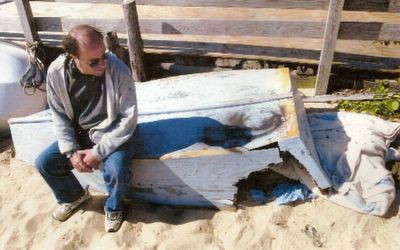
PROVINCETOWN - On a breezy summer morning, when the early light sparkles off the placid harbor waters and nothing moves on the beach but a few scurrying sand crabs, Albert Perry peeks out the open-air window of his small home and burps.
Without room for more than a spot to sleep, his home is a bit cramped. But the pleasant view, cool breeze, and soothing sounds of the shifting tides, as well as the lack of rent and the freedom to drink himself to bed, more than make up for the space, he says.
"This is home sweet home," said the balding 48-year-old, lifting with one hand the wooden frame that shelters him and revealing his life's possessions: a few musty blankets, a ball of socks, and a collection of empty beer bottles.
Nearly every night now, after the tourists have headed home and the late-night partying dies down, Perry and a gaggle of other Provincetown natives sneak onto the public beach on the harbor, swig their last drinks of the night, and slide beneath old, rotting rowboats until morning.
"It's more comfortable than a hard floor - and the boat keeps out the rain," said Perry, a sometimes fisherman whose splintering gray rowboat hasn't moved from its sandy perch in years. "The only problem is sometimes kids, drinking or smoking, sit on top of the boat, and I have to yell: `Hey, there's someone sleeping under here, take it somewhere else.'"
"I get a good laugh out of it," he added.
It may seem like sleeping in a coffin, but Perry and about half a dozen others see the boats as reliable shelter - warm enough, with the right blankets, to stay in through the winter. Without a homeless shelter nearby (the only one on Cape Cod is miles away in Hyannis, and it's almost always full) and with rents rising, sleeping beneath rowboats is their best option - better than the woods, where bugs and rabid animals prowl, they say.
The police, who know all the harbor homeless, don't agree.
While beachfront businesses and tourists rarely issue complaints, the police sometimes roust the homeless, arresting them for everything from fighting to drinking outside to camping on the beach after hours. In the winter, officers take them into "protective custody" on the coldest nights, forcing them indoors.
"We don't and won't look the other way," said Provincetown Police Chief Ted Meyer. "But we're much more tolerant than other places. If we see a guy stumbling around, rather than arresting him, we'll often just let him go home."
When home means an overturned rowboat on the beach, however, Meyer insists that officers make them go elsewhere. Yet, in practice, as long as the homeless aren't raising a ruckus, social workers say, the police don't bother them much. And neighbors in this famously liberal town often look the other way.
Having worked years ago with some of their fathers as a fisherman, David Perry, a security guard at the Seamen's Bank, sees the homeless people every day. One of the men, Glen, recently brought him a cup of coffee to wish him a happy birthday.
"For the most part, these are town boys who've fallen on hard times," said David Perry, who monitors a parking lot off the beach. "They really don't bother people, so unless they accumulate too much stuff, we let them be. I treat them no differently than clients or managers of the bank."
One of the few women who sleeps on the beach is Sean Rehill, 52, a gray-haired artist from Greenwich Village. Like the others, she says, she's been homeless here for several years now because she can't afford to pay rent.
Sipping a bag-covered beer beneath a wharf, she said: "It's a townie's right to sleep on the beach. It's cool. It's convenient to town and it's not isolated. If you can't find a place to live, you should be allowed to stay on the beach."
Another regular here is Gavin, whose rusting metal rowboat lies on a part of the beach where tufts of grass cover the sand. The homeless man, who sometimes passes out with the boat right-side up, has left a few possessions next to the boat: painting supplies, an old outboard motor, and a tattered book titled "Cultural Attitudes in Psychological Perspectives."
The group's only regular link to social services is an outreach team from Vinfen Corp., a nonprofit provider of social services on the Cape. Nearly every Friday for six years now, David Gleason, a Vinfen outreach worker, has visited Provincetown's homeless, bringing them gifts such as new underwear, doughnuts, and sunblock lotion.
On his first visit to the beach, Gleason said, he didn't see anyone, so before leaving he kicked one of the rowboats to be sure. "Someone underneath lifted it up, and said, `Who's there?' " he said. "I jumped - I was so shocked I spilled my coffee."
Now, when he comes, he said, "I just pray I won't find anyone dead under the boat."
With cracked ribs from a motorcycle accident and other medical problems resulting from a fight, Albert Perry knows he's on the edge. But the sunburned fisherman, who goes scalloping when he needs money, isn't in a rush to find another home.
For the past year and a half, he said, he's been living under his battered rowboat, which he says he found when it washed ashore. Looking at a large hole in the stern, which is useful for providing air and a lookout, he says he'll consider searching for another shelter in the winter.
"Until then," he said, "this is my home."
David Abel can be reached at dabel@globe.com. Follow him on Twitter @davabel.
Copyright, The Boston Globe
 By David Abel | Globe Staff | 1/19/2003
The view from the porch consists mainly of a large concrete pillar, the air inside hangs heavy with exhaust fumes, and one of their neighbors, a methadone clinic, attracts scores of heroin addicts every day, but Thomas, David, and John prefer to point out the perks of living in a hut under the Southeast Expressway.
Sure, the rumbling overhead of more than a million cars a week never stops and they often awaken with sore backs, but they view the noise as background music and their beds, blankets folded neatly on the ground, as a cozy, increasingly comfortable refuge.
"For right now, this is as good as it gets," says Thomas, 47, a Roxbury native who, like others, would provide only his first name. "This is our little place and we try to keep it nice. And, right now, it's our only choice."
Beneath the expressway by Berkeley Street, the three homeless men are part of a phenomenon more common to cities in the developing world: All around them, a shantytown is rising from the detritus of the Big Dig.
Over the past few months, as the size of the city's homeless population has risen and state budget cuts have slashed hundreds of shelter beds, about 50 men and women here have built an array of huts, making roofs from old tarps, walls from loading pallets, and doors from discarded road signs.
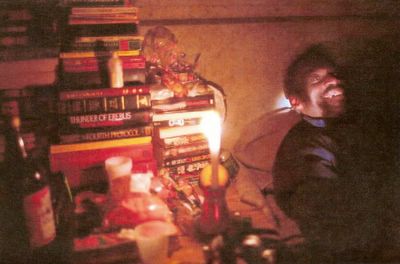
Thomas's new home includes a relatively plush throw rug he and his roommates found in a dumpster, a coffee table-sized wooden spool that displays their growing library of books - ranging from those by Hunter S. Thompson to Isaac Asimov - a fire pit where they grill shish kebab and chicken livers, and their prized possession: a pillowy couch recently donated by Big Dig construction workers.
The increasingly settled community around them includes teenage runaways, a middle-aged Native American, out-of-work Latino immigrants, blacks and whites, and one 81-year-old veteran of the Korean War.
Some fit carpeting and mattresses between abandoned iron beams left from the construction. Others use blankets and cardboard to insulate the large funnels that molded the expressway's concrete pillars. One man pitched a tent, and others make do with little more than a pile of blankets and the elevated highway as a roof.
"We're hearing more and more of these stories, but an encampment in Boston is something new," says Ed Cameron, deputy director of the Emergency Shelter Commission of Boston. "This is a frightening sign of where we're heading. Many of these people really have no other place to go. There's just no room for them. So, the police often look the other way. They have nowhere else to take them."
There are no current numbers for the size of the city's homeless population. A census one night last December found about 6,000 people in shelters and on the streets.
But since then, shelters report more and more people are vying for fewer beds - this summer the state Legislature cut funding for 328 beds - and state officials say record numbers of families are turning up in government offices seeking shelter. Part of a nationwide rise in homelessness, the surging local numbers foretell a crisis this winter, city officials and social workers say.
"I usually say it goes up gradually, but this year it's stunning," says Dr. James O'Connell, who, as president of Boston Healthcare for the Homeless, keeps a close watch on the city's homeless population. "There are just more people now than we can cope with this winter."
Like others below the expressway, many of whom have been living on the streets for years, Thomas, David, and John are well aware there aren't enough beds. So, they've decided to winterize. With the few dollars that Thomas and John earn from demolition work and about $100 a week David pulls in panhandling, or "stemming," as he calls it, the roommates have bought a battery-powered halogen lamp and they're planning to buy a generator and a propane burner to help keep the place a bit warmer.
While they prefer their hut to the crowded shelters, they're conscious of the dangers of living outside. There are numerous thefts and assaults, and in the winter the area beneath the highway becomes a wind tunnel. In recent years, several homeless people died sleeping there.
"My biggest fear is that someone will sneak up on us at night," says David, 33, a Dorchester native who says he has earned as much as $135 panhandling in one day. "I'm not so worried about the winter, as much as staying safe. We try to keep it quiet."
Others, however, are angry there's no room for them at shelters, especially the Pine Street Inn, which has been full every night for much of the past two years. Just a block away, the shelter, the city's largest, has yet to open its lobby, where as many as 200 people slept last winter.
Another homeless man named David, who works as a cook, has suffered turf battles over an insulated funnel where he and a few others regularly sleep. The 37-year-old father, who says he can't afford an apartment because most of his money goes to paying child support, is sick of the fights, the thefts, and the cold. If he could get a bed, he says, he would much prefer to sleep at the shelter.
"It's completely crazy," he says. "Pine Street has space in the lobby - why don't they open it up for us? I'd sleep on a bench there, if they'd let me. It would be much safer."
Pine Street officials say they would like to do more, but they blame the Legislature, which cut the state's budget for homeless services from $37 million in fiscal 2002 to $30 million in fiscal 2003. The cuts, they say, mean the shelter has less money to pay for staff, meals, and counselors to serve the hundreds who seek beds there every night.
With winter approaching, Pine Street president Lyndia Downie says: "We're extremely worried . . . It will exacerbate an already dangerous situation. Right now, it feels like we're trying to plug a dam."
Despite the dangers of sleeping outside, many of the squatters here insist they're relatively well off, at least compared with other homeless people.
At 22, after running away from home four years ago, Laurie boasts about her "hootch" below the highway, a sizeable wood-framed shack covered in plastic. She likes it because she can stay with her boyfriend, make her own rules, and wake up whenever she wants. Also: There's no rent.
"It's the life," she says. "No one bothers you."
There are other perks: Many of the Big Dig workers look after the homeless here. Of more than a dozen homeless people interviewed, almost all had a story of a construction worker bringing them food, offering them wood, buying them lunch, bringing them mattresses, and even offering them jobs for the day.
Sitting in a chair at a table he built from an old cable spool, Robert, the 81-year-old Korean War vet, can't say enough about the kindness of the large men in hard hats. With a small painting of fruit and wine hanging behind him on a rusting iron beam, he holds a container of low-fat cottage cheese, points to boxes of doughnuts, and then gestures at a full-sized futon. All of them, he says, were gifts from Big Dig workers. "They're very nice," he says.
Though the homeless are sometimes viewed as a nuisance - particularly when they're found passed out beneath flatbed trucks or other equipment scattered under the expressway - Big Dig workers seem to have a grudging admiration for them.
Many have stories about the homeless, whom some have come to know well. Others praise their ingenuity.
"They make use of whatever they can get their hands on," said Mark Sarracco, an electrician who sees the homeless every workday. "They really can be quite creative."
Life under the highway has become routine for Thomas, David, and John, who after several months here have perhaps the most elaborate setup in the new neighborhood. They play solitaire at night and wake up to the sound of the same large truck that hurtles by around 4:30 every morning.
"It's our alarm clock," says Thomas, a graying, muscular African-American who speaks Spanish fluently and favors books by Harvard sociologist William Julius Wilson.
At dawn, before he and John head off to find work, they make their beds, tidy the place up, and pour some charcoal in the fire pit to cook breakfast and lunch. David gets up later, tames his scruffy red beard, and watches over the hut. Ambling along nearby roads, he carries a cardboard sign that reads: "Homeless. Hungry. Please Help. Thank you."
The three men met on the streets several years ago and have been looking out for each other since.
"This is our life," Thomas says, getting a nod from David. "It could be worse."
David Abel can be reached at dabel@globe.com. Follow him on Twitter @davabel.
Follow:
SHELTER IS MAKESHIFT, INDEPENDENT
By David Abel
1/19/2003
A crust of ice covers the Charles. Mounds of frozen snow have reshaped the cityscape. And now, deep in the dead of winter, rarely a night passes without the temperature tipping into the teens, or below.
But they're still there, still refusing to compete for a bed at one of the area's crowded shelters, still thankful when they wake up every morning that they're alive and able to hear the drone of traffic passing overhead.
The score of stubborn homeless men and women who built a small shantytown beneath the Southeast Expressway last summer haven't budged since. A fire they made to keep warm destroyed one hovel, and Big Dig construction has hemmed them into a smaller area. But they have used everything from leftover pallets to discarded road signs to reinforce their makeshift huts into what they increasingly view as permanent homes.
"This is our solution to the lack of affordable housing," said Hung Chin, 42, a cheery former sushi chef who braves the winter nights in an elaborately constructed hut with two older men he calls "his fathers." "For as long as I can see, this is our home," Chin said.
Police, city officials, and outreach workers are all well aware of the encampment, a cluster of wood structures and tents just south of East Berkeley Street. Despite repeated efforts to persuade them to come indoors, most of the homeless insist they're better off out here than in shelters, where they would have to abide by rules. They also say they worry about being in close quarters with hundreds of other impoverished, often inebriated people.
"As long as they're not trespassing and it's not a health and safety issue, we're tolerant of them," said Sergeant Tom Lema, who handles homeless issues for the Boston Police Department.
And though city officials see shelters as a safer option than sleeping outside, they won't force their views on them.
"While we're concerned about their safety," said Eliza Greenberg, director of the city's Emergency Shelter Commission, "we respect their autonomy."
Despite the constant howling of frigid winds, which cut through the thin walls of their hovel, Chin and his housemates, Paul Savard, a 60-year-old former line cook, and Bob Gurney, an 83-year-old Korean War veteran, said they were content. Pouring diesel in a glass jar to fuel a small flame, Chin, a Vietnamese immigrant, showed off his homey decor, much of it donated by Big Dig workers.
There was the carpet on the floor, the alcoves where they put their mattresses and store their canned food, and a sturdy chair by the entrance for visitors. The walls and six-foot ceiling are lined with planks of wood, ratty wool blankets, and everything from old scarves to mattresses that block wind. By the road sign, which serves as their door, there was a makeshift armoire, which features a collection of old trophies, matchbox cars, watches, and glass trinkets they have fished from trash bins.
"It isn't so bad," said Gurney, who was barely visible on a recent night beneath a half-dozen heavy blankets. "It could be much warmer, though."
To ward off the cold, their neighbors have taken some creative, if risky, measures. While some have bought, stolen, or found fiberglass insulation, which they have stuffed between their wood and blanket-covered walls, others rely on propane burners or large cans filled with wax.
Between beers, three longtime roommates who only gave their first names - David, John, and Thomas - took turns holding their hands to several candles melted on a wobbly table. In the same frayed sweater and ripped jeans he has worn for months now, David, 33, who once helped shoo a raccoon from John's bed, explained how their previous place burned to the ground, charring a portion of one of the new expressway's concrete pillars.
"We lit a fire, and no one put it out," he said, emphasizing that they have been more careful since then.
Next door, Laurie and her boyfriend, whose porch has a welcome mat and some shrubs arranged for ambience, insisted that they were more vigilant. Though they keep their place warm with candles and a gas grill, which they also cook with, they have taken precautions, mounting a battery-powered fire alarm and an extinguisher inside.
"We're not taking chances," said Laurie, 22, who abandoned her previous "hootch," a less-spacious structure insulated by little more than a plastic tarp.
Some residents are eager for better accommodations. Sleeping alone one morning in his hovel, which is below freezing despite carefully installed fiberglass insulation, a 33-year-old day laborer named Jimmy peeked out his door and complained, "It's cold."
Dressed in two layers of clothing and wrapped in five heavy blankets, he said he never expected to still be there when he first built his hut three months ago. He occasionally spends the night at city shelters. Now, living off sandwiches donated by outreach workers and a local church, he said he was trying to save up to afford his own apartment.
Some nights, he decides to stay at the Pine Street Inn, which is a block away, across Albany Street.
"It may not be ideal in here, and we're the first to admit we're overcrowded," said Shepley Metcalf, a spokeswoman for the Pine Street Inn, which recently crammed 160 extra people into its emergency shelter. "But they have to understand it can be dangerous to be outside this time of year, especially when they're making fires."
For Hung Chin, the danger is relative. With his two roommates, enough food and alcohol, and the heavy jacket and ski mask he now rarely takes off, he said: "You learn to live with the cold."
Showing off the strength of his walls, which Big Dig workers built, and pointing out the special touches, including a frozen pineapple resting on a cinderblock and stuffed animals hanging from the ceiling, Chin said he and his roommates are here to stay.
"We have nowhere else to go," he said. "This is our own place, and we'll keep it as long as we can."
Follow:
BOB GURNEY, 72; VETERAN
By David Abel
Globe Staff
1/26/2003
He was a father, an accomplished electrician, and a veteran of the Army who served two tours during the Korean War.
But something happened, and years ago, Bob Gurney disappeared.
"It was like the earth swallowed him," said Denise Perkins, his niece and one of only two surviving relatives.
On Tuesday, emergency medical workers found the 72-year-old longtime South End resident dead in a dilapidated hut where he was living with two other homeless men.
Perkins said she and her brother had spent years searching veterans hospitals and records of vital statistics for any sign their uncle was alive. The youngest of four in a working-class family, Mr. Gurney last saw his niece and nephew at his brother Paul's funeral some 30 years ago.
After learning about his death from news reports, Perkins said: "It grieves me deeply. We could have done something for him if we knew where he was. Family is very important to us and he was very important to us. This is really a tragedy."
Mr. Gurney grew up in the Mission Hill housing development. One of his oldest friends, retired Boston police officer John Sacco, who attended the former Boston Trade School with him, described Mr. Gurney last week as a "bright, hard-working guy."
The two used to play penny-ante poker and take drives in Mr. Gurney's jalopy. The son of a junkyard owner, Mr. Gurney was the only one of his friends to own a car, Sacco said.
After graduating from trade school, where Mr. Gurney studied to become an electrician, he took a job with the city repairing damaged traffic lights, Sacco said. Afterward, in the 1950s, he joined the Army and served in Japan during the Korean War.
"He used to regale us with stories about Japan," Sacco said.
When he returned to Boston, he found a place in a rooming house in the South End. Mr. Gurney took a job unloading lumber from freight trains, and once, when Sacco was looking for extra cash, he brought along his friend to work with him.
"I quit after the first day," Sacco said. "The work was brutal, but Bob was physically strong and hard working."
At some point, Mr. Gurney met a woman and they had a child. The two never married.
Mr. Gurney was apparently close to the boy, who died about a decade ago, Sacco said, adding that he didn't know the son's name. Outreach workers who later came to know Mr. Gurney said he often spoke about his son.
Jim Greene, a former outreach worker with the Pine Street Inn, said he often heard Mr. Gurney lament, "What sense does it make that I lived and my son died?"
About a year ago, according to Greene, now an official at the city's Emergency Shelter Commission, Mr. Gurney was forced out of an apartment on Shawmut Avenue, where he had lived for the last three decades. The landlord renovated the building, rents went up, and he was evicted, Greene said.
For a while, Mr. Gurney spent his nights at the Pine Street Inn. Doctors who tried to treat him there said he always refused help.
Sometime this summer, Mr. Gurney, who by this time whiled away most days drinking, took to living under the Southeast Expressway with two younger men he had met since becoming homeless. At first, the three lived in a maze of rusting iron beams left over from Big Dig construction.
One September day, sitting in a chair at a table built from an old cable spool, Mr. Gurney couldn't say enough about the kindness of the construction workers. Holding up a container of low-fat cottage cheese, pointing to boxes of doughnuts, and then at a full-sized futon - all gifts from Big Dig workers - he told a Globe reporter: "They're very nice."
In the fall, Big Dig officials forced the homeless men to move. The three settled one block south, where construction workers helped them build the 6-foot high shack they've been living in ever since.
The space was cramped, but the men made the best of it. They decorated their hut with stuffed animals and other trinkets. Barely visible one recent night beneath a half-dozen heavy blankets, and asking a reporter to buy him some booze, Mr. Gurney said: "It isn't so bad. It could be much warmer, though."
A few days later, emergency workers found him dead, wrapped beneath the same unwashed blankets. A preliminary report by the state medical examiner's office said Mr. Gurney, who had asthma and suffered from heart and liver ailments, may have died from natural causes - causes surely not helped by sleeping for a month in unrelenting cold.
Though she hadn't seen him in decades, Denise Perkins said she will always remember her uncle as a "barrel of fun," someone who, when she was a kid, would whirl her around her kitchen. "He was really good to us."
Mr. Gurney's body will be released from the medical examiner's office tomorrow and taken to the Veterans National Cemetery in Bourne. Sometime this week he'll be buried there, according to officials from the New England Shelter for Homeless Veterans, who are providing an honor guard to send him off with a full military ceremony.
David Abel can be reached at dabel@globe.com.
Copyright, The Boston Globe
By David Abel | Globe Staff | 2/08/2003
Even on the coldest, wettest nights, shelters in Boston - unlike those in other major US cities - ban hundreds of homeless men and women, often leaving them to sleep on the streets.
The decision can be deadly. In the past four years, at least five people actively barred from the city's largest shelters were found dead on the streets of Boston, and the number could be significantly higher, outreach workers said.
The Pine Street Inn, the region's largest shelter, now bars 282 people, 86 of whom were added to its list last year, for everything from drug abuse to stealing to fighting. At the Long Island Hospital Shelter, officials last year added 88 names to their list of 264. And last year, the Friends of the Shattuck Shelter banned 306 people for some period of time.
"The system could be much better," said Dr. James O'Connell, president of the Boston Health Care for the Homeless Program, which tracks all the homeless who die in the city. "Shelters are the last rung in our safety net. It's a really tough problem: Where do you go if you can't go there?"
Barring the homeless is a measure shelter officials are rarely eager to take: They know it defeats the efforts of their outreach workers, who already have the difficult task of coaxing the homeless into musty, crowded refuges that often offer nowhere to sleep but a hard floor.
Many of those barred have mental illnesses and substance abuse problems, and being booted from a shelter often further disillusions them, fueling their resistance to social workers. Although nearly all offer those they kick out rides to other shelters, many of the homeless angrily refuse the help.
"We're not trying to be punitive," said John MacDonald, director of the men's emergency shelter at the Pine Street Inn. "But we work with some dangerous folks, and we want to make sure all the people we work with can be in a safe environment."
Shelters have different barring policies, which the homeless describe as confusing and frustrating. Some will bar a person for showing up high or drunk or harassing staff, while others will only ban them for serious offenses like dealing drugs or assaults.
Moreover, some shelters update their banned lists weekly, while others purge names far less frequently. And although the state requires shelters to have grievance procedures for all those barred, they differ from shelter to shelter.
In an ideal world, O'Connell said, there would be no indefinite bans and the state would provide money for more shelters, which would be smaller, less crowded, and easier to manage. With no money available for that, he said, there might be a clear hierarchy of shelters, in which the most unruly scofflaws would be sent to shelters at the lowest end.
Another solution would be for Boston to pass laws similar to those in New York City, where through lawsuits, advocates have persuaded the courts that every city resident has a "right" to shelter. While people can be barred in New York, it can only be for a few days and for the most serious crimes. Those people often still end up with shelter - in jail.
"To bar someone from a shelter can amount to a death sentence," said Patrick Markee, senior policy analyst at the city's Coalition for the Homeless. "The bottom line is that people need engagement. It only makes the problem worse, and the street population more visible, to bar people. Incidents of disruptive behavior are symptomatic of this population and they should be treated with more intensive services, not less."
Officials in Boston, however, believe the city is right to maintain a hands-off policy.
"I don't think the city should dictate how the shelter runs their operations," said Eliza Greenberg, director of the Emergency Shelter Commission of Boston. If someone is barred from all the shelters and has nowhere else to go, she said, "That would be different."
But neither the city nor shelters track the homeless who are barred. Not only does no one know the number of people who have died on the streets, no one knows how many have been barred from multiple shelters, because the shelters don't share bar lists.
When the Long Island shelter barred Rita Butler, a 39-year-old one-time clerk at a liquor store, for fighting with her boyfriend, the two ended up living on the streets for years. "They took us at night to the T station in Quincy, and they just left us there," she said. "There was nowhere for us to go."
Still on Long Island's bar list, she believes, she vows never to go back. "After being treated so rudely, I preferred to sleep outside," she said.
But the cold has driven Butler back indoors. Recently, she had been sleeping at the Boston Night Center, a dingy shelter where scores of people sleep in plastic chairs and curl close to each other on the floor. Although the Pine Street Inn-run Night Center is one of the city's most lenient shelters, Butler was barred in December for fighting. Now, most nights, she sleeps in the South Station bus terminal.
Hung Chin, a 42-year-old former sushi chef, was so indignant about receiving a six-month ban for fighting from the Pine Street Inn last summer that he decided to build his own shelter beneath the Southeast Expressway.
At times, like during the Super Bowl last month, Chin has tried to return. "They told me, `No way. You can't come in.' I was mad. So I just told them, `See you later. I'm never coming back."'
On a recent afternoon at the St. Francis House, the city's largest day shelter, a book kept by a police officer listed 41 people not allowed past the front door. Someone was barred for a month for drinking, another was barred for eight months for "threatening staff with bodily harm," and others were barred indefinitely for everything from "stealing clothes repeatedly," to "numerous violent incidents."
The officer, who wouldn't give his name, said: "If they're on this list, they don't get in."
David Abel can be reached at dabel@globe.com. Follow him on Twitter @davabel.
Copyright, The Boston Globe
By David Abel | Globe Staff | 8/19/2003
When the sun sets in the summer, with the breeze gently blowing off the river, the sailboats gliding through the golden haze, and all the beautiful people coasting by, it's like a glimpse of paradise from his porch.
On such evenings, Carlos Alberto Rodriguez often lights up his grill to cook dinner, opens a cold drink, and sits back in a lounge chair to take it all in from his perch above the Charles. "I like this place," said the graying 51-year-old, who moves around in a wheelchair.
The only problem, aside from the constant roar of traffic a few feet away on Storrow Drive: Neighbors want his home sealed up and are urging city officials to evict him and nearly a dozen others who have moved in with him beneath the Mass. Ave. Bridge.
For years, especially during the summer, the homeless have found a place to sleep beneath the overpasses along Storrow Drive. This summer, with budget cuts taking their toll and the city's homeless population swelling, Back Bay residents are increasingly complaining about the street people sprawled everywhere from the benches along Commonwealth Avenue to encampments beneath the Bowker overpass.
When the calls come in about drinking, fighting, or noise from the area, the police roust the homeless, forcing them away, at least for a short time. But they always seem to find their way back. Now, neighbors and officials are calling for a more permanent solution: They want the state to fence off the areas most frequented by the homeless.
"Ultimately, we should get these people help, but we can't have people sleeping under the bridges - it's unsafe," said Back Bay city councilman Michael Ross, who for the past two years has written letters to state officials who maintain the area. "There's always going to be places where the homeless seek refuge, but when we find these kinds of places, they have to be addressed."
The Department of Conservation and Recreation, formerly the Metropolitan District Commission, oversees maintenance of the area, but because of turnover and budget cuts, officials there haven't addressed the issue.
Asked whether it would be possible or practical to seal off the areas beneath the bridge and overpasses, Katie Ford, a spokeswoman for the Executive Office of Environmental Affairs, says the conservation department's acting director would look into it.
"I can't say whether closing off those areas is the right decision," she said. "In these budget-strapped times, we have to look at everything we spend money on."
But some neighbors see fencing off the area as the only solution.
At night, Tara Grey, who lives at 10 Charles Gate East, said she hears bottles breaking, people yelling, and worries about walking outside her building.
"It's not politically correct to complain about the homeless, but it's disturbing to walk outside my building and find a campsite set up," said Grey, 29, who recently attended a meeting at the Boston Public Library, where neighbors complained to city officials about the throngs of homeless in the Back Bay. "I have to park my car there, and pass by them - I don't feel safe. Something needs to be done, and perhaps a fence is the only way to keep them out."
Ben Godley, 71, who has lived in the building for six years, said he recently walked outside with his daughter and found a man urinating in the nearby Muddy River.
"I'm not against homeless people, but this is getting unbearable - there are more now than I've ever seen," said Godley, who complained the state was willing to spend millions of dollars to dredge the Muddy River but not to preserve it from the refuse the homeless inevitably leave behind.
Other neighbors complain the police look the other way. But there's only so much police can do. By law, officers can't force someone to stay in a shelter, and with so many people on the streets, the police don't have the ability to act as social workers. Unless there's a complaint, for the most part, the police let them be.
"The solution? Frankly, I don't have a solution," said Sgt. Ken MacGregor of the Massachusetts State Police, whose jurisdiction covers the areas beneath the bridge and overpasses.
And what would the homeless do if the state fenced off the area?
Carlos Alberto Rodriguez looked at the row of neatly made beds - on his, he keeps a plastic snake to ward off the rats - and all the trappings of his home, the pots and pans, the shaving cream and deodorant, the bag of sugar and bottles of salad dressing, and then shook his head.
"If they fence off the area, I'll just sleep right there," he said, pointing to a grassy knoll a few feet away along the median of Storrow Drive. "If they move me from there, I'll just keep coming back. I'm homeless, and I have nowhere else to go. This is where I live. This is my home."
But Rodriguez isn't worried.
Over the past seven years, he said, it's been like a game of cat and mouse with police. They shoo him away, and he comes back.
There are other places in the city he could sleep, he acknowledges, but here there's a spout that gushes water when it rains, providing a convenient place to shower, there's a sturdy roof in the bridge, and there's the protection the roads provide from unexpected visitors easily entering his abode.
There's also his friends, Estrella and Mary Luz, two of about a hundred birds he feeds rice to every day. "They keep me company," he said.
And though there's a mound of trash in the center of his home, which includes everything from an old box of matzah to a mangy sleeping bag to dozens of empty bottles of vodka, it doesn't bother him.
"This is my home," he said, gazing into a distance filled with sailboats and SUVs. "We're humans, not animals. We all have hearts."
David Abel can be reached at dabel@globe.com. Follow him on Twitter @davabel.
Copyright, The Boston Globe
 By David Abel | Globe Staff | 3/23/2003
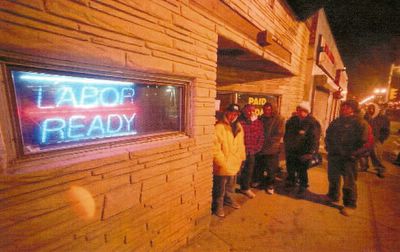
Well before dawn, when howling winds cut through the thickest of winter jackets, the race begins. From homeless shelters, shanties over steam vents, or a relative's couch, they rise to tramp through the night as the city sleeps, each hoping to be first in line.
For 21-year-old Emilio Vazquez, who wakes at 1:30 a.m. to grab his place, being late might mean not buying a meal today.
In the past few years, the daily competition between the city's poorest, most desperate has intensified: More and more of the mainly homeless men, some having recently fallen from the middle class, have been gathering on corners and at storefronts around the city, scrapping to win one of a dwindling number of day jobs.
On a recent morning in South Boston, the line in front of Labor Ready's blue neon sign starts at midnight. It grows steadily, with gimpy men nearing retirement age or muscle-bound ex-cons too young to drink. Some are recently laid off with college educations; others never finished high school. There are blacks raised in Roxbury, local whites with Irish names, and a few immigrants with sketchy legal status.
They all know one thing: get here after 4:30 a.m. and forget about working today.
"The early bird gets the worm," says a 40-year-old man named Mark, who slept for three hours and then, at 2 a.m., hiked from a shelter in Uphams Corner. "Whatever people say about the homeless, I challenge anyone to say that those of us here are not some of the most determined guys you'll ever meet."
Despite discouragement by Labor Ready's local manager, who worries about sleepless workers and the predawn bustle rattling neighbors, some of the men spend the whole night guarding their place in line. And the toll can be greater than lost sleep.
A scuffle erupts every now and then. Almost all know what happened last month at a Labor Ready office in Alabama, in which a prospective worker fatally shot four other job seekers during a dispute over a CD player.
"Everyone here's on the edge," says David Fraser, 21, who caught the last train of the night from Quincy and spent the smallest hours of the morning fighting the cold with about a dozen other insufficiently dressed men. "I mean, you have to struggle - and there's never even a promise you'll get it - for backbreaking work."
And the pay? Minimum wage.
In the past few weeks, to boost the company's declining profits, Labor Ready cut the wages of nearly all its local employees from an average of about $7 to the state's $6.75 an hour minimum. Despite the pay cut, Labor Ready continues to charge companies between $12 and $18 for their work.
Not everyone, though, is eager to complain, especially when a lack of job security creates fear of being blackballed from future work.
Homeless since he ran away from 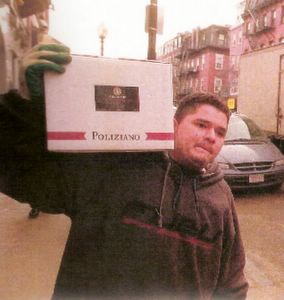 his home in Roxbury five years ago, Emilio Vazquez refuses to bicker about the work conditions. Hurrying over from the Pine Street Inn by 2:15 a.m., he holds the No. 5 spot in line, a position he prays will get him a job.
Nearly every day over the past year, the brawny high-school dropout has come here looking for work, and perhaps because he's young, strong, and enthusiastic, he gets it on average four days a week. The jobs? Demolition work. Clearing construction sites. Shoveling snow. Loading or unloading trucks.
"We all know what we're getting into, and without Labor Ready, many of us probably wouldn't be able to find other work," says Vazquez, who often doesn't eat until getting paid at day's end. "Yeah, it's hard work, and it can be dangerous, but we need the money."
When the Labor Ready manager unlocks the barred door at 5:30, at least 20 men rush into a small, sterile office, signing their names on a list numbered by their spot in line. Under a sign promising "Work Today, Pay Today," they take turns filling up on the free coffee, which one man says is "so bad it gives you the runs."
Drowsy and ornery, the men settle into plastic chairs, most taking the chance to catch a few winks as others stare into the fluorescent lights. Newspapers are read and re-read, the Styrofoam cups refilled, the silence belies a palpable tension.
Some of the men worry they'll be deemed too old or too weak to work that day; others wonder if the manager sees them as too inexperienced or unstable. And there are those convinced there are favorites who will get work no matter what time they arrived.
It doesn't take long for the morning's first winners to get their prize. The manager sends Vazquez, Mark, and three other men to a coveted job in Somerville, where they'll spend the day on trucks delivering boxes filled with liquor.
"The others hate us because we're getting this job," says Vazquez, noting that unlike most other day jobs, this one guarantees at least 10 hours of pay. "But this is my dream job. If they offered me a full-time position, I'd take it in a heartbeat."
Three hours later, while Vazquez and the others are well into their day of heaving heavy boxes down slick, narrow stairwells at restaurants and liquor stores throughout Boston, more than a dozen other men are still at the office in Southie, hoping against the shrinking odds for work.
Pacing the butt-strewn sidewalk, Mark Dlugosz, a 50-year-old former nurse and one of the few men with his own apartment, says he's three months behind on the rent. If he doesn't land a job today, he says he'll probably spend the rest of the day collecting cans or fishing through trash bins. And if can't find work soon, he says, he'll be sleeping at the Pine Street Inn, where he used to volunteer.
Jason Bergeron, a 22-year-old dad who lost his last job as a painter when his boss moved out of town, isn't happy about crashing on his mother's couch at her cramped apartment a few blocks off West Broadway. If he can't get a job, he says, he may turn to theft. He has called every painter in the phone book, but he can't find a job. Everyone wants to know if he has a car, which he lost after driving with a suspended license.
"Standing here doing nothing is worthless," says Bergeron, who says he needs the money not only to eat - but also to pay court fines. "I'd rather make the money than steal, but you do what you have to do to survive."
A few minutes after 9, William Criss gives up. The 51-year-old, who says he only has $2 to his name - money he hoped to use to travel to work this morning - trekked here from the Boston Rescue Mission at 3:30. A regular for several years at Labor Ready, it's the third time in the last week, he says, he hasn't landed a job. So with all his possessions, two small bags stuffed with socks, shampoo, and colored pencils, he takes off. He'll spend the day at the library drawing detailed portraits of fancy homes he'll never own. "I'm more disappointed than angry," he says. "It's been a long time since I've gone out."
Later in the day, Vazquez returns to Labor Ready to collect his pay - $61 after taxes and the fees for using the company's cash machine. His hands are blistered and his feet are swelling. Despite the cold and little more than a hooded sweatshirt to keep warm, he's been sweating all day, having made 42 deliveries.
But now, with the sun setting and some cash in his pocket, the effort feels like - as he puts it - "you didn't waste the day."
More to the point: it's now time to eat. Across the street is a Burger King, and after that, he'll take his girlfriend to a proper restaurant, as he occasionally does when he has money to spend.
"And why not?" he says. "I bust my butt all the time. I should be able to treat her, and myself, nice sometimes."
No matter what, though, it won't be a late night.
David Abel can be reached at dabel@globe.com. Follow him on Twitter @davabel.
Copyright, The Boston Globe
Sidebar:
By David Abel
Labor Ready, the nation's largest day-labor provider, filled 50,000 fewer jobs last year than the year before. In Massachusetts, the firm's 22 branches last year put 13,000 people to work, 4,000 fewer than in 2000. The decline in jobs has been a blow to its bottom line, and the reason the firm recently cut wages in the Boston area.
"What it comes down to is that our wages are subject to pricing pressures," says Stacey Burke, a spokeswoman for Labor Ready, whose stock has dropped 80 percent since 1999 and whose profits have plunged in half, to $11.5 million in 2002.
Social activists and many workers, however, argue that in fact many of them end up making less than minimum wage.
For one thing, they note, the workers nearly always pay the tab to get to their jobs, which in Boston usually involves a train or bus ride. There are the hours they wait for work, which are unpaid. And then, for those lucky enough to score a job for the day, many end up collecting their wages from Labor Ready's special cash machines, which deduct as much as $1.99 from their pay.
The check-cashing fees add up: In 1999, they earned Labor Ready $7.7 million. A year later, after groups in other states filed suits against the company, the Campaign for Contingent Workers, a local nonprofit, persuaded the Massachusetts attorney general's office to order the company to cease charging fees to workers who use the cash machines.
The company's continued use of the cash machines - the attorney general's office says it's responding to complaints against Labor Ready, but officials declined comment on any possible investigation - as well as other allegations that it exploits its workers, spawned a protest movement last year in Western Massachusetts. A nonprofit group called the Anti-Displacement Project organized scores of Labor Ready workers, picketed the company's offices, and launched a website, slaverready.com, which, among other things, accuses it of "modern day slavery," "selling cheap, human labor at the lowest possible cost to its customers."
Earlier this month, the group accused Labor Ready of trying to block its organizing efforts, and it filed unfair-labor practice claims with the National Labor Relations Board in Boston.
"At a time when the social safety net has been cut, people are facing the prospect of no income and a day-labor job where people may have their rights violated on a daily basis," says Minsu Longiaru, an attorney for Greater Boston Legal Services, who has interviewed scores of Labor Ready workers who accuse the company of everything from age discrimination to unsafe working conditions. "This isn't a choice they should have to make."
The company says it maintains a "zero-tolerance policy" toward discrimination, makes safety a priority, and does its best to provide its workers with good jobs and competitive compensation. And despite the inevitable predawn race, it insists that workers whose skills fit the job are chosen, not simply those who sign in first.
As far as the cash machines go, company officials argue they're a perk for their employees, who have the option of receiving a check. Though many of the employees need the money as soon as they finish work, often at a time when most banks are closed, the officials say they're charging fees equivalent to what most banks would charge.
To counter the protests, and what they view as a defamatory website, Labor Ready, in December, filed a lawsuit in federal court against the Anti-Displacement Project, charging the group with infringing on its trademark.
"We have a responsibility to our shareholders to defend our brand, and that's all we were doing," says Burke, Labor Ready's spokeswoman. "What we all need to do now is stay focused on finding work for these people. I think everyone can agree on that."
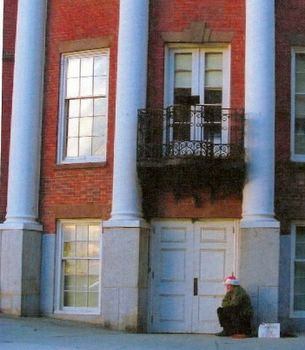 By David Abel | Globe Staff | 12/27/2002
BROOKLINE -- When he first showed up a few months ago, the bearded man in the bright Sephardic yarmulke stood out from the synagogue's other congregants. For one thing, he carried a crucifix. During services, he constantly walked in and out of the sanctuary. And after the rabbi's sermons, the former salesman would clap - a no-no in any temple.
At Young Israel of Brookline, the first impulse of most congregants was to help Milton Kapner, a 52-year-old fellow Jew who had been living in his green Buick since the summer. The rabbi welcomed him to services, answered his questions in classes, and bought him a membership to a health spa so he could shower. Others offered him clothes or took him out for dinners at nice restaurants. One woman even gave him a place to stay for the night.
But after a few months - when, temple officials say, he harassed congregants, crashed a wedding, and twice forced them to call the police - they barred him from the synagogue. Most recently, Kapner, who plays music for money in Harvard Square, stood in front of the temple and heckled congregants as they arrived for services.
"We don't know what to do with him," said Jerry Baronofsky, the orthodox synagogue's president, who has sought help from Jewish Family and Children's Services, a social-services provider. "We want to help him, but the truth is we're not sure the best way to go about it."
It's a quandary common to many churches and synagogues: As more needy people seek shelter and sustenance from religious institutions, where does a congregation draw the line between its interests, whether it be security or order in the sanctuary, and its mission to help the poor?
Clergy members at churches and synagogues throughout the area say they've seen a rise in the number of needy people, many of them homeless, who slip in for meals after services or sit quietly to stay warm for a while.
For the most part, unless they're disruptive, the needy are welcomed, or at least tolerated. Some of the major churches in downtown Boston even have street ministries, special outreach offices for the homeless. On Tremont Street, the Episcopal Cathedral of St. Paul, for example, provides pastoral counseling, referral services, and a telephone to those in need.
Not all churches or synagogues are as welcoming. In some cases, those scruffy, loud newcomers who aren't members or are deemed to be dressed inappropriately are turned away at the door.
"They won't let them in either because of past problems or because they anticipate the person isn't going to behave within the norms of the institution," said the Rev. Deborah W. Little, who founded Common Cathedral, an outdoor worshipping community of about 150 homeless people in Boston. "It's not always easy to find the right balance."
At St. Paul's, long a draw for the homeless, church officials had to hire a security guard because so many people crowded onto their porch, either to sleep or do drugs. Recently, after someone rubbed feces on the wall of one of the bathrooms, they decided to review an old policy of allowing the homeless to use the toilet.
"Many of the homeless are members of our congregation in good standing," said the Rev. Sarah Fike of St. Paul's. "But sometimes it can be a struggle with maintaining as much openness as possible and the necessary safety and cleanliness. Our kids, after all, need clean bathrooms."
The Arlington Street Church, which also attracts many homeless, especially to its Friday night "supper club," has a special policy for those who disrupt services. When someone disrupts repeatedly, said associate minister Carol Strecker, church officials approach the person and ask them to agree to a verbal contract. Often, in order to stay, the person must consent to therapy sessions and to allow a church member to sit next to them during services.
Sometimes, however, no matter how hard church officials try, the disruptive person is beyond help - and can be a threat to the congregation.
At the Park Street Church, one homeless man reached into the collection basket and instead of adding a donation, he grabbed all the cash. Church officials called the police.
At the Ruggles Baptist Church on Beacon Street, according to the Rev. Larry Showalter, one woman insisted on remaining after hours to play the piano. When church officials asked her to leave, she refused. When they banned her from entering, she began stalking them, demanding they let her in to play the piano. After she violated a restraining order, police arrested her and sent her to jail for six months.
"It's sad when there's nothing you can do to help," Showalter said.
For the congregants of Young Israel, which like many synagogues is increasingly security-conscious since Sept. 11, Milton Kapner never posed a physical threat. But the fast-talking guest, who told congregants he graduated from Columbia University and lost his home in Needham, began making people feel uncomfortable, even chasing some away from services.
"The truth is he was welcome here, as long as he followed the rules," said Robert Wolff, the synagogue's former president. "But after a while, people lost their patience."
Approached recently at the McDonald's on Harvard Street, where he often cajoles people to buy him a free meal, Kapner refused to speak. In a previous phone interview, he complained: "I've been excommunicated. It's the worst thing that can happen to a Jew."
A few days later, after a crossing guard reported Kapner was endangering himself walking through traffic on Washington Street, he ambled into Brookline District Court and started screaming, police said. Health officials decided to commit him to a hospital, where he will stay until doctors release him.
"Maybe this is the best thing for him," said Baronofsky, Young Israel's president. "Hopefully, it will help."
David Abel can be reached at dabel@globe.com. Follow him on Twitter @davabel.
Copyright, The Boston Globe
By David Abel | Globe Staff | 7/7/2005
WINTHROP -- Last summer, when the short woman with scraggly hair and despondent eyes approached him, the pastor did more than promise help – he let the newly homeless woman sleep in the choir’s loft of his church.
Nearly a year later, the 52-year-old former nurse remains at the Holy Rosary Parish in Winthrop, where she often wakes on fetid cushions to the 9 a.m. Mass, her possessions – old mail, New Balance sneakers, a tube of Crest – surrounding the old, broken organ.
Her presence has raised an awkward issue for parishioners at Holy Rosary and other churches: Is the church a pristine, peaceful, non-threatening place to pray; or should it sacrifice some of its cherished quiet to be a sanctuary for the neediest?
Some parishioners are fed up by what they see as her disturbing their peace, and they want her out. Others have tried to help without success, bringing her food, trying to rent her an apartment, offering her medical attention, nearly all of which she's refused. Still others sympathize with her and think she should be allowed to stay as long as she wants, and that the church should be a refuge.
For all his efforts, Father Thomas DiLorenzo has reached his limit. Marie Matarazzo, a life-long resident of this small, harbor-side town, must be out soon, he said.
"I invited her to stay, because she had no place else to live," DiLorenzo said. "I wasn’t going to put her out. She was having a difficult time. But sometimes you can only give people help when they want it. She doesn’t want help, and wouldn’t take it. You can’t make people deal with their problems."
He added: "Now, she has to make a decision. I’m not going to keep her another year."
Parishioners are divided and many have asked: What should you do when you try to help someone, and they won’t accept the help?
"It’s difficult – this is a situation for which I just don’t have a simple answer," said Patricia McGee, a life-long parishioner who has served as the church’s cantor for the past 30 years. "No one seems to know the right thing to do."
One woman who belongs to the church and declined to have her name printed said she thinks it’s wrong for a church to substitute for a homeless shelter.
"People are disgusted," the woman said. "She’s a disturbance ... and she makes a ruckus. This is something outside the realm of what a church should allow. I know people who have left the church because of this."
Another long-time parishioner, Mary Rice has allowed Matarazzo to shower at her home.
"She's a beautiful girl, smart, and lovely," she said. "We’re trying to do the will of God."
A spokesman from the Archdiocese of Boston said officials there don’t encourage similar policies in other churches, but they understand there’s a fine line parishioners and priests must draw between their comfort and the church’s mission to help the poor.
"Although this is not an ideal situation – we wouldn’t encourage people sleeping in churches – we understand and respect that the father’s heart is in the right place," said Terry Donilon, the spokesman. "That’s what the church is about – helping people in need."
Matarazzo also has burdened her family, putting her three brothers through fruitless efforts to end her homelessness, they said. Like the church, for the most part, they have given up.
Before last summer, Matarazzo lived in a two-family brick home here on Shirley Street. Last year, five years after the death of her father, her brothers decided to follow their father’s dying wishes – which he put in his will, they said –and sell the house and divide the proceeds. They hope to earn the more than a half-million dollars.
Her brother, Jim Matarazzo, who sees his sister regularly and collects her mail, said he helped subsidize her sister’s living at the family's home over the past several years, because the never-married former nurse hadn’t worked for more than a decade. But when they suggested she move, she refused.
It took six court hearings, a constable, and police officers to remove her from the home, he said, where she had horded hundreds of empty Special K boxes, 27,000 pennies, $240 worth of empty cans, and 14 cats, among other things.
"I found a nice apartment near the shelter where she had the cats, and I offered to pay a year in advance," said her brother, adding it took a year to clean up the house before putting it up for sale. "But she raised a lot of problems with the landlord, and they refused to rent to her."
Her family and others have since made repeated efforts to find her a new home, but he said: "It’s always ... too this or too that, and she finds a way for it not to work." They’ve also tried to get her medical help. His brothers, he said, once had her taken to a mental health facility in Lynn, but because officials couldn’t keep her there against her will, she left.
Matarazzo appreciates the church’s efforts, he said, but he thinks she won’t move on until she decides it’s time.
"She’s choosing to be homeless," he said, adding she has tens of thousands of dollars saved and could, if she found a job, secure a mortgage to buy the family’s house. "I will absolutely not help her anymore."
For her part, Marie Matarazzo still hasn’t adapted to her new circumstances.
After a recent morning sitting in the pews listening to a homily about the value of prayer, the woman with mussed brown hair, wearing a fleece covered in cat fur and a vacant stare, pined for her old home.
"I miss it," she said in a soft, plaintive, lucid voice. "It’s the home where I grew up, where I was born. I lived there all my life. My brothers knew I couldn’t go anywhere from there. I talk to (my brother) Jimmy every day. I say I want to go home, and he says, ‘Dad wanted us to sell the home.’ I don’t believe that was what my father wanted."
She said she appreciates all the church’s help, but she doesn’t know where to go at the end of the month.
Asked why she won’t accept help, she paused and then said: "I don’t know. I don’t know. I really don’t know."
David Abel can be reached at dabel@globe.com. Follow him on Twitter @davabel.