The Jet Setter


By David Abel
Globe Staff
9/16/2002

The rows of vinyl seats where she used to sleep are all gone. New checkpoints have blocked off a few preferred nooks and the mood has changed, with stocky officers in black fatigues and combat boots holding large, menacing rifles.

There's something else different about Logan Airport - a lingering eeriness, a missing excitement, and most egregious of all for her, a disappeared community.

Before the Sept. 11 terrorist attacks, Judie Jones and at least a half-dozen elderly women spent nearly every night blending in with travelers and sleeping in secret spots throughout the terminals. A year later, with the size of the security staff doubled and the airport enforcing an old rule barring the homeless, few if any of the women have returned.

The changes have upset Jones, a short, Shakespeare-quoting 67-year-old who calls Logan her home. But the chain-smoking native of Australia doesn't blame airport officials or the once-dreaded troopers, who she now says are "beautiful to watch." The blame, she says, squarely lies with "that swine, bin Laden," whom she calls a "hurricane of hysteria" and a "pusillanimous excrescence."

"On Sept. 11 last year, you broke my heart and the heart of every decent, law-abiding American," she wrote to him in an "open letter" from "the lady who loves Logan."

In another missive to the wanted Al Qaeda leader, she added, "It's not so much what you've done to a group of homeless people. We'll survive. But how dare you change the fun, the bustle, and the excitement that was Logan!"

For years, especially during the winter, the state troopers at Logan often looked the other way when running into Jones and the other women they had come to know. Others, who presented problems, were often put in cabs and sent to shelters, as the airport's policy instructed. But since the attacks, the airport has maintained something close to a zero-tolerance policy.


"It's a whole new ballgame here," said Phil Orlandella, a Logan spokesman. "I don't think anyone looks the other way anymore. We get calls now for anyone who looks or acts suspiciously - and sometimes those people are homeless. We have to be careful."

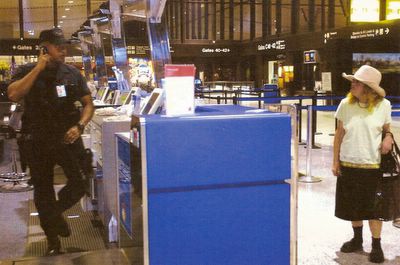
On a recent night at Logan, Jones, wearing a large felt Stetson, a pair of well-worn flip-flops, and a gold necklace over a lime blouse, lugged two handbags, searched ashtrays for cigarette butts, and, as has long been her custom, hunted for abandoned Smarte Cartes, returning each for a quarter. "It's good fun, like the poker machines in Vegas," she said.
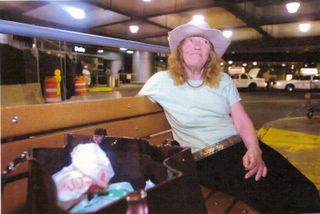
Picking up a half-filled cup of ice coffee someone left for trash, and between puffs of a whole cigarette from a friend, she winked and said, "I can see why I might be vaguely suspicious."

The outspoken woman with bright blue eyes, auburn hair, and creased cheeks that frame a nearly toothless smile says she has returned to the airport because people there treat her like "an international traveler, a human being who they call ma'am.' " It's also a way of earning as much as $15 a day returning carts.

"If I had my choice, I would live here again," she said.

To visit for the day is one thing. To return to sleep, though, is too risky - she's afraid she might get arrested.

On Sept. 11, 2001, when she learned about the hijackings while at a job conference, it began to dawn on her that she too would be directly affected. Her home would be locked down with security forces, she worried, ready to shoot at anyone who didn't seem to belong.


"Under no circumstances would I go to the airport - it was too scary," she said. "Who knows what would have happened?"

That night, and through the spring, Jones, who speaks French and German and once studied Latin, stayed at the city's homeless shelter on Long Island. After feeling confined, complaining about her living conditions, and running into problems with the shelter's staff, she moved to the Erich Lindemann Mental Health Center on Staniford Street in Boston when a social worker found her a bed there.

Fed up again with her living situation, the prickly woman pines for the serenity she felt in the well-cleaned lounges at Logan, where she could always find leftover meals, an interesting conversation, and classical music to sooth her as she fell asleep.

Terminal A, where she used to sleep on occasion, was recently razed to make way for a more modern facility. The cops are more likely to growl than they are to flash a smile. And her old acquaintances are nowhere to be found: Marie, a gray-haired woman who always wore a suit and said she was waiting to catch a plane to meet her grandson in New York; Elizabeth, who wore a turban and had food to share; and Peewee, an eccentric who often offered her cigarettes.
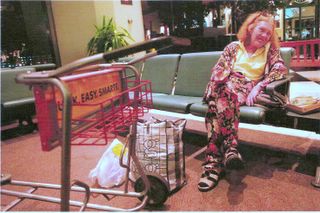
On her first trip back to Logan in December, she wondered, "Where were the people? Where was the laughter? Where was the holiday happiness? . . . They've turned my home into a ghost town."

As time has passed, she feels more secure, as if life at Logan is returning to normal, or at least a new normal. There's the constant crawl of taxis. The great mix of people from all over the world. The food and financial opportunities. And, during the day, when there are even a few other homeless people, the old feeling comes back. "Who's to say I'm not a Parisian world traveler?" she said.

But, eyeing one of the muscular troopers toting a large assault rifle, she added: "I wouldn't dare come back to sleep."

With $6 in quarters in her purse and sipping from the cup of ice coffee, Jones smiled, watched the steady flow of pedestrians stream into the airport, and said, "My sense of optimism has returned. Logan is like America - the phoenix rising from the ashes."

Previous story:

AT LOGAN AIRPORT, A LOUNGE LIFE
HOMELESS WOMEN KEEP BAGS PACKED AT TERMINAL

By David Abel
Globe Staff
7/21/2001

For Judie Jones, home is a place that spans 2,400 acres and moves 80,000 people a day.

The petite 66-year-old from Australia is one of at least a half-dozen elderly women who spend nearly every night somewhere in the terminals of Logan International Airport.

"The skycaps, porters, and security people all come here to work, but, darling, this is my home," Jones says. "It's like Bob Hope used to say, but for me it's true: Airport waiting rooms are my real home."

Like the other "Logan ladies," as she calls them, Jones - a former substitute teacher and aspiring novelist - does her best to blend in. She dresses nicely, lugs around a Smarte Carte stacked with neatly arranged bags, and showers as often as possible.

"If someone asks what I'm doing, I say, `Oh, I'm just in from the Cape' or `I'm in from LA,' or, if I'm in the right mood, I say, `I'm just in from Paris.' "

Still, once the gates to most airlines have shut, the food courts have closed, and midnight passes, it's not hard to tell that the short woman stretched out comfortably across the vinyl seats of Terminal A intends to spend the night.

Officially the Massachusetts Port Authority doesn't allow anyone to live at the airport, which is open 24 hours a day. About a decade ago, when the homeless began descending on Logan in large numbers, Massport started sending them to shelters in agency-subsidized cabs. "This is a public facility; it's not a place for people to sleep," says Phil Orlandella, a Logan spokesman. "That is our policy and that will be our policy."

The state troopers who enforce the policy, however, use their discretion. They kick out the vast majority who hang around the airport, especially young men. But in spite of a memo this month warning that the homeless are "harassing employees and travelers," troopers let the older women stay.

"We call them our resident homeless," says Albert Manzi, who for years has worked the graveyard shift at Logan. "We do our best to get them to a better place, but some of them just like it here. They don't cause us any problems."

One trooper who asked not to be named said he won't evict certain people in the winter. Once, on a night when the temperature dropped below zero, a Massport official told him to remove one of the women. "I couldn't do that," he recalls. "I just took her to a different terminal."

Even among the slew of bonafide travelers sprawled out throughout the airport, Jones sticks out. She frequently quotes Shakespeare and compares herself to "a pushy broad like Ethel Merman." She cheerfully boasts about finding her colorful pants suit at the "Salvation Army Boutique." Her frizzy strawberry blond hair and craggy, sunburned skin frame a nearly toothless smile.

Manic, she rifles through crumpled dollar bills and cigarette butts stuffed in her plastic purse, sorts piles of papers in an old shopping bag, and scatters bags of junk food.

The commotion could easily give her away - and that would be a bad thing, she says. Like many homeless people, Jones loathes shelters, complaining they're overcrowded and dangerous. "There was so much brutality at the shelters that I couldn't stay there anymore," she says, calling Boston's Night Center "The Fright Center." "I thought, `Where else could I go that I would be shown humanity and treated with the graciousness of an international traveler?' "

At Logan, she feels safe, comfortable, and free to come and go as she pleases. She has also had good luck here. The troopers have only ordered her to leave once, she says. And Jones gets along well with them, enough so that she merrily introduces a reporter to troopers at the airport substation.

Arriving in the States shortly after divorcing her husband in 1988, she says, she has moved around, living everywhere from Las Vegas to San Antonio to Columbus, Ohio. Her last stop before Boston was Providence, where a string of bad luck first forced her onto the streets and where she discovered the perks of sleeping at an airport, she says.

A year ago, Jones caught a bus to Boston. She stayed in shelters for a few months until realizing she would be far more anonymous in the ever-churning world of Logan than at Providence's smaller T.F. Green Airport.

There are also distinct benefits to living at Logan. The airport is carpeted and clean, the bathrooms well maintained, there's air-conditioning, and the place abounds with leftover meals, sodas, and dropped change.

There are TVs to watch, what Jones calls "the best available selections of smokable cigarette butts in the whole of Boston," and there are often "presents" available, including airline personal care kits. "What a difference between the quality of the items handed out by Air France and the quality handed out at the shelters!" she says. "The deodorant is a brand-name spray, compared with that awful stick I've had to use."

There are even moneymaking opportunities. When she is low on cash, Jones walks around the airport, collecting scores of abandoned Smarte Cartes and returning each for a quarter. "I feel much more at home here because I can be a person of the world, not some statistic," she says, snatching another clump of butts from an ashtray outside Terminal E. "It's big and it's free and there's no oppression. It's really a fascinating place. The views are great, for which I pay nothing. I love watching the airplanes and the sunrise. And another thing: There's always someone to talk to."

Well after midnight, she runs into some of the other ladies. Marie, a gentle gray-haired woman in a rumpled blue suit with a pretty blouse, and a Filene's shopping bag on her wrist, could be anyone's grandmother.

"How's everything with you, Judie?" Marie says in a soft brogue, politely declining a stranger's offer to bring her some food and insisting she's about to catch a bus back to the city. When Jones leaves, she whispers, "The poor love. She doesn't know what day it is, she's been here so long."

Around the airport, Jones points to a few others who live at Logan but blend in with the late-night travelers. "That man is deaf," she points to an older man asleep in Terminal C. She opens the door to a bathroom in Terminal E, and a large 74-year-old woman named Mary is snoring on a bench next to a Smarte Carte.

Pointing to her resume, clumped with an old shopping bag filled with letters and articles she has written for Boston's homeless newspaper, Jones declares that she would make a perfect candidate for a job in Logan's public relations office. "How many people know this airport better than I do?" she says, adding that she has a master's degree. "How many are as attached to it as I am?"

After applying recently, Massport sent her a curt letter: "They basically said, `Thanks, but no thanks,' " she says.

Near bedtime around 3 a.m., on her way to her secret nook at the airport, a place she calls "No Man's Land," the old lady finds a spare pillow and blanket on a bench someone must have left from a recent flight. "Wonderful," she says. "Isn't life fun?"

Lying on a clean metal bench hidden away by two large display cases of model airplanes and a broad window looking over the great sprawl of Logan airport, Jones squints into the fluorescent lights and slips on a pair of old sunglasses. "Do I look glamorous or exhausted?" she jokes.

Then she shuts her eyes and tries to sleep, before the morning traffic wakes her.

David Abel can be reached at dabel@globe.com.

Copyright, The Boston Globe
A Secret Life

By David Abel
Globe Staff

1/24/2004

Something happened when he raised his voice.

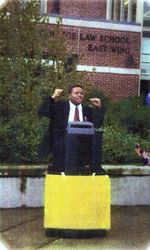
The quiet, chubby student, so polite around campus he answered professors "yes, sir" or "no, ma'am," seemed to channel the guttural roar of a southern preacher. As he thundered about the need for justice or the plagues of poverty, it was like his colleagues at Boston College Law School were witnessing the second coming of Martin Luther King Jr., a young man whose zeal, many believed, might one day propel him to the highest offices of the land.

Then he made the two-hour commute to his home for the past year, a musty room where he slept on a thin, vinyl mattress among hundreds of men crowded into one of the city's largest homeless shelters. There, isolated at the island refuge in Boston Harbor, the aspiring attorney often seemed like just another junkie, walking about aimlessly and hurting so much for the next high he sometimes begged others for money.

Arthur Cornelius Harris, a 27-year-old who made it from the ghetto to a few months shy of graduating one of the nation's top law schools, managed to bridge two very different worlds, and two very different identities.

But as he lurched toward a bright future, charming judges, professors, and friends while disguising a secret none imagined, he couldn't escape the darkness of the past, a place where, he once wrote gratefully: "The early grave that calls for me is still empty."

BORN INTO A LAND of preachers and agitators, his relatives among the vanguard who marched for civil rights, Arthur's upbringing in Montgomery, Ala., rarely emerged from the shadow of his city's history. "As black men in America today," his grandfather would tell him, "you have a debt you can never repay."

Given all the poverty, despair, and drug-driven violence around him, which he saw as the legacy of slavery, Arthur felt what he called an "awesome responsibility" to "make America live up to her promise of equality and justice."

The first challenge was surviving.

A latch-key middle child who grew up in one of Montgomery's most dangerous housing projects, Arthur's mother admonished him and his older brother to never open the door or answer the phone, unless it rang five times, until she returned home from her job as a hotel housekeeper.

But the then-scrawny boy couldn't escape the violence, no matter how adroit he became at talking his way out of trouble. Over the years, a neighbor, who enticed the fatherless boy with gifts, such as shoes and shirts, sexually abused him. And later, when his mother thought he was running with the wrong kids, she beat him up so badly, police held him for several days at a shelter for child abuse victims, eventually returning Arthur to live with his grandfather for several years. "I would whup them with a belt, wherever - wherever," said Mona Scott, his mother. "I wanted them to be afraid of me, to protect them."

When Arthur went to elementary school, one of only two blacks in his class, he would come home and say, "My name is not Arthur; my name is 'nigger.' That's what the kids call me."

Despite all the hard times, the boy with the oddly long arms began to stand out. In the fifth grade, he already showed a flair for speaking before a group, precociously articulate for a boy. "Whatever I required, he would go beyond the call of duty," said Rosa Abernathy, who taught Arthur in elementary school and later saw him whenever he returned home. "He was one of the best students I had in more than 40 years of teaching."

By the time he reached high school, after years of listening closely to the call and response at Sunday-morning services in the Baptist church near his home, he found his voice. Then having won election as president of his sophomore class and treasurer of the local youth group of the National Association for the Advancement of Colored People, he found his calling -- to be an "activist," as he would later proudly call himself.

Arthur earned respect through persistence. While holding a job as a cashier at a local drugstore, he kept score at basketball games, organized dances, performed in plays, wrote for the school newspaper, and once, one of the gangs at his junior high school tried to recruit him to help them with their schoolwork. As teachers watched him walk so purposefully around town, often passing an African head shop sign that read "Welcome to the Ghetto," they would say: "Look at that Arthur Harris. He's off to something."

Keeping busy helped him bottle up the inner turmoil -- the anger of meeting his father only once, when he was 15, the separation for most of his high school years from his mother, the repeated stops by police whose profile he often fit, and the struggling with his sexuality while relatives and reverends told him he would go directly to hell if he didn't mend his ways.

"I challenge anyone to go to my middle school or high school, live in my neighborhood, and come out any better than I did," Arthur wrote later. "Most yield to the grave, the prison, the drugs, or some other escape route. I was lucky."

FOLLOWING HIS MOTHER'S advice to leave Montgomery, and aiming to become the family's first college graduate, Arthur was admitted to the University of Alabama at Birmingham, 90 miles north of home.

Walking around campus in a conservative suit, with one pin or another fastened on his lapel, and often flashing his big smile, Arthur quickly made a name for himself among the campus's 10,000 undergraduates.

"I've never had a student touch me like Arthur," said Niyi Coker, a professor of African-American studies who became a mentor to the young man. "There was something special about him -- you just knew he was going places."

Though he found the schoolwork challenging and had to work fulltime as a stock boy at the campus bookstore and as a cashier at a local drugstore, Arthur made time for extracurricular activities.

Like Martin Luther King, he majored in sociology and joined the prestigious black fraternity Alpha Phi Alpha, where he served as chaplain and led brothers on volunteer missions to local soup kitchens. Soon, Arthur sought a larger stage, and he practiced for it. As a freshman, standing sideways in front of his dorm-room mirror, he would put one hand in his pocket, extend the index finger of the other one, and rehearse theatrically stabbing the air.
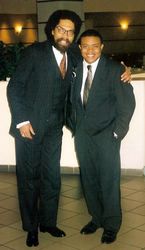
By his senior year, he had served as president of the student government, chairman of the Black Student Union, president of the Omicron Delta Kappa National Leadership Honor society, and membership on everything from the university's mock trial team to the local YMCA's mentor program.

The titles were not mere resume builders. Arthur took his positions seriously -- and the administration took notice.

Once, he happened to pass the university president having her hair done in a local beauty parlor. Cornered, he unleashed a litany of student gripes. Then he told her how he thought she should wear her hair.

"He was the king of boldness," said Bettina Byrd-Giles, the assistant director of student programs while Arthur served as president. "He would say things no one else would dare."

He also learned how to attract the attention of those beyond campus.

To protest budget cuts in the university system, he led hundreds of students from schools around Alabama to the state capitol, eventually persuading lawmakers to rescind many cuts. When university trustees proposed severing the medical school from the campus, he organized a movement that hounded the trustees until they abandoned the idea. And when administrators suspended black fraternities and sororities for missing a campus meeting, he held a rally that attracted hundreds of students and local media, ultimately winning a lift of the suspension.

"Arthur was the type of student who made the administration scared," said Jalon Alexander, a friend who Arthur pushed into student politics and who eventually succeeded him as president. "By the way he spoke, he could make you believe in anything he wanted."

If administrators feared Arthur, they also respected him.

When President W. Ann Reynolds ran into him behind the counter of a drugstore, and realized how little money he had and how he sent much of it home, she decided - without telling him - to pay his tuition his senior year, $3,200. Then, after hearing Arthur was accepted to a special pre-law program for promising minorities at Suffolk University Law School, she used her frequent flier mileage to cover the cost of the flight to Boston.

"It was the best money I ever spent," said Reynolds, noting Arthur probably had more of an effect on the university than many administrators. "I wish I could have done more."

SINCE HIS TEENS, Arthur believed a law degree provided the key to power, the key to righting all the wrongs he saw around him.

But when he applied to some 20 law schools, none admitted him, the result, most likely, of never becoming a proficient test taker. So when he learned about the Council on Legal Education Opportunity's summer program in Boston, an intense 7-week course which offered him the a chance making it to law school, he decided to come north.

In 2000, standing on Boston's Freedom Trail for the first time, he wrote, "I was reborn right there on the spot by a thought … that somehow I had survived … I had finally made it out."

A few weeks later, he did something almost no other student has done before: Arthur talked his way into Boston Law School.

On a visit to Suffolk, Elizabeth Rosselot, BC Law's assistant dean of admissions, found herself in a room with Arthur, listening to him speak with "a fire" she had never seen in a prospective student. "It's usually about 'I, me, and mine,'" she said. "What I saw was just an incredible determination to beat the odds."

A half hour later, she promised him a spot in the class of 2004.

When he arrived a year later, after struggling to finish his math requirements in Alabama, the initial euphoria wore off quickly.

The first year of law school proved grueling, and Boston, the north, was different than he expected -- colder, not just in its climate, but less welcoming than he imagined.

Uneasily out of the closet and living among mostly well-off white students, Arthur thought he made a mistake, that perhaps he should drop out and move to Canada, or somewhere else he might escape homophobia and racism. As time passed, he would become indignant about law school and the "suburban" professors, who he saw as teaching more about process than action, about how to abide by the system instead of how to improve it.

"I too have a dream," he wrote in a paper titled "A Burning Desire for Justice" in the fall of his second year. "I am not like Thurgood Marshall, who only wanted a good legal job after law school, but ended up fighting for civil rights because there were no other opportunities … I came to the law with an understanding that I was to use it as a tool, to help stop the modern-day tidy ethnic cleansing of my people."

Fond of quoting the late Senator Paul Wellstone, he often urged people to "never separate the life you live from the words you speak." To many, he did just that.

Once, after discovering a website that charged the Coca Cola Co. with assorted barbaric acts, he refused to drink Coke, making his friends go from restaurant to restaurant in search of a place that served Pepsi. When a military recruiter came to campus, Arthur signed up for an interview and let the officer know how he felt about the military's policies excluding gays. And last year, while attending a local anti-war protest, Arthur whipped out his own bullhorn when he found the rally not quite spirited enough.

"Only Arthur could chastise people at an anti-war protest for being apathetic," said Sam Lieberman, a close friend of Arthur's at the law school.

Then he decided to move into a homeless shelter.

THE WAY HE EXPLAINED it, the abrupt decision seemed to make sense. After all, his friends and professors thought, this is Arthur Harris, not the typical law student.

When he moved in little more than a year ago, he told them he wanted to live with the people he planned to represent after school, because "sometimes," he explained, "you have to get down in the hole with them, in order to pull them out."

But not everyone bought Arthur's explanation, and though he assured them he would be fine and there was a method to his perceived madness, he confided to a few that there was another reason for his moving into the shelter - money.

Arthur had been living a ways from the law school, in an undergraduate dorm, working as a resident assistant. Although the job, which he didn't like, provided free room and board, the federal loans he received required the compensation - a value of about $8,000 - be deducted from his financial-aid package.

"He definitely preferred getting the money," said Christopher Strader, a fellow resident assistant and another of Arthur's close friends on campus. "He didn't like living alone. He was lonely."

He also seemed depressed, frequently confiding in friends and professors that he felt out of place, that his creativity had been drying up, that he wanted to drop out of law school, where he was diagnosed with a nonverbal disability and earned mostly Cs. Around the same time, reeling from a bout of unrequited love, he told friends he thought about buying a wedding ring, to avoid questions about his sexuality.

A year later, long after judges, professors, and friends welcomed him to live with them, many wonder whether Arthur had another reason for living in the shelter, one he refused to reveal.

"It seemed, at first, like a completely irrational decision to live in a shelter if you didn't have to," said Mary Ann Chirba-Martin, a professor who described him as "a fish out of water" at law school. "Perhaps he found a piece of home there."

TO GET TO THE SHELTER, Arthur usually took public transportation from the Newton campus to the Boston Medical Center, where he waited for a bus that took him and scores of other homeless men and women more than 10 miles away, through Quincy, down a desolate road and across a rickety bridge to one of the old quarantine hospitals on Long Island.

When he first arrived in December of 2002, the shelter assigned him a social worker and a bed, No. 313. "He said he had no family, no friends, and no support, and he didn't know what he would do," said Valerie Pruitt, who served as his case manager and knew Arthur attended law school.

The two kept in touch over the months, mostly by phone or e-mail. When Pruitt offered Arthur the possibility of moving into a better shelter - a recovery program where he might have his own room - he said he wasn't interested.

Over the year, Arthur made several good friends at the shelter, most of whom couldn't understand why he chose to live in a place they would have left in a hot minute. He found a lover there, but then something happened. In September, at 31, Ricky Negron, suddenly died, one of eight homeless people to die last year as the the result of a heroin overdose.

The loss devastated Arthur.

"He would say, 'I wish I was with Ricky - I wish he didn't have to die,'" said Robert Wooden, 52, a friend from the shelter.

A few months before, other friends noticed, Arthur had started acting strangely. "He would come up to me and ask me for $10 or $20," said Leon Smith, 21, who spent weekends going to the movies or eating out with Arthur.

Then Smith and others noticed a pattern: Arthur would return from school around 7 p.m., eat dinner in the shelter's cafeteria, and then walk the refuge's dark corridors, hunting for what he called "pop."

It was a good night, when he found it and had the money.

"He liked the way it made him feel, and he encouraged me to try it," Smith said. "It got rid of the depression and made him joyous. He would come up and kiss me and sing, 'There's no me without you … I'm so happy to be alive."

As summer gave way to fall and the cold of Thanksgiving blew over the island, Arthur began seeking a more direct high. Rather than sniffing the white powder, he asked David Johnson, a 35-year-old veteran junkie who slept a few beds away, to teach him how to shoot up the heroin.

"He didn't really understand the road it was taking him down," Johnson said. "I wanted him to look at my life, to see how awful it is, and how it's like we're all in a boat, pulling different oars, sinking."

ON THE EVENING OF Nov. 22, after e-mailing friends about his plans to return to Alabama to promote his latest cause - electing Howard Dean president - he hopped off the bus and sat down for dinner with his friend Carlos Ramirez.

As they devoured a plate of rice and beans in the shelter's cafeteria, Ramirez noticed something wasn't quite right about Arthur.

"Who's got pop around here?" he kept asking Ramirez, 23, who met Arthur a few months before at another shelter in Boston.

Later, after dinner broke up, Ramirez found Arthur on the shelter's third floor, in the TV room. He was wearing shorts and sandals, but sweating profusely.

"He was a wreck," said Ramirez, who noticed his eyebrows looked puffy, his eyes red, and a white powder coating his upper lip and nostrils. "He looked like he was going to blow up."

Ramirez touched his arm, but Arthur didn't seem to feel anything. "I said, Arthur, what's wrong with you?"

Shortly after, he saw Arthur hunched over, his eyes rolling and dilating. As Arthur slowly made his way to the bathroom, he assured Ramirez he was fine. "Don't worry about me," he said.

At 5:30 the next morning, when Arthur hadn't cleared out with the 143 other men on his floor, shelter officials found him in bed.

He was dead.

HOW COULD A YOUNG man who had so much promise and who regularly preached against such poison have fallen into the trap of the most dangerous, addictive drugs?

"Arthur loved everyone," said Niyi Coker, his professor at the University of Alabama. "He fought everyone's causes, but in the final analysis, Arthur forgot to love himself, and in doing that, he cheated the world of everything he could have contributed."
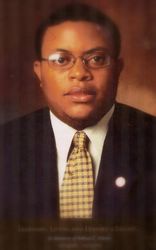
When his mother learned of Arthur's drug use, she couldn't believe it. "He lived a double life," Mona Scott said. "I guess he knew not to tell me, because I would've been up there in a minute, escorting him to classes, if necessary."

At Boston College, where he managed to keep his drug problem a secret, administrators, professors, and friends couldn't understand the contradiction -- of how much Arthur, in the end, actually separated the words he spoke from the life he lived.

"It makes me think he must have been in pain, a lot of pain," said Norah Wilie, the law school's assistant dean of students, who added Arthur's name would be noted during graduation this year among the students listed in the class of 2004. "It's hard to understand why people can make such tragically bad choices."

And for many of his closest friends, who knew him only as a wellspring of inspiration and a model for anyone to pattern their lives, the loss of Arthur represents the defeat of a force for so much good.

"I thought Arthur was going to change the world - I felt that deep in my bones," Christopher Strader said. "That's what's so sad. The world's going to be completely normal without him."


David Abel can be reached at dabel@globe.com.

Copyright, The Boston Globe

The Hermit's Hidden Perch


By David Abel
Globe Staff
12/03/2002

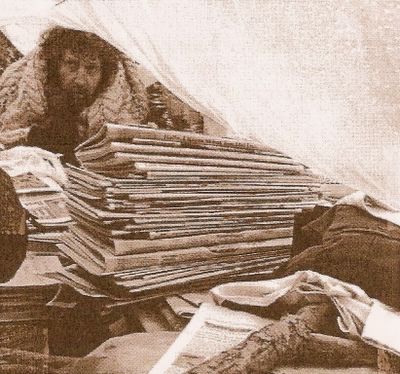
From his secret perch in the woods, the hermit watches the morning light spread over the pond and seep through a patch of trees, sprinkling a golden haze over his humble home. At night, when the raccoons leave their lair in the beech tree and the birds nest until morning, he wraps himself in a heap of blankets and takes comfort in the stillness.

A self-proclaimed philosopher, Donald Keaney revels in escaping the quiet desperation of the city. But unlike another solitude-savoring New Englander, who more famously sought answers to life's persistent questions beside another pond in the woods, the shaggy 61-year-old hasn't left, nor given up its many conveniences.

For the past 17 years, Keaney, the son of a French horn player for the Boston Symphony, has found a way to lead a rustic existence in the middle of Boston - living in a self-made tent in the woods near Jamaica Pond, less than a mile from the middle-class Brookline home where he grew up.

Like Henry David Thoreau, whom he has long admired, Keaney loathes government and can't be bothered with social conventions, such as paying rent or concealing his opinions. And though he has enough money, he has little desire for more than the barest of essentials - a plastic tarp for a roof, a half-dozen heavy blankets, and the 11 newspapers he reads every day and stacks around him by the thousands.

"Living outside with nature means living in the most intimate way," says Keaney, who was raised by a Jewish mother and Irish father and calls himself a "Lepre-Cohen." "It's peaceful, no one bothers me, and there's no better place to read than under natural light."

One of a hard-core group of homeless who refuse to sleep in city shelters, Keaney and about 300 wizened men and a few women live outdoors throughout the year, doing what they can to survive Boston's hottest days and coldest nights.

While he spends much of his time alone in the woods, Keaney makes his way downtown nearly every day, dining in soup kitchens, speaking out at rallies and lectures on college campuses, attending classical concerts, and collecting his newspapers. He also visits friends - a few homeless guys he buys food for and talks politics with. And occasionally he ventures to Watertown to see his sister, who hosts him for holidays such as Passover and receives his subscriptions to a half-dozen conservative magazines, including The National Review and Weekly Standard.

Esther Keaney, an Ivy-League educated accountant with her own business, isn't sure how her brother ended up on such a different path. He doesn't do drugs or drink, she says, and as a beneficiary of a trust fund left by a wealthy aunt who worked as a secretary for Fidelity founder Edward C. Johnson, he can certainly afford an apartment.

"I don't believe there's any mental illness, though it's possible," says his sister, who has urged him to find a more permanent place to live. "I just think he genuinely likes living in the woods."

Donald Keaney began sleeping outdoors when he was young and went to camp in Maine, where as a gifted clarinetist he won awards for his chamber music. Over the years, he sought more isolation, living for months at a time in New Hampshire's White Mountains and the Maine woods. Yet the freedom of living alone, on his own terms, hasn't always translated into an idyllic life.

Like anyone without a home, he has suffered his share of indignities. Thieves have stolen his sleeping bags, pillaged his tents, and walked off with his blankets. Sometimes, when he can't make it back to the woods, he spends the night in vestibules for ATM machines. And at least once, he says, someone tried to kill him while he was asleep.

"While we have a lot in common, Thoreau and I have led very different lives," he says. "I'm not a romantic."

His sister worries he's not taking care of himself. He doesn't shower much, his teeth are rotting, his nails are long and dirty, and his beard and hair are unruly. None of that bothers Keaney. He's more concerned about staying warm, which he does by wearing layers of heavy wool sweaters, staying out of sight, and keeping abreast of current events.

A self-described "paleo-conservative," who believes in less government, less immigration, and less politically correct public debate, he spends much of his day poring over his newspapers, including The Wall Street Journal, Investors Business Daily, the Globe, Herald, Harvard Crimson, Christian Science Monitor, and The New York Times, Post, and Daily News.

When he's done reading, he uses some of the papers to insulate his tent, little more than a tarp upheld by twine. The rest he keeps for future reference, neatly stacking them on small branches and in plastic bags. His collection of tens of thousands of newspapers - some of which are now covered in moss - dates back to 1991.

"I'm someone who speaks the truth," he says. "You have to know what's going on to speak the truth."

One truth he prefers not to publicly acknowledge is his precise location in the large stretch of woods. The last thing he wants, he says, is more visitors.

While Keaney's home is camouflaged by a thicket of oaks, pines, and hemlock trees, the property owner knows he's there. But without any complaints about his presence, and sure after all these years he's not doing any harm, they let him be.

"He likes to be alone and we don't want to interfere with him," says James Karloutsos, who maintains the property which Keaney asked not to have identified. "As long as he takes care of the environment and himself, we let him live his way."

Social workers who know Keaney say unlike many other visitors to soup kitchens, he helps wash dishes and mop the floor after meals.

"He's quiet, conscientious, and very much his own person," says Macy DeLong, executive director of Solutions at Work, a social services provider in Cambridge, which has given Keaney tickets to classical concerts.

On a recent morning in the woods, with freezing rain pelting his plastic tarp and a cutting wind rustling his newspapers, Keaney hunches over a recent copy of The Wall Street Journal. Wrapped in a heavy wool sweater and several military-grade blankets, his solitude interrupted, he talks about the "illusions" of liberals, the "brilliance" of the Constitution, and his "Manichaean" or good-vs.-evil view of nature.

"Living in the woods, you can see life is very tragic," he says, explaining how he watches hawks pounce on other birds and raccoons chase other raccoons. "It can be no different with people. I don't know if I'm a misanthrope, but we have a lot of limitations."

Offering an extra sweater and blanket to his visitors, he flashes the first, if slight, smile when asked if he's content with his choices. He leans closer, pauses, and says:

"We are what we are, and we are responsible for who we are."

David Abel can be reached at dabel@globe.com.

Copyright, The Boston Globe

Low Rollers

By David Abel
Globe Staff
5/04/2003

The snoring starts as soon as the lights go out. When the bus leaves its corner, most conk out, knowing well after so many trips that this is likely to be two of only four hours of sleep tonight.

For some passengers on the late bus to Mohegan Sun, the rigid seats in tight rows aren't just beds for the night, they're the closest thing they have to a home.

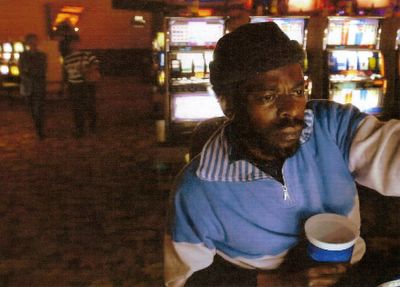
Some on the packed tour bus are sojourners for a night of gambling, others are high-rolling addicts who often make the all-night trip to the enormous casino in Uncasville, Conn. But for a few like Assaad Lahoot, who rides the bus nearly every night, there's a different attraction than the "legendary gaming experience" advertised.

Most of all, the lure is shelter. Other perks: the free food and drinks. There are also many diversions. Aside from playing slots or staring at the roulette wheel, there's the live entertainment, ways to make money (other than gambling), and, importantly, the lounge where they can sneak some sleep while pretending to watch TV.

"This is my life - it's much better than sleeping on the streets or in a shelter," says Lahoot, 51, one of scores of homeless people who descend on Mohegan Sun and Foxwoods nearly every night and do their best to blend in.

With his sweatshirt's hood pulled over his head and his body curled on the back three seats of the darkened bus, the former house painter, whose four children remain in his native Lebanon, explains how he survives:

Unable to find a painting job because of a bum arm, he says, he often spends his days standing on corners distributing a company's coupons. The little money he earns, though, is enough to afford the $10 bus ticket to the casino. After a day hanging around downtown avoiding trouble, Lahoot walks to Chinatown to catch the 9:30 p.m. bus.

In addition to the trip to the casino, the ticket comes with a $15 voucher for food or merchandise at the casino, and two $10 coupons he can use as chips for gambling. Like other drifters at the casino, if he finds a buyer, Lahoot may sell both, the voucher usually fetching $6 and the coupons $10.

The $6 profit - assuming he doesn't gamble it away - often leaves enough to tip the bus driver and ticket taker a dollar each. "It's not a bad deal," Lahoot says, adding that the benefits include an all-you-can-eat buffet.

When the bus pulls into the reservation just before midnight, it parks next to dozens of other buses from New York and New England. Some 40 crusty-eyed passengers file out. Besides Lahoot and a few other homeless men, there's a young cook hoping to win some quick cash, a mother of eight looking to "relax" after working long hours at a nursing home, a recent immigrant from Ireland on a night out with a fellow telephone operator, and a balding salesmen who says the all-night trips to the seven-year-old casino have helped send his daughter to private school.

They enter the bus lounge, a brightly lit room where more than 100 vinyl red and yellow seats surround a large kiosk of several TVs. Sprawled on the seats are a mix of bedraggled visitors, some homeless, others exhausted from a day of gambling.

In the distance, through a marble hallway connecting to the 300,000 square feet of everything from blackjack to baccarat tables, are the indoor waterfalls, the 1,200-room hotel, and the plethora of high-priced shops and restaurants. Many of the regulars in the lounge, where there are only faint sounds of the incessant ringing from the thousands of slot machines, spend the whole night here - and the security guards know them well.

"They're not supposed to be sleeping," says John Barry, one of the casino's guards who struts around the carpeted floors talking into an earpiece. "We may nudge them a bit, but as long as they wear their shoes, we let them be."
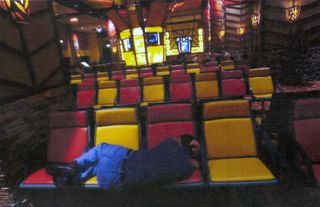
There's John, a scruffy 40-year-old sometimes poker player who walks to the casino from Norwich, Conn., and says he's "traveling to Florida." There's Mary, an elderly Jamaican in a straw hat who spends nearly every night wandering around with a cane that she doesn't seem to use. And then there's Geri, a 58-year-old one-time resident of Las Vegas, who says she's done it all, from serving cocktails to singing as a showgirl.

Wearing large sunglasses studded with rhinestones and a black sequined dress, and with her lips painted pink, she sees a touch of glamour in her lifestyle. "Sometimes I'll spend several days here," says Geri, who like most visitors to the casino would only give her first name. "I like the ambience."

At around 3 a.m., nearly 24 hours after arriving on a bus from New York, Geri brushes on some more of the already heavy makeup, and describes her living situation this way: "You could say I'm in transition."

A few seats away, two regulars, both named George, nosh on large containers of pistachio nuts, paid for with the vouchers they received on the bus from Boston. One of them, a long-haired Asian man who says he makes his living by gambling, shows off a pricey pair of New Balance sneakers, which he bought with nearly a week's worth of vouchers. The 43-year-old dice player also shows off a pair of $200 sunglasses, which his friend bought in the same way.

Having long ago finished gambling for the night, the two Georges start arguing about whether casinos should be allowed in Massachusetts.

"People will satisfy their compulsions regardless," says the younger George, noting the thousands of jobs and millions in tax dollars a casino would bring. "Think of all the people like us. We wouldn't have to come here, and the money would stay in Massachusetts."

The other George, an 80-year-old Navy veteran and former radio operator who says he's been gambling nearly every day since serving in World War II, argues his friend's point is precisely the problem.

"I've been gambling 900 years and I know the odds are stacked against you," he tells his friend, whom he met riding the bus years ago. "It would be murder to have casinos too close to Boston. People like me would go every day - and we'd all be broke."

Not long before the bus leaves for Boston at 4:30 a.m., Lahoot ambles back into the bus lounge and slumps into one of the vinyl chairs. A man next to him has a jacket over his head. Another man stretches across three seats, unperturbed by the roving guards in turquoise jackets. Everywhere is the sound of snoring.

Lahoot boards the bus for Boston and mumbles something about losing money while playing roulette. He shrugs and settles into the same back seat.

He closes his eyes. Dawn is breaking. Another night has passed.

David Abel can be reached at dabel@globe.com.

Copyright, The Boston Globe

Barred, Unclaimed, Then Buried

His six-month ban from a city shelter was up the next day, but Jack McDonnell decided to die. Did it have to be that way?

By David Abel
Globe Staff
1/07/2004

Before stripping off all his clothes, cursing the cancer that took his wife, and lying naked on the frozen ground, Jack McDonnell said he wanted to die.

He got his wish.

The call came in early last month, on one of the season's first frigid nights, for a man dancing naked in the streets near West Roxbury District Court in Jamaica Plain. When officers arrived shortly after dusk, they found the 58-year-old Vietnam veteran sprawled out beneath a bridge, in a cramped, fenced-off area strewn with garbage and teeming with rats. He was waiting to die.

One of hundreds of homeless men and women barred from city shelters on any day of the year - including the coldest winter nights - McDonnell was banned at the nearby Friends of the Shattuck Shelter, where he often stayed during a decade of homelessness. His six-month expulsion would have expired the next day.

When paramedics arrived around 6:30 p.m. on Dec. 4, the naked man remained conscious. They wrapped him in a wool blanket, fastened his cold body to a long board, and ferried him to the back of an ambulance, where the driver had the heat on full blast. Then he stopped breathing, and paramedics lost his pulse. A few hours later, at Beth Israel Deaconess Medical Center, doctors pronounced him dead - the first homeless man authorities believe died of hypothermia this winter season.

Could McDonnell, a father of two and a former alcoholic-awareness counselor, have been saved? Did the city's safety net fail a man who became homeless after his wife died a decade ago? And how could a man who police and outreach workers knew was self-destructive, who nearly died of hypothermia once before and who was again drowning himself in alcohol, be left to sleep under the Arborway Causeway on a day when the temperature plunged to 22 degrees?

Some homeless advocates blame state budget cuts, noting the shelter recently laid off McDonnell's longtime social worker and that the Legislature last year slashed more than half of the state's detox beds. Others question why publicly subsidized shelters, the last refuge of the most downtrodden, are allowed to bar the homeless, sometimes for minor reasons. Some argue city police should have the power to take McDonnell, who had been well known to them for years, into protective custody.

"The system failed him, maybe even defeated him," said Joe Churchill, executive director of the Shattuck shelter. "You feel a sense of despair whenever you hear about a case like this."

Six-month ban


A well-known presence at the Shattuck since the early 1990s, McDonnell was barred in June after stumbling in drunk, cussing staff, and raising his fists when issued a warning, shelter officials said. Deemed a risk to the staff and other guests, administrators asked a state trooper to escort him off shelter property and inform him he wouldn't be allowed to return or obtain any of its social services for six months.

By the time of his death, McDonnell was among 103 people barred from the Shattuck last year for more than a day, 47 of whom had received similar six-month penalties. In 2002, the shelter banned 306 people - some indefinitely, some just for a day - for offenses including violence, stealing, selling drugs, sexual activity, bringing food into the sleeping quarters, and failing to follow staff directions or maintain proper hygiene.

Barring the homeless from shelters has long been controversial. Pushing people out of a refuge often defeats the efforts of outreach workers, who spend countless hours trying to persuade the hundreds of city residents who regularly sleep outside to come inside.

When the trooper booted McDonnell last summer - a fate that had befallen him before - the drunken homeless man vowed never to return, screaming "to hell with all of them," friends of his said.

So he moved under the bridge, where he befriended Tabetha Blanton, a 19-year-old who a year ago traded foster care for homelessness. The two often sang old songs together - tunes like "Build Me Up, Buttercup" - and she would help cut his hair, trim his beard, and mend some of the wounds he suffered from the random attacks street dwellers confront all too often. Once, someone slit his throat while he slept beneath the bridge, and later she used nail clippers to remove stitches from his neck.

Blanton encouraged him to return to the shelter, to appeal his case, as anyone barred can. But he refused. "He said he would never come back - he felt rejected," said Blanton, who called him "Grandpa."

More than a week after his death, she began to cry while remembering him. "I loved him," she said. "It broke my heart when he died." When she asked why he wouldn't stay in another shelter, she said he insisted: "I'm happy. I just need a blanket and a pillow."

Other friends said McDonnell thought it wasn't worth the effort of staying at another shelter. At the Shattuck, where he had become a part of the family, he had a bed reserved and kept many of his possessions in a locker. At other shelters, he told his friends, he didn't want to be packed in "like sardines."
In recent years, the state's homeless population has reached record numbers.

One night last month, a survey of 80 state shelters found they exceeded capacity by an average of 26 percent. The shelters, according to the Massachusetts Housing and Shelter Alliance, have exceeded capacity every month over the past five years.

"There aren't enough beds," said David Lewis, 53, a former carpenter who knew McDonnell for two years and joined him under the bridge after also being barred from the Shattuck. "He didn't want to go to the Pine Street Inn or anywhere else to sleep in a chair or on the hard floor of the lobby."

Safety concerns


As cruel as barring may seem during the winter, shelter officials say it's an unfortunate necessity.

Although they acknowledge barring has sometimes-deadly consequences - at least six people barred from city shelters, including McDonnell, have died in the streets in the past four years, outreach workers say - their first obligation, they argue, is the safety of the majority of guests who follow the rules.

"If we could save everyone, we would do that," said Deborah Farrell Nelson, a spokeswoman for the Shattuck.

But with more and more people cramming every night into already overcrowded shelters and fewer dollars and staff to oversee them, she and others said, the necessity for barring has only increased in recent years. At the Shattuck, which accommodates 110 people every night in bunk beds and dozens of others on thin mats, budget cuts in the past year and a half have required shelter administrators to lay off one-third of their staff, including Ali Rashid, who had served as McDonnell's social worker and helped find beds for him and others at area detox facilities.

The problem, however, isn't the lack of money as much as it is the way the shelter system works, homeless advocates say.

Even if shelters had more money, advocates note, they don't employ sufficient staff with the medical authorization to treat the mentally ill and hard-core drug addicts, many of whom end up in the city's emergency shelter system. Moreover, the city lacks programs to look after those who are barred, protective-custody laws that would allow officers to forcibly remove people from the streets, or an organized hierarchy of shelters, in which police might be able to transfer scofflaws to a more secure facility. Now, when someone is particularly unruly, violent, or breaks the law, he often ends up in what many on the streets call the "Gray Bar Hotel" - jail.

Another problem, advocates say, is the shortage of detox beds. Last year, at a time when most detox centers had a waiting list, the Legislature cut the number of state-subsidized beds from 997 to 420, with many of the losses in the Boston area. Men like McDonnell would check into detox once or twice a month, to sober up for a while. The result, advocates say: At least eight of the city's 42 homeless deaths as of late December were the result of overdoses, significantly more than in previous years.

The city's lack of a protective-custody law - which would enable police officers, like those in New York, Philadelphia, and other northern cities, to remove the homeless from the streets on the coldest nights - makes it more likely people will die on the streets of Boston, advocates say. In 2002, 12 people died on the streets here, while advocates reported only 10 died in New York City, which has a homeless population more than six times the size of Boston's. In 2003, at least 1,400 street people died throughout the country, according to the National Coalition for the Homeless.

"These are all tough and complicated issues," said Dr. James O'Connell, president of the Boston Health Care for the Homeless Program, who argues the city should open small shelters to accommodate those who are barred. "I hate barring, but sometimes, given the way the system works now, it's absolutely expedient."

As far as promoting protective custody, which many outreach workers argue would push many of the homeless underground and make them harder to look after, O'Connell said: "This is a lingering and torturing issue. When is it OK for us to take away someone's rights? I don't know the answer."

But he and others believe more should have been done to look after McDonnell, who a few years ago was found lying in the middle of a road during a snowstorm and last year was found suffering from hypothermia, shelter officials said. Studies show a homeless person with a previous bout of hypothermia is seven times more likely to die of exposure if left on the streets, O'Connell said.

Back then, when Paula McDonald, who now runs the Shattuck shelter, served as McDonnell's social worker, she obtained a court-ordered treatment plan and had him involuntarily committed to spend a month sobering up at Bridgewater State Hospital. This time, with fewer resources and the bar preventing him from returning to the shelter, McDonnell slipped through the cracks.

"If the position of his social worker had not been cut," McDonald said, "I think there's a possibility he wouldn't be dead."

A generous man


A former garbage man who grew up in Hyde Park, according to shelter staff and friends, McDonnell rarely talked about his past, except when the vodka or whiskey got to his head and he dwelled on the cancer that claimed his wife, Maria, and thrust him to the bottle and a life on the streets.

Often in good spirits, the man with straw-colored, scraggly hair always let his friends know he was approaching. They could hear his voice booming down the street: "If it was good enough for Peter, it was good enough for Paul," they could hear him sing. "If he didn't have any money, he didn't have it at all."

Friends considered McDonnell a generous man, though his possessions, which were still under the bridge late last month, included little more than old Fila sneakers, an deflated air mattress, a cooler, National Geographic magazines, a wood sign reading "Need Coffee Truck," and what he called his "little shrine" of toy ducks and rabbits.

"If he had a penny, he would give it to you," said Jim Morgan, 48, who met McDonnell six years ago. Morgan pointed to a pillow and blanket that McDonnell gave him when Morgan, too, found himself barred from the Shattuck and living under the bridge.

Friends and shelter officials said they believe McDonnell had two sons but that he hadn't seen them in years. The only relative they know he kept in contact with was his mother, Mary McDonnell, who would meet him by the Forest Hills MBTA station to bring him money. She last lived in Roslindale, shelter officials think, but her phone number no longer works, and they aren't certain she's still alive.

At the shelter, despite his occasional outbursts, the staff liked McDonnell. Once, the shelter director said, he brought a big rose bush to the Shattuck and planted it beside the building. "It bloomed beautifully for two years," the shelter director said. "He would do nice things like that."

But McDonnell also had a temper, especially when he drank, which he did increasingly in recent months. Once the alcohol took effect, despair followed, friends and shelter officials said, and he would talk about joining his wife. It became a kind of mantra, so his friends under the bridge didn't take him seriously earlier last month when he began taking off his brown corduroy jeans and red flannel shirt.

Finally, one of them, a man who his friends call Jimmy K, put a blanket atop McDonnell. But he threw it off and kept muttering about his wife. After the sun set, friends said Jimmy K ran to a phone and dialed 911.

By the time police and paramedics arrived beneath the bridge and slipped through the small opening in the fenced-off area, they found McDonnell's body dangerously cold.

"There was a lot that could have been done that wasn't," McDonald said. "But what really killed Jack was his alcoholism."

McDonnell may have gotten his wish, but he's yet to join his wife. No relative has come to claim his body, and, for now, the man who spent the past six months of his life outside will, in death, remain inside, at the city morgue.


David Abel can be reached at dabel@globe.com.

Copyright, The Boston Globe

A Panhandler's Altruism


By David Abel
Globe Staff
7/14/2003

CAMBRIDGE -- It's an annual rite of summer: Hundreds of homeless people leave city shelters to sleep on the streets, and everywhere, under bridges, in wooded areas, throughout the parks, are the mangy blankets, the empty beer bottles, and the trash they leave behind.

Natalie Hefflefinger, for one, can't stand the mess.

The petite 65-year-old spends her days singing in Harvard Square and her nights sleeping in a nearby park. Almost every evening, she takes the day's earnings to CVS, buys a box of trash bags - the good kind that don't break - and fills them to keep the parks clean. Sometimes, when she has enough change, she ambles along Mount Auburn and other area streets, dropping quarters in meters running low.

"It's a way to give something back," she said. "People think of the homeless as always taking from society. This is how I can thank society for letting me sleep in the parks."

One of scores of people who make the square their home, Hefflefinger doesn't want her adopted neighborhood to go to rot. Though the city has posted signs warning the homeless against sleeping in parks after dark, officials let many stay - especially those who help maintain them.

"If people store debris, sleeping bags, or build houses, we don't let that happen," said Lisa Peterson, commissioner of the city's Department of Public Works, which maintains more than 100 public spaces throughout Cambridge. "But some people can really surprise you."

The daughter of a gardener who grew up in a middle-class family in Malden, Hefflefinger has lived on the streets for years. She won't say how long, but her decaying teeth, scarred hands, and old, tattered boots attest to years of life without a home.

"Self-reliance isn't easy, but people have been very nice," she said, remembering the man who gave her $300 for cleaning up.

An artist who likes to draw landscapes - "I'm just an amateur," she said - and a singer with an interest in patriotic tunes - "I like to sing `America the Beautiful' " - the soft-spoken woman is one of the square's few homeless allowed to linger in local cafes.

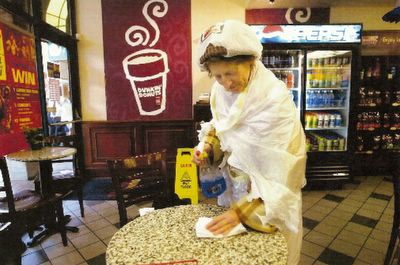
She always pays for her coffee, and, after parking herself in a chair for a few hours, she pulls a bottle of Windex from her cart to wash off the table. She also tips.

"She's one of the most consistent tippers we have, always leaving behind a dollar," said Daniella Pinto, manager of the Dunkin' Donuts by the John F. Kennedy School of Government. "It's a pleasure to have her here."

Often, the cafes are the only shelter she has. On a recent morning, after waking in Longfellow Park to a downpour, she used some extra garbage bags to craft a raincoat, tied a plastic 7-Eleven bag to her head for a hood, and covered her overstuffed shopping cart with a blue tarp. After walking around for a while, a mop, rake, and buckets hanging off her cart, she stopped in one of her regular haunts for coffee and a jelly doughnut.
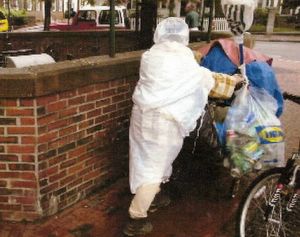
"Harvard Square is a good place for me. I like books and art," she said.

Pressed, she widens her blue eyes and admits she wouldn't mind a place to live. "I'm not doing so great, but I'm not falling apart," she said in a gentle voice. "The mosquitoes are wicked now."

Married twice with five grown children, she had a messy breakup and doesn't keep in touch with her family, whom she last saw years ago when they lived in Nashua. "I'd rather not get into it," she said. "I'm not looking for any charity."

A former secretary and onetime waitress, Hefflefinger wants to earn her keep. And though she accepts donations - many of her clothes are presents from strangers - she always tries to give something back.

What would she want the most if she could have it? A replacement for the prescription glasses she lost, she said. For now, though, the nights are warm, and that, in itself, is good. She refuses to return to a shelter, she said, preferring the freedom of the outdoors.

On another recent day, with her mop of brown hair twisting in the evening breeze, she had little time to talk. She worked - ensuring that not a scrap of trash or any of last autumn's crinkled leaves remained in Longfellow Park.

After a few hours of tidying up, with dirt caked in her fingernails and sweat filling her craggy cheeks, she stood proudly over 11 white trash bags, the park looking its summer's best.

Two at a time, she carried the bags to a nearby sidewalk, stacking them for the garbage truck to take the next morning.

"This is just something I can do," she said. "It's my way, I guess, of saying thanks."

David Abel can be reached at
dabel@globe.com.

Copyright, The Boston Globe
From Iraq to Homelessness

By David Abel
Globe Staff
8/21/2003

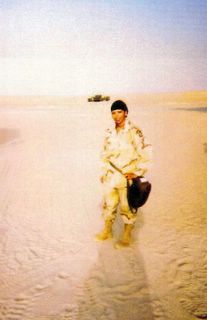
Three months ago, Vannessa Turner was in charge of a small unit, drove a 5-ton truck through ambushes, and wherever she went in Iraq, the Army sergeant held her M-16 at the ready.

The single mom's war ended in May, when she collapsed in 130-degree heat, fell into a coma, and nearly died of heart failure.

Now, after more than a month recovering in Germany and Washington, D.C., the muscular Roxbury native spends her days riding city buses to ward off boredom, roaming area malls looking at things she can't afford, and brooding over how she and her 15-year-old daughter are suddenly homeless, sleeping on friends' couches and considering moving into a shelter.

"I almost lost my life in Iraq - and I can't get a place to live?" said Turner, 41, who Army officials say is the first known homeless veteran of the war in Iraq. "Yeah, I'm a little angry. Right now, not having a home for my daughter is the greatest burden in my life."

Though Army officials said they're trying to help, Turner, still wearing a leg brace and limping from nerve damage in her right leg, blames the service for not doing more.

When she went to the Veterans Administration Medical Center in West Roxbury after coming home last month, officials there told her she had to wait until mid-October to see a doctor. When she asked the Army to ship her possessions from her unit's base in Germany, where she lived with her daughter for more than a year, they told her she had to fly back at her own expense to get them herself. And when she sought help to secure a veterans' loan for a house in Boston, she said mortgage brokers told her her only real option was to move to Springfield or Worcester.
The Army acknowledges "mistakes were made."

"The Army can be a bureaucracy, but there are people in the bureaucracy who want to help," said Major Steve Stover, an Army spokesman. "I don't think it's acceptable for anyone to be homeless, and I believe most people in the Army want everyone to take care of each other."

Unfortunately, Turner is unlikely to be the last soldier serving in Iraq to return without a home.

Although veterans make up just 9 percent of the US population, they account for about 23 percent of the nation's homeless, according to the Washington-based National Coalition of Homeless Veterans. In a given year, of the 2.5 million people who become homeless in the United States, about 550,000 are vets, many of whom served in Vietnam and suffer from post-traumatic stress disorder.

But many are also like Turner - physically disabled, unemployed, and unable to afford their own place.

"In a country as wealthy as ours, with the best military in the world, it's outrageous veterans become homeless," said Linda Boone, the coalition's executive director.

Raised by her mother and grandmother in Roxbury, Turner earned a scholarship to study at Saint Mary's College in Moraga, Calif., where she graduated in 1984. She moved to Los Angeles to become an actress. When it proved difficult to find a job, she returned to Boston and soon gave birth to her daughter, Brittany. Over the next decade, she held a variety of low-paying jobs, working as a ticket agent for airline and bus companies, as a security officer for local universities, and as a performer in a few dance groups.

Then one day she saw an Army commercial and thought life in the military might really be, as the ad promised, a way to be all she could be - a way beyond the dead-end jobs, a way to learn new skills, earn decent money, and see the world. She enlisted in 1997 and served in Saudi Arabia, Korea, and Germany, before the Army sent her to Kuwait in February.

A cook and driver who thrived on the discipline of military life, Turner remained close to the front lines after her unit crossed into Iraq in April. "The hardest part was the unknown," she said. Guerillas ambushed her convoy while she traveled to Camp Balad, 40 miles north of Baghdad. "There were snipers all around us, and I kept thinking: `God, don't make my daughter motherless'."

Not long after dawn on May 18, Turner stood in a long line, waiting to buy food. Perhaps it was the heat, the 70 pounds of equipment she wore, or an ointment she used to protect herself from all the sand fleas, she said, but she started to feel dizzy. The last thing she remembers, she couldn't breathe. She collapsed, medics forced a breathing tube in her mouth, and she was taken away in a helicopter.

A few days later, she awoke in Germany with her mother next to her. The military flew her to Washington, where she stayed under close observation until doctors at the Walter Reed Army Medical Center released her July 10.

Discharged from the Army, a friend drove her back to Boston. Since then, she and her daughter have gone from the couch in her mother's cramped one-bedroom apartment, to a friend's couch, to her sister's friend's friend's couch, she said. She has little money - she sent much of her combat pay to help her brother and sister, who's also homeless - and feels uncomfortable about imposing on relatives and friends, most of whom have little space to provide.

So now, she and her daughter's clothes and possessions are scattered around town and the two aren't sure what to do.

"It's aggravating - I like having my own stuff and I don't like invading other people's space," said Brittany, who this week slept in a cramped Roxbury apartment, on an air mattress with two cousins. "It shouldn't be this way."

Not sure whether her case is a fluke, Turner wonders whether other veterans should expect the same treatment. In the past two weeks, the Army has promised to ship her possessions back from Germany, she's seen doctors at the veterans' hospital, and she's been told to expect her first disability check next month.

But the help, she said, only came after the office of Senator Edward M. Kennedy intervened. For example, she said, the Army refused to fly her brother and sister to Germany to bring her daughter home. Then the senator's office called and suddenly a flight was offered.

"Was that a coincidence?" Turner said. "I don't think so."

Veterans' officials, both nationally and locally, now know about her case and vow to make it a priority. "I don't know how she fell through the cracks. She really shouldn't have," said Tom Kelley, commissioner of the Massachusetts Department of Veterans Services. "No veteran, especially a wartime veteran, should be homeless."

Wearing a bandanna around her head to cover bald patches caused by trauma from her collapse, and refusing to cut off her hospital wristband, Turner hopes things improve before her daughter starts school next month. As angry as she is about the military's treatment, she hasn't given up on the possibility of reenlisting when her medical condition is reviewed next year.

"I think I like being a soldier better than being a veteran," she said.


David Abel can be reached at dabel@globe.com.

Copyright, The Boston Globe

Fresh Breath

By David Abel
Globe Staff
1/05/2003

It's when the shakes start, sometime after midnight or on a Sunday afternoon, that Michael McGlaulin sets out to score a bottle of "cheap whiskey" or what merchants call "wine for the homeless."

It's a stiff brew with a sharp aftertaste. But unlike other cocktails, this one has a few distinct advantages - it's among the cheapest on the market, it's available anytime, any day, and in addition to freshening breath, according to manufacturers, it helps fight gingivitis.

"I drink the big bottle every day," says McGlaulin, 55. He explains one recent night, while drinking on the steps of a church, that he steals it or panhandles to buy it. "I can't stand the taste, but it carries me over; it prevents the seizures."

In recent months, with more homeless on city streets, police say downtown convenience stores have seen a spate of thefts. The most stolen item: mouthwash. At $3.99 for a 50-ounce bottle, Listerine and similar brands pack a punch - with as much as 27 percent alcohol content, compared with about 12 percent for the typical bottle of wine. Another perk: drinking it is legal. Police can't arrest anyone for drinking mouthwash in public.

In response to the thefts and abuse, the owner of three 7-Eleven stores in the area decided to cut the number of brands he sells and keep the remaining bottles behind the counter. At the new Walgreen's on Summer Street, managers and clerks say they keep watch whenever people who are believed to be homeless enter the store.

And at several downtown CVS stores, signs next to the bottles of mouthwash read: "Selected products have been protected by the manufacturer against theft."

But the thirsty are rarely swayed from their objective. "They don't care - the signs don't mean anything to them," says Michelle Jimenez, a cashier at the CVS on Summer Street. "They either take a bottle and walk out, or they pay. We can't not sell it to them."

When the homeless walk into the 7-Eleven across the street, where the franchise owner estimates he has lost tens of thousands of dollars in thefts at his store this year, the clerks are told to try to dissuade them from buying mouthwash. "I say, `Try to steer the customer away,' " says J.R. D'Avila, the manager of the 7-Eleven on the corner of Arch Street. "The stuff's just not good for them."

However, health officials and outreach workers, who say they've seen a rise in the abuse of mouthwash by homeless alcoholics in recent years, argue it would be dangerous for stores to refuse to sell them mouthwash, especially on holidays or during the stretch between Saturday night and Monday morning when the state's liquor stores are closed.

Without a fix for too long, alcoholics suffer withdrawal - and some die from it. Studies of Boston's homeless population over the past decade have shown that more suffer seizures and die when they can't get a drink.

A study of 14 homeless people who died between 1998 and 1999 found nearly all died on Sunday or early Monday morning, according to Healthcare for the Homeless, the study's author. Three years earlier, a study of 1,700 emergency calls from shelters to police found that 25 percent of the calls were for seizures, with 75 percent of the calls on a Sunday or Monday.

"There's really a tough ethical dilemma," says Dr. James O'Connell, president of Healthcare for the Homeless, adding that mouthwash does not have any more severe medical consequences than other alcohol. "There are no easy answers. The real problem is alcoholism. But from a harm-reduction point of view, it's better to let them drink Listerine than to have a seizure," which can cause brain damage.

The best solution, O'Connell and others said, is to get the person into a detox facility or substance-abuse program. But with more drug and alcohol abusers on the streets, there aren't enough beds.

The annual census of Boston's homeless, conducted earlier this month, found there are now about 6,200 men and women living on the streets, nearly double the number there were a decade ago. Combined with budget cuts, the increase has put huge pressure on agencies that help the homeless.

As Jim Greene prowls city streets in his job as the daytime outreach coordinator of the Pine Street Inn, the region's largest shelter, he now finds only one detox bed for every 10 people he finds who could use one - up from a bed for every three people he met a few years ago. "The people who drink Listerine are the people most gravely in need," he said. "These are end-stage alcoholics who are in the most need of our attention."

They have gotten the attention of local business owners and police, who raised the issue of mouthwash theft and abuse at a recent gathering of the Downtown Crossing Association, a local business group, and at a meeting last month of city officials, emergency personnel, and homeless advocates.

The officer often called to "clean up the mess," as he said, is Jim O'Malley, who for decades has spent the evening hours patrolling downtown. He often finds homeless alcoholics passed out with an "overwhelming" stench of mouthwash seeping through their pores. "It's sad people can be that desperate," he said.

One of the men he occasionally finds inebriated on mouthwash is Dorchester native Donald Sullivan, who on a recent afternoon sat at the entrance of a Downtown Crossing T station guzzling a newly bought bottle from CVS.

"It tastes horrible, but it helps keep me warm," says Sullivan, 39, noting he's drinking the yellow CVS brand, the most potent for the price. "You have to do what you have to do."

Another man, a former painter named Mike, says he sometimes has to haggle with store clerks or ask passersby to get him a bottle. Even though it "warps my brain a bit," caused him to tumble down a flight of stairs recently, and nearly got him thrown out of a shelter, the 50-year-old insists it's worth it.

"The truth is, it's easy to drink - and it makes the shakes go away," he said.

David Abel can be reached at
dabel@globe.com.

Copyright, The Boston Globe

The Outsiders


David Abel
Globe Staff
1/24/2003

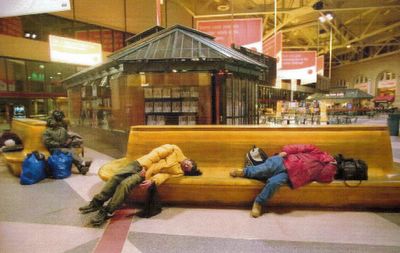
All around the former elementary school teacher, who was seated primly at 3 a.m. in South Station, limp bodies hung over wooden benches. Other people curled in nearby corners, hacking and snoring, and several moved about, as if walking in their sleep.

A few blocks away in a Downtown Crossing doorway, beneath a heap of blankets, a 40-year-old pregnant woman and her 39-year-old fiance cuddled and told each other their dreams of a wallpapered room in a new home for their coming child.

Around the same time, next to several makeshift huts under the Southeast Expressway, a 53-year-old refugee from the Congo shivered in a newly bought tent. A musician who speaks six languages and last year painted houses for a living, he nodded to the dozen candles by his bed and said: "They don't do much to keep out the cold."

With the mercury hovering around zero - a temperature so extreme it drew tears, numbed the hands and feet, and induced dizziness, a few of the dozens of people who manage to live in Boston without shelter explained how they survived on one of the coldest nights of the year, from dusk Wednesday to dawn yesterday.

Some kept warm by pacing nonstop throughout the city. Others huddled beneath blankets in bank vestibules near ATM machines. Still more rode trains and buses for as long as possible, nodded off in movie theaters, or spent their few dollars getting high in a bar.
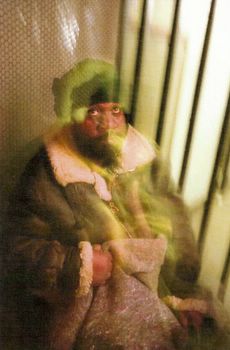
Why don't they seek refuge? The answers include pride and resistance to asking for help, fear of assault or robbery, a belief that shelters are rife with vermin and disease, and a dislike of crowded places. A record number of homeless residents did seek a bed in state shelters in the first two weeks of this month, as the city's homeless population reaches its highest levels ever.

For Mary, the former teacher, who wouldn't give her age or last name, staying on the streets is about maintaining her independence - and not compromising her principles. "A shelter would seem like captivity to me," said the grandmotherly woman. "I would rather take my chances with the elements, but that doesn't mean I'm mentally ill or suicidal. On the contrary, I want to be comfortable like anyone else."

For at least the past five years, she has lived on the streets of Boston. A pink-cheeked woman who favors tea and crossword puzzles, she roams from downtown doorways to benches in the Prudential Center to the aisles of thrift shops and Wal-Mart. On particularly cold days, she rides the T for a while and spends nights either at ATM machines or South Station, where security guards let the homeless rest. Yesterday she spent the wee hours there with the others. "It's surprising how you can develop a psychological toughness to a lot of little problems in life," she said. "I never thought I would be able to endure being cold, hungry, and not having a place of my own to go to at night, especially when it's so cold."

With "a little less" than $1,000 a month in either a pension or public aid - she won't say where her money comes from - the warmly dressed former Quincy resident said she always keeps enough money on her to hop a Greyhound bus, if necessary, to stay warm. To keep out of the cold, she said, she has taken winter trips to Seattle and to Jacksonville, Fla. And once a week, she takes the bus to Foxwoods in Connecticut, where she whiles away her time on the quarter slot machines. "I won't allow myself to lose more than $5," she said.

But her insistence on such strict self-reliance, she acknowledges, has its shortcomings. Despite a master's degree in education from Boston State College - now UMass-Boston - she said she cannot afford all the books she would like, her own TV, or good dental care.

So why doesn't she seek public housing or look for an apartment she might afford?

"There are a lot of personal, complicated explanations," she said, sitting cross-legged on a wooden bench, wearing a new parka, ski pants, wool socks, and sturdy winter shoes. "But unless I had two broken arms and legs, I wouldn't return to a shelter."

Both C.J. Charles and his fiancee, Jessica - awakened in the morning by office workers heading to 1 Milk St. - relied on body warmth, multiple layers, and blankets to keep from freezing.

"I would describe a night here as North Pole-cold," said Charles, a onetime gas station attendant from Mattapan who has been homeless off and on for the past 16 years. Jessica, who wouldn't give her last name, added: "It's terrible living like this, but we force ourselves to go on."

The couple offered cigarettes and a seat on their "bed" to strangers at around 4:30 a.m. yesterday, and said they plan to get married and that they've applied for public housing. But even with a baby due in five months, the two insist it would be more dangerous for them to trade a night on the streets for one in a shelter.

"My experience in shelters was lice, roaches, and crabs," said Charles, who last month moved with Jessica to Milk Street from the Boston Common, where they had run-ins with raccoons and would get soaked whenever it rained or snowed. At the shelter, "the food they serve needs to change. I mean, chicken six times a week?"

The couple now survives by hustling. A woman recently gave them a $500 check, they said, and they decided to spend the night at a hotel. Despite the risk of frostbite, which can take hold within minutes in bitter weather, Charles said: "No matter what, I feel safer here than in the shelters."

Bernard Tshimangoley, the Congolese refugee, lost his house painting job a year ago because of back trouble, and drove from Portland, Maine, to Boston in his Hyundai sedan to look for work. But since arriving here, he hasn't found a job. "No one would hire me," he said, "and I'm very humiliated to be in this situation."
A few weeks ago, despite the cold spell, Tshimangoley decided to move out of a Boston shelter and take his chances living in a tent.

The singer, who said he spends his time composing songs when not searching for public housing, believes the shelter where he stayed was making him sick. And, now, living just a few yards from where an elderly man died in the cold this week, he does his best to keep warm, dozing next to rows of burning candles and the hotplate he uses as his kitchen. "It's really quite cold," he said, near dawn, "but at least I'm not sick."

David Abel can be reached at dabel@globe.com.

Copyright, The Boston Globe

Harvard to Homelessness


By David Abel
Globe Staff

FOR MONTHS, WHENEVER I PASSED the man with the long, gray beard and tranquil smile, he would lift his eyes from one of the thick books he borrowed from the public library and greet me with a smooth Brahmin voice. It was the kind of carefully enunciated, overly proper diction you'd expect from the grand poobhas at a Cambridge faculty club than from the scruffy 60-year-old, who had grass stains covering his white pants and wore a flower in a winter cap someone had given him from Lord & Taylor.

"A good morning to you," he beamed heartily as he watched me leave my apartment building, which stood a few yards from his usual perch, an old wooden park bench beneath a large maple tree.

Leonard Frank Buck sat cross-legged and seemed oddly regal for a homeless man. When he wasn't reading Dostoyevsky or playing the Beatles' "All My Loving" on his recorder, he puffed his pipe and drew strangers into deep discussions, anyone from half-naked joggers to the old Russian women who attended the nearby Orthodox church, an onion-domed structure where he sometimes slept. The rosy-cheeked vagabond claimed to speak Russian, French, German, Greek, and a bit of Spanish, all of which he practiced when given the chance. "Dobroye utro," he greeted the Russians, or "Vaya con dios," go with God, he would tell the Latino ex-cons who lived at a halfway house across the street.

Leo, as he preferred to be called, often drew me into a conversation and knew what I did for a living. After a while, he began looking for my stories in the newspaper and critiquing them, often questioning the meaning of something or regaling me with a far deeper command of the subject than I managed. The more we talked, the more I began to wonder who this bright-eyed man was and how he ended up on a wooden bench with nothing but a tattered satchel stuffed with books and a large Styrofoam Dunkin' Donuts cup, which he used to conceal the potent Steel Reserve beer he'd swig.
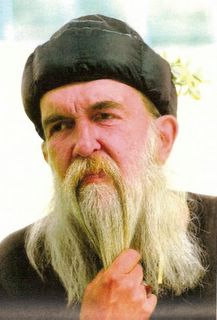
"This isn't as much the life that I have chosen, but the life that has chosen me," he told me one day. "I refuse to make the compromises that would change my situation. Maybe I love to suffer. Masochism has its own rewards, you know."

I had spent several years covering academia in New England, and I was usually rushing off to interview a professor or administrator of some sort at a nearby university. I had little time to ponder Leo's plight or delve into his story. In fact, he rarely gave me a chance to ask him questions. But he struck me as one of the more pensive people I'd come across, with more wisdom than many of the academics I'd met. In the few minutes we had to chat, he gently interrogated me or offered up observations about anything from relationships to religion. In some ways, and I watched it happen with more than a few of my neighbors, he had become something of a neighborhood therapist, a kind of priest without a parish.

The more I got to know him, the more the mystery of the jovial man on the bench began to gnaw at me. I wondered how someone like Leo could endure living on the streets, whether our society enabled such poverty, whether it was really his choice, whether mental illness kept him from having his own roof, or whether he was merely a man asserting his freedom to live as he wanted, unencumbered by hefty rents, a tedious job, or the gravity of owning possessions. The latter part of the deal seemed to me quite alluring. I mean, who wouldn't prefer to have no responsibilities other than having to return a novel to the library by its due date?

So, one summer morning, on a slow news day, I took a seat beside Leo and asked if he would tell me his story. It took some prodding, but after a while of hemming and hawing, he reluctantly obliged. He told me he grew up in a middle-class family in a suburb of Scranton, Pennsylvania, where he had been the valedictorian of his high school class. Afterward, he attended the University of Pennsylvania, eventually earning a master's degree in theology from the Ivy League school. Later, with the Vietnam War raging, he was accepted as a doctoral candidate at Harvard University's Divinity School.

He wasn't making it up. I called the schools to check.

The bottom didn't fall out until years after he dropped out of Harvard. "People were so uptight," he said of his two years studying at the nation's top university. "No one laughed."

Married with a son, he worked as an administrator at several area hospitals, until 1981, when superiors fired him from a job he held for seven years as a supervisor at the renowned McLean Hospital. "There was a personality conflict," he said, preferring not to get into it.

Then, in quick order, Leo's wife left with their boy. His landlord forced him out of his home. He stayed at shelters for a while, and soon after, he began living on the streets. When we met, he told me he had spent much of the previous 15 years homeless and estranged from his family.

Little could be said to glamorize Leo's life. He was one of thousands of people who lacked a home in Boston, more than a quarter of whom had a college education.

He was an alcoholic who suffered from bouts of depression and an ailment that forced him to hobble around with a cane. Over the years, he had been robbed and beaten up several times. Showering was a hassle. His meals usually came from soup kitchens, and when he stayed at a shelter, he had to be up and out by 5 a.m. To cover the cost of his tobacco and booze, he spent a few hours each day outside subway stations playing songs on his recorder, which netted him roughly $10 a shift.

But Leo wasn't the type to complain.

"The alternatives seem much worse," he told me, emphasizing that if he needed help, he knew where to get it. "I know many who are a lot less in tune with themselves."

Leo wasn't comfortable talking about himself; he preferred to learn about others, to consider their quandaries. He helped college students refine their poetry, inmates of the halfway house learn to live on the outside, and many of the local professionals, including one often-harried reporter, see a world beyond their horizons. He also liked to talk about all the friends he had made over the years - including the former Governor Michael Dukakis, whom he befriended while the erstwhile presidential candidate made his way to work picking up trash. About how, for him, there were no strangers, how he could engage just about anyone on any subject, from the spiritual roots of Hinduism to the wit of Oscar Wilde.

When a pal stopped over one morning while we chatted, Leo asked: "How's mom?"

"She's doing better," said his friend, an artist, who explained his mother had been recovering from surgery.

The two had been friends for five years. "He helps me reflect on life," the 39-year-old man told me. "We have a kind of mutual psychoanalysis. It's always interesting what he says."

A few minutes later, another old friend, a Cuban exile, stopped by to catch up. Leo asked him about his granddaughter and then the two discussed Fidel Castro for a while.

When the man shuffled off, Leo stretched out on his sturdy bench, gulped some beer from the slit in his Dunkin' Donuts cup, and then flashed his dentures with a great, satisfied smile.

We talked some more about the news, the environment, and he admired all the pretty people passing. The sun began streaming through the top leaves of the maple tree, and that meant the morning had nearly passed.

It was time to move on to the library.

Before steadying his cane and lumbering off, Leo offered me this: "There are some limitations. But it's not a bad life."

David Abel can be reached at
dabel@globe.com

Motor Homes


By David Abel
Globe Staff
3/09/2003

SOMERVILLE - Under the sallow haze of streetlights, between a frozen river and an empty mall, a few working cars blend in with the rusting wrecks in the parking lot.

Inside these heaps of rubber and metal - the remains of decades-old cars, vans, pickups, and trailers - some huddle under heavy blankets, others hover over propane tanks, and a few live large, watching TV, cooking meals, and keeping warm with help of generator-provided electricity.

The score or more of the homeless people living here in the parking lot behind the old Assembly Square Mall have found what most of them describe as the best possible halfway house - a safer, more peaceful refuge than the shelters and a place of their own that is considerably warmer and more comfortable than sleeping on the streets.

"This roof has probably saved my life," said Siro Lopez Blanco, a 45-year-old father of four, pointing to the porous roof of a broken-down pickup he discovered here last fall after living in a nearby field. "It leaks when it snows and there's no heat, but it blocks the wind and nobody bothers me here."

That may change soon.

In a few weeks, this vast potholed parking lot may become part of a major building project: Last month, after years of wrangling with local activists, Somerville's Planning Board approved permits to allow IKEA, the Scandinavian furniture retailer, to begin building a large store in an adjacent field.

Though the construction could be stalled by appeals, the small homeless community, which has grown and bonded in recent years, is starting to feel the pinch of the coming development.

The owners of the lot, the Assembly Square Limited Partnership, have made it clear to the homeless they aren't wanted. In recent weeks, security guards have told some to leave or risk getting towed. They have recorded license plates, more than a few bearing New Hampshire's "Live Free or Die" motto, and told others that barriers will soon be built where many of the cars and trucks are now parked.

"We're trying to change the landscape there, and obviously, we want our patrons to feel safe and to go to the site," said Natasha Perez, a spokeswoman for the partnership, which owns the old, mostly abandoned mall, now with only two stores, a K Mart and a Building 19. "We're also concerned about the safety of the homeless, and we're working with the city to improve their situation."

But the homeless, many of whom have lived here on and off for years, say they just want to be left alone.

"We're not plotting any bad things, we're just people struggling to survive with nothing in our pockets," said a haggard 39-year-old man named Bill, who said he has been living in his still-mobile Chevy Blazer since he lost a $48,000-a-year job a few days after Sept. 11, 2001.

If crime is a worry of the property's owners, there isn't much evidence it's a problem. A spokesman for the Somerville Police Department said the force hasn't received a complaint from the area in the past two years.

But city officials and property owners are also concerned about the trash. Though the homeless acknowledge they've littered the area with beer cans, they say most of the garbage - the smashed TVs, the burned-out fridge, the old bathtub, and the kitchen sink - were discarded by nonresidents of the parking lot.

"The place has become a dumping ground," said Somerville Mayor Dorothy Kelly Gay, who took part in a homeless census late last year that counted 23 people living in their cars here. "It's becoming a health hazard."

But she and others in the city aren't sure uprooting the homeless is the answer. Local advocates for the homeless argue that people living in the lot - and the census probably missed many, they say - are acting reasonably. The city's homeless shelters, as well as those in Boston, are all already overcrowded.

They're also part of a broader trend: In a survey recently released by the University of Massachusetts at Boston, the number of homeless people who told researchers they were living in cars, among other outdoor locations, increased by 16 percent between 2000 and 2001.

"This is their creative response," said Gordon Calkins, director of First Step, a local outreach program for the homeless. "I recognize the property owners can do what they want, but these people are taking care of themselves - and it's just a car in a parking lot. If they're not hurting anyone, why does it have to be a big deal?"

Alby and Donna, who've been parking their "motor coach" here every day for the past three months, say if cities offered used RVs to the homeless and let them stay in parking lots overnight, there would be less of a homeless problem. "It would be like communes in the '60s," explained Donna, 44, who said she's a waitress and once served in the Navy.

And unlike most Americans, the couple argues, they're completely independent. If they have to, they can pick up all their possessions and move with the flick of the ignition. They also don't worry about having to plug into an electrical grid. For a few dollars, their gas-powered generator provides hours of power for their stove, their shower's hot water heater, a refrigerator, TV, and VCR, and other conveniences.

"The only thing we're missing is a washer and dryer, and maybe delivery of the Globe," said Alby, 43, an ex-convict from East Boston who became homeless after leaving prison.

Despite their mobility, the couple isn't eager to move. It's hard to find places to park their rusting trailer, and they've made friends in their new community. Next door is James Baker, or J.B., a 52-year-old former MBTA bus driver, who now drives a teal 1984 Mercedes and lives in a trailer formerly owned by a restaurant named "Mom's Ribs," which still has its logo on the side of his RV.

The neighbors share the cost of gas to power Alby and Donna's generator and J.B. often drops in to watch movies. Cooking chicken in his trailer this week, J.B. said he started living in his RV three years ago when his landlord began asking $1,200 for his one-bedroom apartment.

"This is one of the only places around where people leave you alone," said J.B., a Dorchester native who now lives off monthly disability payments from the government. "If they tell me to move, I have to move. But the questions is: Where else is there for me to go?"

Among his other parking lot neighbors are Bob and Sally, who found their Assembly Square hideaway after being kicked out of a hotel lot in Woburn.

Bob, a 47-year-old former metal worker, said they can't find a better place to park their 1990 Chevy van, which has carried them more than 360,000 miles. The couple has survived the winter by using a propane tank to keep warm at night (keeping the van on, they say, might put them at risk of inhaling carbon monoxide). "When we have propane, it's like Bermuda," Bob said.

They have a TV, a cellphone, and a queen-sized bed, and they bathe by using jugs of store-bought water to fill a kiddie pool.

As plumes of smoke drifted from nearby factories after midnight one recent night, Bob said: "I tell my family I'm having a great time, that it's fun living in the van. You have to fool people, and yourself, sometimes. That's about all you can do when it gets this bad."

David Abel can be reached at dabel@globe.com.

Copyright, The Boston Globe

Out in the Open

Defiantly, at home on the Eslanade


By David Abel
Globe Staff

1/15/2006

David LeRoi isn’t hiding anymore.

The 55-year-old Vietnam vet, by his account, spent much of the last 15 years living everywhere from camouflaged huts in the woods in Franklin Park to crevices hollowed out along the Mass. Turnpike tunnels.

Now, despite cold and snowstorms, the self-described father of four has traded his invisibility for a perch so flagrant he might as well have camped out on City Hall Plaza.

Nearly every day for the past few months, except when briefly rousted by police a few weeks ago, LeRoi has pitched his bright blue tent smack in the open on the Esplanade — just a few feet from the thousands of commuters who pass on Storrow Drive, beside one of the park’s main jogging paths, and well in view of the multimillion-dollar townhouses across the parkway.

‘‘When they ask me to leave, I just say, ‘No — I’m not going,’’’ he says. ‘‘This is going to be the last place anyone’s going to tell me I can’t be. I’m making a stand here. My presence is unmovable.’’

The former electrician’s campsite has become a one-man test of the Department of Conservation and Recreation’s new policy of taking a more aggressive approach with the homeless, made visible in September when the state forced some three dozen people from elaborate shanties they built under the Mass. Ave. Bridge and Park Drive.

Last month, after repeatedly asking him to move, State Police arrested LeRoi for trespassing. But when he appeared in Boston Municipal Court, and the judge learned LeRoi hadn’t been accused of harassing anyone, drinking, or vandalizing, he dismissed the charges.

‘‘I usually deal with murderers, rapists, etc., but here’s a person who’s relatively clean, well-spoken, not causing trouble, and with no criminal history,’’ said Judge Michael F. Flaherty, who cleared LeRoi. ‘‘His behavior was not in question, and he found a place where he feels safe. Is there an appropriate punishment? Jail? A fine? I don’t think so. I told him to relocate, to the other side of the river, to Cambridge,’’ which isn’t state property.

Instead, LeRoi returned to his spot on the banks of the frozen lagoon, this time reinforcing his tarps with rope, cardboard, and an array of duct-taped wood, metal, and large umbrellas.

To endure temperatures that have dropped as low as 10 degrees in recent weeks, the lean man with a gap-toothed grin has hoarded warm clothes from local charities, including a puffy winter jacket, Thinsulate gloves, thermal underwear, and three pairs of socks he wears beneath heavy boots.

At night, he zips himself in two sleeping bags set off the ice-covered ground on a park bench, which his tent surrounds. He uses extra blankets to keep several bottles of water warm enough so they don’t freeze. To avoid attracting wildlife — he once found a rat lounging on a knapsack inside his tent — he seals all his trash in plastic bags and hangs them from the spokes of an opened umbrella that props up his roof.

‘‘I’m really very peaceful here,’’ he says. ‘‘My body has learned to adapt.’’
Of course, sleeping outside — as some 300 of the city’s roughly 6,000 homeless people do every winter — can be risky. Aside from the cold, there’s the crime. Last year, 53 homeless people died on the streets, nine more than in 2004, according to Boston Health Care for the Homeless Program. At least four of those deaths are suspected homicides.

The danger is the principal argument state officials use to justify their efforts to remove the homeless from the parks.

‘‘Public parks just aren’t safe,’’ says Joe Ferson, a spokesman for the Department of Conservation and Recreation. ‘‘It’s not appropriate for him setting up residence. We’ve asked him to move, and we’ve had help from State Police. We may ask them to assist us again in the future.’’

Troopers say they don’t know what else can be done, particularly if LeRoi doesn’t violate laws other than trespassing.

‘‘He seems intent on staying, to the point where we’re going to let him do it,’’ says State Police Trooper Michael F. Rafferty, who oversees the enforcement of trespassing laws on state property in the area. ‘‘The judge laughed it out of court. There’s not much we can do. Our hands are tied.’’

Rafferty, who often deals with the city’s homeless, says troopers have received only a few complaints about LeRoi. ‘‘He’s a gentleman,’’ Rafferty says.

LeRoi has impressed others in the neighborhood.

One man recently brought him a bottle of laundry detergent, though he says he doesn’t really need it. (He usually trashes his old clothes for new ones he picks up at local charities.) Another neighbor slid an envelope with $30 beneath his tarp, which he used to buy toothpicks to clean his yellow teeth, Lysol to kill mold in the tent, a flashlight, and a headset to listen to news on his radio.

‘‘I’m down to $16, but that’s the most I’ve had for a long time,’’ he says.
He also receives help from the outreach workers who ride the Pine Street Inn’s big white van, which roams the streets at night, regularly bring him sandwiches, blankets, and sometimes, new tarps.

‘‘Every time I see that tent, it catches me off guard,’’ says Dr. James O’Connell, president of the Boston Health Care for the Homeless Program, who often rides the van. ‘‘I see him all the time, and I’m always amazed the tent’s still there the next day. It’s very unusual. You never really see tents in the wide open like that.’’

The oddity of such an obvious encampment — the homeless usually prefer less visibility, usually hiding their shanties beneath bridges or in the woods — has created its own camouflage.

Jan Scullin, 64, who lives in the Back Bay and walks past the tent nearly every morning, hasn’t noticed anything strange about the big blue bulge, or LeRoi’s Roadmaster mountain bike, which he locks to the tent.

‘‘I thought it was something to do with grounds keeping, maybe a mini-tractor or leaf collector,’’ she says. ‘‘I had no idea someone was living in there.’’

Other neighbors want LeRoi out.

‘‘His being here really detracts from the beauty of the area,’’ says Norman Priebatsch, 61, who runs past the tent every day. ‘‘There are standards we really must maintain here. It’s not like the city doesn’t provide for the destitute.’’

LeRoi insists he wouldn’t be happier anywhere else, even in the dead of winter, even though he’s reduced to urinating in a container. Shelters are for the ‘‘delinquent,’’ he says.

The oldest of 13 children, LeRoi grew up in Dorchester, graduated Charlestown High School, served in an engineering company in Vietnam, and went on to work as a licensed electrician, he says. He became homeless in 1990 as the result of major ‘‘family problems,’’ he says and records confirm. He has avoided his relatives since, even changing his name, he says, so they can’t find him.

In a recent interview inside his tent, he sits next to the camouflage slicker he uses as a pillow and vents.

‘‘I wanted to be invisible, hidden, but they wouldn’t let me be,’’ he says. ‘‘So, now, here I am, next to all these ivory towers around me. The people are educated and comfortable. They’re going to have to live with me in their presence. They’re going to have to look at themselves by me being here — and if they don’t like what they see, I’m sorry.’’

He shows off his newly acquired toothpicks, which he keeps in a metal Altoids box, and says he has a message for his neighbors.

‘‘When you look at me and think I’m lower than you, you make yourself lower than me,’’ he says. ‘‘You don’t know me ... I’m not an evil guy.’’

As for the future, he plans to reinforce his tent and convert it into something akin to a gazebo.

‘‘My goal is to stand up against authority,’’ he says. ‘‘I’m not afraid.’’

David Abel can be reached at dabel@globe.com.

Love in a Time of Poverty

By David Abel
Globe Staff
7/21/2003

He had no money for his escape, so she gave him everything she had. They were separated by thousands of miles, an authoritarian government, and a maze of bureaucratic obstacles in four countries, but they yearned to live together like an ordinary couple.

It had been nearly a year since the survivor of Angola's brutal civil war and the daughter of a middle-class German family last saw each other in Cuba, where they married. He used her savings to pay for the planes, buses, and horses it would take for them to meet in Boston, a city they heard welcomed immigrants.

But not long after Nelson Da Costa and Maren Tober were reunited on a blustery day last fall in Copley Square, the young, penniless couple were separated once again. Without a place to stay and lacking visas to work, the two college-educated artists were homeless, forced to sleep apart in shelters that segregate men and women.

"It was horrible we couldn't live together," said Da Costa, who is seeking asylum in the United States. "That was the only reason for us to be here."

One of the few childless, married couples of the thousands of people using the city's shelters, they've spent the past eight months meeting social workers, lawyers, and city officials, hoping to find a place where they could live together.

This week, after he spent months sleeping on a cot in a Dorchester church basement and she in a cramped room at the Pine Street Inn, they're swapping the misery of homelessness for the luxury of being housekeepers.

For the next 16 weeks, they will have the use of an exclusive gym, with a sauna and Olympic-sized swimming pool included, and what amounts to their own two-bedroom apartment, with central air, cable TV, and a view of Boston Harbor.

The couple, each of whom speaks four languages, required a unique solution to their unique predicament. One day, the city's chief homeless advocate called a hotel in Charlestown, and asked if they had a room to spare. Instead, the hotel provided two rooms, one to be use as an art studio and the other a bedroom, with a full-size kitchen.

For at least the next four months, the couple will live at the hotel, which the manager asked to keep anonymous to avoid a deluge of similar requests. In return, they'll work a combined 40 hours a week, including helping to paint rooms, while housekeepers vacuum their floors and change their sheets.

"They're practically newlyweds, and it's sad a homeless shelter was their starter home," said Eliza Greenberg, the director of the city's Emergency Shelter Commission, who helped reunite the couple. "We wanted to do better by them."

It's been a long trip to find such comfort, though the consolation competes with an unease about the future.

Raised in a small village in the mountains of Angola, Da Costa, 32, watched soldiers murder his family and many of his neighbors during the country's civil war, according to a statement he wrote as part of his asylum application. An orphan, he was shot and left for dead when rebel soldiers attacked his orphanage.

A doctor from Cuba, which sent thousands of troops to support the leftist government in the war-torn African country, found Da Costa, taught him to paint, and after watching him slowly recover from the wound to his shoulder, helped him win a scholarship to study in Havana.

Tober, 24, grew up in a loving family in the formerly communist East Berlin, where teachers once spoke romantically about the Cuban revolution. An aspiring artist who studied Spanish, she decided to travel with a student group to Cuba, where the warm light of the tropics would inspire her painting.

The two met there in 1998, and almost immediately, fell in love. She visited again, and in December 2001, they were married at a small villa in Havana. But marriage to foreigners in Cuba can raise suspicions, and when Da Costa sought a visa to move to Germany, he said, the Cuban government threatened to send him back to Angola, where he feared for his life. Further complicating matters, the German Embassy told him he could only apply for a visa from his homeland.

With pressures increasing on him in Cuba - Da Costa believed he could be sent back to Angola at any time - the couple devised a plan: Tober would return home and earn some money. When she had enough, she would send him the cash needed to escape. Then the two would meet in Boston.

They arrived in Boston this past November, Tober by flying from Germany and Da Costa by a more circuitous route. Using $3,000 she wired him, Da Costa flew to Nicaragua, Belize, and then Mexico, where he followed a group of Guatemalans across the Arizona border, traveling by truck, horse, and at times on foot. From the border, he spent three days in a van before reaching Boston.

Tired and broke when they met each other outside Trinity Church, Da Costa and Tober went to a refugee center and received $20 and directions to the Pine Street Inn. Without children, the couple were not allowed in family shelters. And lacking residency, they were not entitled to public housing.

"All we want to do is be normal people, to use our education, and live together in a free country," Tober said.

Since arriving in Boston, the couple has found an attorney to press Da Costa's asylum case, improved their already proficient English, and spent as much time as possible painting, with supplies donated to city homeless programs. She paints mostly landscapes, places she dreams of going, with warm colors she says symbolizes her hope for a better future. He paints colorful collages of the faces that still haunt him from Angola, a style he calls "figurative expressionism," dreamscapes of suffering and a lust for renewal.

When not painting or working on his asylum - Tober came on a tourist visa - they've been searching for a way to live together.

This week, they finally had that chance for the first time since their wedding.

As they lugged her battered suitcases and his garbage bags filled with clothes to the hotel this week, both had trouble accepting that the spacious room with the private bathroom and the big windows was really theirs, at least for the next four months. Taking it all in, Da Costa said: "It's beautiful. It's perfect. The body is here, but the mind is still in the shelter."

Holding his hand, then hugging him, Tober said, "You see it but you don't believe it."

If they find permanent housing and obtain legal residency, De Costa said, he hopes to work teaching special-needs children, using art as therapy. Tober said she would like to start her own business, selling their paintings, and one day, opening their own gallery.

Until then, without the easy access to food at the shelters, they'll be struggling to find enough to eat.

"There are so many emotions right now," Tober said. "But this is a good start. We'll get by."

David Abel can be reached at
dabel@globe.com.

Copyright, The Boston Globe

Beached Bums


By David Abel
Globe Staff
9/03/2002

PROVINCETOWN - On a breezy summer morning, when the early light sparkles off the placid harbor waters and nothing moves on the beach but a few scurrying sand crabs, Albert Perry peeks out the open-air window of his small home and burps.

Without room for more than a spot to sleep, his home is a bit cramped. But the pleasant view, cool breeze, and soothing sounds of the shifting tides, as well as the lack of rent and the freedom to drink himself to bed, more than make up for the space, he says.

"This is home sweet home," said the balding 48-year-old, lifting with one hand the wooden frame that shelters him and revealing his life's possessions: a few musty blankets, a ball of socks, and a collection of empty beer bottles.

Nearly every night now, after the tourists have headed home and the late-night partying dies down, Perry and a gaggle of other Provincetown natives sneak onto the public beach on the harbor, swig their last drinks of the night, and slide beneath old, rotting rowboats until morning.

"It's more comfortable than a hard floor - and the boat keeps out the rain," said Perry, a sometimes fisherman whose splintering gray rowboat hasn't moved from its sandy perch in years. "The only problem is sometimes kids, drinking or smoking, sit on top of the boat, and I have to yell: `Hey, there's someone sleeping under here, take it somewhere else.'"

"I get a good laugh out of it," he added.

It may seem like sleeping in a coffin, but Perry and about half a dozen others see the boats as reliable shelter - warm enough, with the right blankets, to stay in through the winter. Without a homeless shelter nearby (the only one on Cape Cod is miles away in Hyannis, and it's almost always full) and with rents rising, sleeping beneath rowboats is their best option - better than the woods, where bugs and rabid animals prowl, they say.

The police, who know all the harbor homeless, don't agree.
While beachfront businesses and tourists rarely issue complaints, the police sometimes roust the homeless, arresting them for everything from fighting to drinking outside to camping on the beach after hours. In the winter, officers take them into "protective custody" on the coldest nights, forcing them indoors.

"We don't and won't look the other way," said Provincetown Police Chief Ted Meyer. "But we're much more tolerant than other places. If we see a guy stumbling around, rather than arresting him, we'll often just let him go home."

When home means an overturned rowboat on the beach, however, Meyer insists that officers make them go elsewhere. Yet, in practice, as long as the homeless aren't raising a ruckus, social workers say, the police don't bother them much. And neighbors in this famously liberal town often look the other way.

Having worked years ago with some of their fathers as a fisherman, David Perry, a security guard at the Seamen's Bank, sees the homeless people every day. One of the men, Glen, recently brought him a cup of coffee to wish him a happy birthday.

"For the most part, these are town boys who've fallen on hard times," said David Perry, who monitors a parking lot off the beach. "They really don't bother people, so unless they accumulate too much stuff, we let them be. I treat them no differently than clients or managers of the bank."

One of the few women who sleeps on the beach is Sean Rehill, 52, a gray-haired artist from Greenwich Village. Like the others, she says, she's been homeless here for several years now because she can't afford to pay rent.

Sipping a bag-covered beer beneath a wharf, she said: "It's a townie's right to sleep on the beach. It's cool. It's convenient to town and it's not isolated. If you can't find a place to live, you should be allowed to stay on the beach."

Another regular here is Gavin, whose rusting metal rowboat lies on a part of the beach where tufts of grass cover the sand. The homeless man, who sometimes passes out with the boat right-side up, has left a few possessions next to the boat: painting supplies, an old outboard motor, and a tattered book titled "Cultural Attitudes in Psychological Perspectives."

The group's only regular link to social services is an outreach team from Vinfen Corp., a nonprofit provider of social services on the Cape. Nearly every Friday for six years now, David Gleason, a Vinfen outreach worker, has visited Provincetown's homeless, bringing them gifts such as new underwear, doughnuts, and sunblock lotion.

On his first visit to the beach, Gleason said, he didn't see anyone, so before leaving he kicked one of the rowboats to be sure. "Someone underneath lifted it up, and said, `Who's there?' " he said. "I jumped - I was so shocked I spilled my coffee."

Now, when he comes, he said, "I just pray I won't find anyone dead under the boat."

With cracked ribs from a motorcycle accident and other medical problems resulting from a fight, Albert Perry knows he's on the edge. But the sunburned fisherman, who goes scalloping when he needs money, isn't in a rush to find another home.

For the past year and a half, he said, he's been living under his battered rowboat, which he says he found when it washed ashore. Looking at a large hole in the stern, which is useful for providing air and a lookout, he says he'll consider searching for another shelter in the winter.

"Until then," he said, "this is my home."

David Abel can be reached at dabel@globe.com.

Copyright, The Boston Globe

Camping in the Big Dig


By David Abel
Globe Staff
1/19/2003

The view from the porch consists mainly of a large concrete pillar, the air inside hangs heavy with exhaust fumes, and one of their neighbors, a methadone clinic, attracts scores of heroin addicts every day, but Thomas, David, and John prefer to point out the perks of living in a hut under the Southeast Expressway.

Sure, the rumbling overhead of more than a million cars a week never stops and they often awaken with sore backs, but they view the noise as background music and their beds, blankets folded neatly on the ground, as a cozy, increasingly comfortable refuge.

"For right now, this is as good as it gets," says Thomas, 47, a Roxbury native who, like others, would provide only his first name. "This is our little place and we try to keep it nice. And, right now, it's our only choice."

Beneath the expressway by Berkeley Street, the three homeless men are part of a phenomenon more common to cities in the developing world: All around them, a shantytown is rising from the detritus of the Big Dig.

Over the past few months, as the size of the city's homeless population has risen and state budget cuts have slashed hundreds of shelter beds, about 50 men and women here have built an array of huts, making roofs from old tarps, walls from loading pallets, and doors from discarded road signs.

Thomas's new home includes a relatively plush throw rug he and his roommates found in a dumpster, a coffee table-sized wooden spool that displays their growing library of books - ranging from those by Hunter S. Thompson to Isaac Asimov - a fire pit where they grill shish kebab and chicken livers, and their prized possession: a pillowy couch recently donated by Big Dig construction workers.

The increasingly settled community around them includes teenage runaways, a middle-aged Native American, out-of-work Latino immigrants, blacks and whites, and one 81-year-old veteran of the Korean War.

Some fit carpeting and mattresses between abandoned iron beams left from the construction. Others use blankets and cardboard to insulate the large funnels that molded the expressway's concrete pillars. One man pitched a tent, and others make do with little more than a pile of blankets and the elevated highway as a roof.

"We're hearing more and more of these stories, but an encampment in Boston is something new," says Ed Cameron, deputy director of the Emergency Shelter Commission of Boston. "This is a frightening sign of where we're heading. Many of these people really have no other place to go. There's just no room for them. So, the police often look the other way. They have nowhere else to take them."

There are no current numbers for the size of the city's homeless population. A census one night last December found about 6,000 people in shelters and on the streets.

But since then, shelters report more and more people are vying for fewer beds - this summer the state Legislature cut funding for 328 beds - and state officials say record numbers of families are turning up in government offices seeking shelter. Part of a nationwide rise in homelessness, the surging local numbers foretell a crisis this winter, city officials and social workers say.

"I usually say it goes up gradually, but this year it's stunning," says Dr. James O'Connell, who, as president of Boston Healthcare for the Homeless, keeps a close watch on the city's homeless population. "There are just more people now than we can cope with this winter."

Like others below the expressway, many of whom have been living on the streets for years, Thomas, David, and John are well aware there aren't enough beds. So, they've decided to winterize. With the few dollars that Thomas and John earn from demolition work and about $100 a week David pulls in panhandling, or "stemming," as he calls it, the roommates have bought a battery-powered halogen lamp and they're planning to buy a generator and a propane burner to help keep the place a bit warmer.

While they prefer their hut to the crowded shelters, they're conscious of the dangers of living outside. There are numerous thefts and assaults, and in the winter the area beneath the highway becomes a wind tunnel. In recent years, several homeless people died sleeping there.

"My biggest fear is that someone will sneak up on us at night," says David, 33, a Dorchester native who says he has earned as much as $135 panhandling in one day. "I'm not so worried about the winter, as much as staying safe. We try to keep it quiet."

Others, however, are angry there's no room for them at shelters, especially the Pine Street Inn, which has been full every night for much of the past two years. Just a block away, the shelter, the city's largest, has yet to open its lobby, where as many as 200 people slept last winter.

Another homeless man named David, who works as a cook, has suffered turf battles over an insulated funnel where he and a few others regularly sleep. The 37-year-old father, who says he can't afford an apartment because most of his money goes to paying child support, is sick of the fights, the thefts, and the cold. If he could get a bed, he says, he would much prefer to sleep at the shelter.

"It's completely crazy," he says. "Pine Street has space in the lobby - why don't they open it up for us? I'd sleep on a bench there, if they'd let me. It would be much safer."

Pine Street officials say they would like to do more, but they blame the Legislature, which cut the state's budget for homeless services from $37 million in fiscal 2002 to $30 million in fiscal 2003. The cuts, they say, mean the shelter has less money to pay for staff, meals, and counselors to serve the hundreds who seek beds there every night.

With winter approaching, Pine Street president Lyndia Downie says: "We're extremely worried . . . It will exacerbate an already dangerous situation. Right now, it feels like we're trying to plug a dam."

Despite the dangers of sleeping outside, many of the squatters here insist they're relatively well off, at least compared with other homeless people.

At 22, after running away from home four years ago, Laurie boasts about her "hootch" below the highway, a sizeable wood-framed shack covered in plastic. She likes it because she can stay with her boyfriend, make her own rules, and wake up whenever she wants. Also: There's no rent.

"It's the life," she says. "No one bothers you."

There are other perks: Many of the Big Dig workers look after the homeless here. Of more than a dozen homeless people interviewed, almost all had a story of a construction worker bringing them food, offering them wood, buying them lunch, bringing them mattresses, and even offering them jobs for the day.

Sitting in a chair at a table he built from an old cable spool, Robert, the 81-year-old Korean War vet, can't say enough about the kindness of the large men in hard hats. With a small painting of fruit and wine hanging behind him on a rusting iron beam, he holds a container of low-fat cottage cheese, points to boxes of doughnuts, and then gestures at a full-sized futon. All of them, he says, were gifts from Big Dig workers. "They're very nice," he says.

Though the homeless are sometimes viewed as a nuisance - particularly when they're found passed out beneath flatbed trucks or other equipment scattered under the expressway - Big Dig workers seem to have a grudging admiration for them.

Many have stories about the homeless, whom some have come to know well. Others praise their ingenuity.

"They make use of whatever they can get their hands on," said Mark Sarracco, an electrician who sees the homeless every workday. "They really can be quite creative."

Life under the highway has become routine for Thomas, David, and John, who after several months here have perhaps the most elaborate setup in the new neighborhood. They play solitaire at night and wake up to the sound of the same large truck that hurtles by around 4:30 every morning.

"It's our alarm clock," says Thomas, a graying, muscular African-American who speaks Spanish fluently and favors books by Harvard sociologist William Julius Wilson.

At dawn, before he and John head off to find work, they make their beds, tidy the place up, and pour some charcoal in the fire pit to cook breakfast and lunch. David gets up later, tames his scruffy red beard, and watches over the hut. Ambling along nearby roads, he carries a cardboard sign that reads: "Homeless. Hungry. Please Help. Thank you."

The three men met on the streets several years ago and have been looking out for each other since.

"This is our life," Thomas says, getting a nod from David. "It could be worse."

Follow:


SHELTER IS MAKESHIFT, INDEPENDENT

By David Abel
1/19/2003

A crust of ice covers the Charles. Mounds of frozen snow have reshaped the cityscape. And now, deep in the dead of winter, rarely a night passes without the temperature tipping into the teens, or below.

But they're still there, still refusing to compete for a bed at one of the area's crowded shelters, still thankful when they wake up every morning that they're alive and able to hear the drone of traffic passing overhead.

The score of stubborn homeless men and women who built a small shantytown beneath the Southeast Expressway last summer haven't budged since. A fire they made to keep warm destroyed one hovel, and Big Dig construction has hemmed them into a smaller area. But they have used everything from leftover pallets to discarded road signs to reinforce their makeshift huts into what they increasingly view as permanent homes.

"This is our solution to the lack of affordable housing," said Hung Chin, 42, a cheery former sushi chef who braves the winter nights in an elaborately constructed hut with two older men he calls "his fathers." "For as long as I can see, this is our home," Chin said.

Police, city officials, and outreach workers are all well aware of the encampment, a cluster of wood structures and tents just south of East Berkeley Street. Despite repeated efforts to persuade them to come indoors, most of the homeless insist they're better off out here than in shelters, where they would have to abide by rules. They also say they worry about being in close quarters with hundreds of other impoverished, often inebriated people.

"As long as they're not trespassing and it's not a health and safety issue, we're tolerant of them," said Sergeant Tom Lema, who handles homeless issues for the Boston Police Department.

And though city officials see shelters as a safer option than sleeping outside, they won't force their views on them.

"While we're concerned about their safety," said Eliza Greenberg, director of the city's Emergency Shelter Commission, "we respect their autonomy."

Despite the constant howling of frigid winds, which cut through the thin walls of their hovel, Chin and his housemates, Paul Savard, a 60-year-old former line cook, and Bob Gurney, an 83-year-old Korean War veteran, said they were content. Pouring diesel in a glass jar to fuel a small flame, Chin, a Vietnamese immigrant, showed off his homey decor, much of it donated by Big Dig workers.

There was the carpet on the floor, the alcoves where they put their mattresses and store their canned food, and a sturdy chair by the entrance for visitors. The walls and six-foot ceiling are lined with planks of wood, ratty wool blankets, and everything from old scarves to mattresses that block wind. By the road sign, which serves as their door, there was a makeshift armoire, which features a collection of old trophies, matchbox cars, watches, and glass trinkets they have fished from trash bins.

"It isn't so bad," said Gurney, who was barely visible on a recent night beneath a half-dozen heavy blankets. "It could be much warmer, though."

To ward off the cold, their neighbors have taken some creative, if risky, measures. While some have bought, stolen, or found fiberglass insulation, which they have stuffed between their wood and blanket-covered walls, others rely on propane burners or large cans filled with wax.

Between beers, three longtime roommates who only gave their first names - David, John, and Thomas - took turns holding their hands to several candles melted on a wobbly table. In the same frayed sweater and ripped jeans he has worn for months now, David, 33, who once helped shoo a raccoon from John's bed, explained how their previous place burned to the ground, charring a portion of one of the new expressway's concrete pillars.

"We lit a fire, and no one put it out," he said, emphasizing that they have been more careful since then.

Next door, Laurie and her boyfriend, whose porch has a welcome mat and some shrubs arranged for ambience, insisted that they were more vigilant. Though they keep their place warm with candles and a gas grill, which they also cook with, they have taken precautions, mounting a battery-powered fire alarm and an extinguisher inside.

"We're not taking chances," said Laurie, 22, who abandoned her previous "hootch," a less-spacious structure insulated by little more than a plastic tarp.

Some residents are eager for better accommodations. Sleeping alone one morning in his hovel, which is below freezing despite carefully installed fiberglass insulation, a 33-year-old day laborer named Jimmy peeked out his door and complained, "It's cold."

Dressed in two layers of clothing and wrapped in five heavy blankets, he said he never expected to still be there when he first built his hut three months ago. He occasionally spends the night at city shelters. Now, living off sandwiches donated by outreach workers and a local church, he said he was trying to save up to afford his own apartment.

Some nights, he decides to stay at the Pine Street Inn, which is a block away, across Albany Street.

"It may not be ideal in here, and we're the first to admit we're overcrowded," said Shepley Metcalf, a spokeswoman for the Pine Street Inn, which recently crammed 160 extra people into its emergency shelter. "But they have to understand it can be dangerous to be outside this time of year, especially when they're making fires."

For Hung Chin, the danger is relative. With his two roommates, enough food and alcohol, and the heavy jacket and ski mask he now rarely takes off, he said: "You learn to live with the cold."

Showing off the strength of his walls, which Big Dig workers built, and pointing out the special touches, including a frozen pineapple resting on a cinderblock and stuffed animals hanging from the ceiling, Chin said he and his roommates are here to stay.

"We have nowhere else to go," he said. "This is our own place, and we'll keep it as long as we can."


Follow:

BOB GURNEY, 72; VETERAN

By David Abel
Globe Staff
1/26/2003

He was a father, an accomplished electrician, and a veteran of the Army who served two tours during the Korean War.

But something happened, and years ago, Bob Gurney disappeared.

"It was like the earth swallowed him," said Denise Perkins, his niece and one of only two surviving relatives.

On Tuesday, emergency medical workers found the 72-year-old longtime South End resident dead in a dilapidated hut where he was living with two other homeless men.

Perkins said she and her brother had spent years searching veterans hospitals and records of vital statistics for any sign their uncle was alive. The youngest of four in a working-class family, Mr. Gurney last saw his niece and nephew at his brother Paul's funeral some 30 years ago.

After learning about his death from news reports, Perkins said: "It grieves me deeply. We could have done something for him if we knew where he was. Family is very important to us and he was very important to us. This is really a tragedy."

Mr. Gurney grew up in the Mission Hill housing development. One of his oldest friends, retired Boston police officer John Sacco, who attended the former Boston Trade School with him, described Mr. Gurney last week as a "bright, hard-working guy."

The two used to play penny-ante poker and take drives in Mr. Gurney's jalopy. The son of a junkyard owner, Mr. Gurney was the only one of his friends to own a car, Sacco said.

After graduating from trade school, where Mr. Gurney studied to become an electrician, he took a job with the city repairing damaged traffic lights, Sacco said. Afterward, in the 1950s, he joined the Army and served in Japan during the Korean War.

"He used to regale us with stories about Japan," Sacco said.
When he returned to Boston, he found a place in a rooming house in the South End. Mr. Gurney took a job unloading lumber from freight trains, and once, when Sacco was looking for extra cash, he brought along his friend to work with him.

"I quit after the first day," Sacco said. "The work was brutal, but Bob was physically strong and hard working."

At some point, Mr. Gurney met a woman and they had a child. The two never married.

Mr. Gurney was apparently close to the boy, who died about a decade ago, Sacco said, adding that he didn't know the son's name. Outreach workers who later came to know Mr. Gurney said he often spoke about his son.

Jim Greene, a former outreach worker with the Pine Street Inn, said he often heard Mr. Gurney lament, "What sense does it make that I lived and my son died?"

About a year ago, according to Greene, now an official at the city's Emergency Shelter Commission, Mr. Gurney was forced out of an apartment on Shawmut Avenue, where he had lived for the last three decades. The landlord renovated the building, rents went up, and he was evicted, Greene said.

For a while, Mr. Gurney spent his nights at the Pine Street Inn. Doctors who tried to treat him there said he always refused help.

Sometime this summer, Mr. Gurney, who by this time whiled away most days drinking, took to living under the Southeast Expressway with two younger men he had met since becoming homeless. At first, the three lived in a maze of rusting iron beams left over from Big Dig construction.

One September day, sitting in a chair at a table built from an old cable spool, Mr. Gurney couldn't say enough about the kindness of the construction workers. Holding up a container of low-fat cottage cheese, pointing to boxes of doughnuts, and then at a full-sized futon - all gifts from Big Dig workers - he told a Globe reporter: "They're very nice."

In the fall, Big Dig officials forced the homeless men to move. The three settled one block south, where construction workers helped them build the 6-foot high shack they've been living in ever since.

The space was cramped, but the men made the best of it. They decorated their hut with stuffed animals and other trinkets. Barely visible one recent night beneath a half-dozen heavy blankets, and asking a reporter to buy him some booze, Mr. Gurney said: "It isn't so bad. It could be much warmer, though."

A few days later, emergency workers found him dead, wrapped beneath the same unwashed blankets. A preliminary report by the state medical examiner's office said Mr. Gurney, who had asthma and suffered from heart and liver ailments, may have died from natural causes - causes surely not helped by sleeping for a month in unrelenting cold.

Though she hadn't seen him in decades, Denise Perkins said she will always remember her uncle as a "barrel of fun," someone who, when she was a kid, would whirl her around her kitchen. "He was really good to us."

Mr. Gurney's body will be released from the medical examiner's office tomorrow and taken to the Veterans National Cemetery in Bourne. Sometime this week he'll be buried there, according to officials from the New England Shelter for Homeless Veterans, who are providing an honor guard to send him off with a full military ceremony.


David Abel can be reached at dabel@globe.com.

Copyright, The Boston Globe

Banned


By David Abel
Globe Staff
2/08/2003

Even on the coldest, wettest nights, shelters in Boston - unlike those in other major US cities - ban hundreds of homeless men and women, often leaving them to sleep on the streets.

The decision can be deadly. In the past four years, at least five people actively barred from the city's largest shelters were found dead on the streets of Boston, and the number could be significantly higher, outreach workers said.

The Pine Street Inn, the region's largest shelter, now bars 282 people, 86 of whom were added to its list last year, for everything from drug abuse to stealing to fighting. At the Long Island Hospital Shelter, officials last year added 88 names to their list of 264. And last year, the Friends of the Shattuck Shelter banned 306 people for some period of time.

"The system could be much better," said Dr. James O'Connell, president of the Boston Health Care for the Homeless Program, which tracks all the homeless who die in the city. "Shelters are the last rung in our safety net. It's a really tough problem: Where do you go if you can't go there?"

Barring the homeless is a measure shelter officials are rarely eager to take: They know it defeats the efforts of their outreach workers, who already have the difficult task of coaxing the homeless into musty, crowded refuges that often offer nowhere to sleep but a hard floor.

Many of those barred have mental illnesses and substance abuse problems, and being booted from a shelter often further disillusions them, fueling their resistance to social workers. Although nearly all offer those they kick out rides to other shelters, many of the homeless angrily refuse the help.

"We're not trying to be punitive," said John MacDonald, director of the men's emergency shelter at the Pine Street Inn. "But we work with some dangerous folks, and we want to make sure all the people we work with can be in a safe environment."

Shelters have different barring policies, which the homeless describe as confusing and frustrating. Some will bar a person for showing up high or drunk or harassing staff, while others will only ban them for serious offenses like dealing drugs or assaults.

Moreover, some shelters update their banned lists weekly, while others purge names far less frequently. And although the state requires shelters to have grievance procedures for all those barred, they differ from shelter to shelter.

In an ideal world, O'Connell said, there would be no indefinite bans and the state would provide money for more shelters, which would be smaller, less crowded, and easier to manage. With no money available for that, he said, there might be a clear hierarchy of shelters, in which the most unruly scofflaws would be sent to shelters at the lowest end.

Another solution would be for Boston to pass laws similar to those in New York City, where through lawsuits, advocates have persuaded the courts that every city resident has a "right" to shelter. While people can be barred in New York, it can only be for a few days and for the most serious crimes. Those people often still end up with shelter - in jail.

"To bar someone from a shelter can amount to a death sentence," said Patrick Markee, senior policy analyst at the city's Coalition for the Homeless. "The bottom line is that people need engagement. It only makes the problem worse, and the street population more visible, to bar people. Incidents of disruptive behavior are symptomatic of this population and they should be treated with more intensive services, not less."

Officials in Boston, however, believe the city is right to maintain a hands-off policy.

"I don't think the city should dictate how the shelter runs their operations," said Eliza Greenberg, director of the Emergency Shelter Commission of Boston. If someone is barred from all the shelters and has nowhere else to go, she said, "That would be different."

But neither the city nor shelters track the homeless who are barred. Not only does no one know the number of people who have died on the streets, no one knows how many have been barred from multiple shelters, because the shelters don't share bar lists.

When the Long Island shelter barred Rita Butler, a 39-year-old one-time clerk at a liquor store, for fighting with her boyfriend, the two ended up living on the streets for years. "They took us at night to the T station in Quincy, and they just left us there," she said. "There was nowhere for us to go."

Still on Long Island's bar list, she believes, she vows never to go back. "After being treated so rudely, I preferred to sleep outside," she said.

But the cold has driven Butler back indoors. Recently, she had been sleeping at the Boston Night Center, a dingy shelter where scores of people sleep in plastic chairs and curl close to each other on the floor. Although the Pine Street Inn-run Night Center is one of the city's most lenient shelters, Butler was barred in December for fighting. Now, most nights, she sleeps in the South Station bus terminal.

Hung Chin, a 42-year-old former sushi chef, was so indignant about receiving a six-month ban for fighting from the Pine Street Inn last summer that he decided to build his own shelter beneath the Southeast Expressway.

At times, like during the Super Bowl last month, Chin has tried to return. "They told me, `No way. You can't come in.' I was mad. So I just told them, `See you later. I'm never coming back."'

On a recent afternoon at the St. Francis House, the city's largest day shelter, a book kept by a police officer listed 41 people not allowed past the front door. Someone was barred for a month for drinking, another was barred for eight months for "threatening staff with bodily harm," and others were barred indefinitely for everything from "stealing clothes repeatedly," to "numerous violent incidents."

The officer, who wouldn't give his name, said: "If they're on this list, they don't get in."


David Abel can be reached at dabel@globe.com.

Copyright, The Boston Globe

No Rooms, But a View


By David Abel
Globe Staff
8/19/2003

When the sun sets in the summer, with the breeze gently blowing off the river, the sailboats gliding through the golden haze, and all the beautiful people coasting by, it's like a glimpse of paradise from his porch.

On such evenings, Carlos Alberto Rodriguez often lights up his grill to cook dinner, opens a cold drink, and sits back in a lounge chair to take it all in from his perch above the Charles. "I like this place," said the graying 51-year-old, who moves around in a wheelchair.

The only problem, aside from the constant roar of traffic a few feet away on Storrow Drive: Neighbors want his home sealed up and are urging city officials to evict him and nearly a dozen others who have moved in with him beneath the Mass. Ave. Bridge.

For years, especially during the summer, the homeless have found a place to sleep beneath the overpasses along Storrow Drive. This summer, with budget cuts taking their toll and the city's homeless population swelling, Back Bay residents are increasingly complaining about the street people sprawled everywhere from the benches along Commonwealth Avenue to encampments beneath the Bowker overpass.

When the calls come in about drinking, fighting, or noise from the area, the police roust the homeless, forcing them away, at least for a short time. But they always seem to find their way back. Now, neighbors and officials are calling for a more permanent solution: They want the state to fence off the areas most frequented by the homeless.

"Ultimately, we should get these people help, but we can't have people sleeping under the bridges - it's unsafe," said Back Bay city councilman Michael Ross, who for the past two years has written letters to state officials who maintain the area. "There's always going to be places where the homeless seek refuge, but when we find these kinds of places, they have to be addressed."

The Department of Conservation and Recreation, formerly the Metropolitan District Commission, oversees maintenance of the area, but because of turnover and budget cuts, officials there haven't addressed the issue.

Asked whether it would be possible or practical to seal off the areas beneath the bridge and overpasses, Katie Ford, a spokeswoman for the Executive Office of Environmental Affairs, says the conservation department's acting director would look into it.

"I can't say whether closing off those areas is the right decision," she said. "In these budget-strapped times, we have to look at everything we spend money on."

But some neighbors see fencing off the area as the only solution.

At night, Tara Grey, who lives at 10 Charles Gate East, said she hears bottles breaking, people yelling, and worries about walking outside her building.

"It's not politically correct to complain about the homeless, but it's disturbing to walk outside my building and find a campsite set up," said Grey, 29, who recently attended a meeting at the Boston Public Library, where neighbors complained to city officials about the throngs of homeless in the Back Bay. "I have to park my car there, and pass by them - I don't feel safe. Something needs to be done, and perhaps a fence is the only way to keep them out."

Ben Godley, 71, who has lived in the building for six years, said he recently walked outside with his daughter and found a man urinating in the nearby Muddy River.

"I'm not against homeless people, but this is getting unbearable - there are more now than I've ever seen," said Godley, who complained the state was willing to spend millions of dollars to dredge the Muddy River but not to preserve it from the refuse the homeless inevitably leave behind.

Other neighbors complain the police look the other way. But there's only so much police can do. By law, officers can't force someone to stay in a shelter, and with so many people on the streets, the police don't have the ability to act as social workers. Unless there's a complaint, for the most part, the police let them be.

"The solution? Frankly, I don't have a solution," said Sgt. Ken MacGregor of the Massachusetts State Police, whose jurisdiction covers the areas beneath the bridge and overpasses.

And what would the homeless do if the state fenced off the area?

Carlos Alberto Rodriguez looked at the row of neatly made beds - on his, he keeps a plastic snake to ward off the rats - and all the trappings of his home, the pots and pans, the shaving cream and deodorant, the bag of sugar and bottles of salad dressing, and then shook his head.

"If they fence off the area, I'll just sleep right there," he said, pointing to a grassy knoll a few feet away along the median of Storrow Drive. "If they move me from there, I'll just keep coming back. I'm homeless, and I have nowhere else to go. This is where I live. This is my home."

But Rodriguez isn't worried.

Over the past seven years, he said, it's been like a game of cat and mouse with police. They shoo him away, and he comes back.

There are other places in the city he could sleep, he acknowledges, but here there's a spout that gushes water when it rains, providing a convenient place to shower, there's a sturdy roof in the bridge, and there's the protection the roads provide from unexpected visitors easily entering his abode.

There's also his friends, Estrella and Mary Luz, two of about a hundred birds he feeds rice to every day. "They keep me company," he said.

And though there's a mound of trash in the center of his home, which includes everything from an old box of matzah to a mangy sleeping bag to dozens of empty bottles of vodka, it doesn't bother him.

"This is my home," he said, gazing into a distance filled with sailboats and SUVs. "We're humans, not animals. We all have hearts."

David Abel can be reached at dabel@globe.com.

Copyright, The Boston Globe

The Scrum for Work


By David Abel
Globe Staff
3/23/2003

Well before dawn, when howling winds cut through the thickest of winter jackets, the race begins. From homeless shelters, shanties over steam vents, or a relative's couch, they rise to tramp through the night as the city sleeps, each hoping to be first in line.

For 21-year-old Emilio Vazquez, who wakes at 1:30 a.m. to grab his place, being late might mean not buying a meal today.

In the past few years, the daily competition between the city's poorest, most desperate has intensified: More and more of the mainly homeless men, some having recently fallen from the middle class, have been gathering on corners and at storefronts around the city, scrapping to win one of a dwindling number of day jobs.

On a recent morning in South Boston, the line in front of Labor Ready's blue neon sign starts at midnight. It grows steadily, with gimpy men nearing retirement age or muscle-bound ex-cons too young to drink. Some are recently laid off with college educations; others never finished high school. There are blacks raised in Roxbury, local whites with Irish names, and a few immigrants with sketchy legal status.

They all know one thing: get here after 4:30 a.m. and forget about working today.

"The early bird gets the worm," says a 40-year-old man named Mark, who slept for three hours and then, at 2 a.m., hiked from a shelter in Uphams Corner. "Whatever people say about the homeless, I challenge anyone to say that those of us here are not some of the most determined guys you'll ever meet."

Despite discouragement by Labor Ready's local manager, who worries about sleepless workers and the predawn bustle rattling neighbors, some of the men spend the whole night guarding their place in line. And the toll can be greater than lost sleep.

A scuffle erupts every now and then. Almost all know what happened last month at a Labor Ready office in Alabama, in which a prospective worker fatally shot four other job seekers during a dispute over a CD player.

"Everyone here's on the edge," says David Fraser, 21, who caught the last train of the night from Quincy and spent the smallest hours of the morning fighting the cold with about a dozen other insufficiently dressed men. "I mean, you have to struggle - and there's never even a promise you'll get it - for backbreaking work."

And the pay? Minimum wage.

In the past few weeks, to boost the company's declining profits, Labor Ready cut the wages of nearly all its local employees from an average of about $7 to the state's $6.75 an hour minimum. Despite the pay cut, Labor Ready continues to charge companies between $12 and $18 for their work.

Not everyone, though, is eager to complain, especially when a lack of job security creates fear of being blackballed from future work.

Homeless since he ran away from his home in Roxbury five years ago, Emilio Vazquez refuses to bicker about the work conditions. Hurrying over from the Pine Street Inn by 2:15 a.m., he holds the No. 5 spot in line, a position he prays will get him a job.

Nearly every day over the past year, the brawny high-school dropout has come here looking for work, and perhaps because he's young, strong, and enthusiastic, he gets it on average four days a week. The jobs? Demolition work. Clearing construction sites. Shoveling snow. Loading or unloading trucks.

"We all know what we're getting into, and without Labor Ready, many of us probably wouldn't be able to find other work," says Vazquez, who often doesn't eat until getting paid at day's end. "Yeah, it's hard work, and it can be dangerous, but we need the money."

When the Labor Ready manager unlocks the barred door at 5:30, at least 20 men rush into a small, sterile office, signing their names on a list numbered by their spot in line. Under a sign promising "Work Today, Pay Today," they take turns filling up on the free coffee, which one man says is "so bad it gives you the runs."

Drowsy and ornery, the men settle into plastic chairs, most taking the chance to catch a few winks as others stare into the fluorescent lights. Newspapers are read and re-read, the Styrofoam cups refilled, the silence belies a palpable tension.

Some of the men worry they'll be deemed too old or too weak to work that day; others wonder if the manager sees them as too inexperienced or unstable. And there are those convinced there are favorites who will get work no matter what time they arrived.

It doesn't take long for the morning's first winners to get their prize. The manager sends Vazquez, Mark, and three other men to a coveted job in Somerville, where they'll spend the day on trucks delivering boxes filled with liquor.

"The others hate us because we're getting this job," says Vazquez, noting that unlike most other day jobs, this one guarantees at least 10 hours of pay. "But this is my dream job. If they offered me a full-time position, I'd take it in a heartbeat."

Three hours later, while Vazquez and the others are well into their day of heaving heavy boxes down slick, narrow stairwells at restaurants and liquor stores throughout Boston, more than a dozen other men are still at the office in Southie, hoping against the shrinking odds for work.

Pacing the butt-strewn sidewalk, Mark Dlugosz, a 50-year-old former nurse and one of the few men with his own apartment, says he's three months behind on the rent. If he doesn't land a job today, he says he'll probably spend the rest of the day collecting cans or fishing through trash bins. And if can't find work soon, he says, he'll be sleeping at the Pine Street Inn, where he used to volunteer.

Jason Bergeron, a 22-year-old dad who lost his last job as a painter when his boss moved out of town, isn't happy about crashing on his mother's couch at her cramped apartment a few blocks off West Broadway. If he can't get a job, he says, he may turn to theft. He has called every painter in the phone book, but he can't find a job. Everyone wants to know if he has a car, which he lost after driving with a suspended license.

"Standing here doing nothing is worthless," says Bergeron, who says he needs the money not only to eat - but also to pay court fines. "I'd rather make the money than steal, but you do what you have to do to survive."

A few minutes after 9, William Criss gives up. The 51-year-old, who says he only has $2 to his name - money he hoped to use to travel to work this morning - trekked here from the Boston Rescue Mission at 3:30. A regular for several years at Labor Ready, it's the third time in the last week, he says, he hasn't landed a job. So with all his possessions, two small bags stuffed with socks, shampoo, and colored pencils, he takes off. He'll spend the day at the library drawing detailed portraits of fancy homes he'll never own. "I'm more disappointed than angry," he says. "It's been a long time since I've gone out."

Later in the day, Vazquez returns to Labor Ready to collect his pay - $61 after taxes and the fees for using the company's cash machine. His hands are blistered and his feet are swelling. Despite the cold and little more than a hooded sweatshirt to keep warm, he's been sweating all day, having made 42 deliveries.

But now, with the sun setting and some cash in his pocket, the effort feels like - as he puts it - "you didn't waste the day."

More to the point: it's now time to eat. Across the street is a Burger King, and after that, he'll take his girlfriend to a proper restaurant, as he occasionally does when he has money to spend.

"And why not?" he says. "I bust my butt all the time. I should be able to treat her, and myself, nice sometimes."

No matter what, though, it won't be a late night.

David Abel can be reached at
dabel@globe.com.

Copyright, The Boston Globe

Sidebar:

By David Abel

Labor Ready, the nation's largest day-labor provider, filled 50,000 fewer jobs last year than the year before. In Massachusetts, the firm's 22 branches last year put 13,000 people to work, 4,000 fewer than in 2000. The decline in jobs has been a blow to its bottom line, and the reason the firm recently cut wages in the Boston area.

"What it comes down to is that our wages are subject to pricing pressures," says Stacey Burke, a spokeswoman for Labor Ready, whose stock has dropped 80 percent since 1999 and whose profits have plunged in half, to $11.5 million in 2002.

Social activists and many workers, however, argue that in fact many of them end up making less than minimum wage.
For one thing, they note, the workers nearly always pay the tab to get to their jobs, which in Boston usually involves a train or bus ride. There are the hours they wait for work, which are unpaid. And then, for those lucky enough to score a job for the day, many end up collecting their wages from Labor Ready's special cash machines, which deduct as much as $1.99 from their pay.

The check-cashing fees add up: In 1999, they earned Labor Ready $7.7 million. A year later, after groups in other states filed suits against the company, the Campaign for Contingent Workers, a local nonprofit, persuaded the Massachusetts attorney general's office to order the company to cease charging fees to workers who use the cash machines.

The company's continued use of the cash machines - the attorney general's office says it's responding to complaints against Labor Ready, but officials declined comment on any possible investigation - as well as other allegations that it exploits its workers, spawned a protest movement last year in Western Massachusetts. A nonprofit group called the Anti-Displacement Project organized scores of Labor Ready workers, picketed the company's offices, and launched a website, slaverready.com, which, among other things, accuses it of "modern day slavery," "selling cheap, human labor at the lowest possible cost to its customers."

Earlier this month, the group accused Labor Ready of trying to block its organizing efforts, and it filed unfair-labor practice claims with the National Labor Relations Board in Boston.

"At a time when the social safety net has been cut, people are facing the prospect of no income and a day-labor job where people may have their rights violated on a daily basis," says Minsu Longiaru, an attorney for Greater Boston Legal Services, who has interviewed scores of Labor Ready workers who accuse the company of everything from age discrimination to unsafe working conditions. "This isn't a choice they should have to make."

The company says it maintains a "zero-tolerance policy" toward discrimination, makes safety a priority, and does its best to provide its workers with good jobs and competitive compensation. And despite the inevitable predawn race, it insists that workers whose skills fit the job are chosen, not simply those who sign in first.

As far as the cash machines go, company officials argue they're a perk for their employees, who have the option of receiving a check. Though many of the employees need the money as soon as they finish work, often at a time when most banks are closed, the officials say they're charging fees equivalent to what most banks would charge.

To counter the protests, and what they view as a defamatory website, Labor Ready, in December, filed a lawsuit in federal court against the Anti-Displacement Project, charging the group with infringing on its trademark.

"We have a responsibility to our shareholders to defend our brand, and that's all we were doing," says Burke, Labor Ready's spokeswoman. "What we all need to do now is stay focused on finding work for these people. I think everyone can agree on that."

The Clergy's Charge

By David Abel
Globe Staff
12/27/2002

BROOKLINE -- When he first showed up a few months ago, the bearded man in the bright Sephardic yarmulke stood out from the synagogue's other congregants. For one thing, he carried a crucifix. During services, he constantly walked in and out of the sanctuary. And after the rabbi's sermons, the former salesman would clap - a no-no in any temple.

At Young Israel of Brookline, the first impulse of most congregants was to help Milton Kapner, a 52-year-old fellow Jew who had been living in his green Buick since the summer. The rabbi welcomed him to services, answered his questions in classes, and bought him a membership to a health spa so he could shower. Others offered him clothes or took him out for dinners at nice restaurants. One woman even gave him a place to stay for the night.

But after a few months - when, temple officials say, he harassed congregants, crashed a wedding, and twice forced them to call the police - they barred him from the synagogue. Most recently, Kapner, who plays music for money in Harvard Square, stood in front of the temple and heckled congregants as they arrived for services.

"We don't know what to do with him," said Jerry Baronofsky, the orthodox synagogue's president, who has sought help from Jewish Family and Children's Services, a social-services provider. "We want to help him, but the truth is we're not sure the best way to go about it."

It's a quandary common to many churches and synagogues: As more needy people seek shelter and sustenance from religious institutions, where does a congregation draw the line between its interests, whether it be security or order in the sanctuary, and its mission to help the poor?

Clergy members at churches and synagogues throughout the area say they've seen a rise in the number of needy people, many of them homeless, who slip in for meals after services or sit quietly to stay warm for a while.

For the most part, unless they're disruptive, the needy are welcomed, or at least tolerated. Some of the major churches in downtown Boston even have street ministries, special outreach offices for the homeless. On Tremont Street, the Episcopal Cathedral of St. Paul, for example, provides pastoral counseling, referral services, and a telephone to those in need.

Not all churches or synagogues are as welcoming. In some cases, those scruffy, loud newcomers who aren't members or are deemed to be dressed inappropriately are turned away at the door.

"They won't let them in either because of past problems or because they anticipate the person isn't going to behave within the norms of the institution," said the Rev. Deborah W. Little, who founded Common Cathedral, an outdoor worshipping community of about 150 homeless people in Boston. "It's not always easy to find the right balance."

At St. Paul's, long a draw for the homeless, church officials had to hire a security guard because so many people crowded onto their porch, either to sleep or do drugs. Recently, after someone rubbed feces on the wall of one of the bathrooms, they decided to review an old policy of allowing the homeless to use the toilet.

"Many of the homeless are members of our congregation in good standing," said the Rev. Sarah Fike of St. Paul's. "But sometimes it can be a struggle with maintaining as much openness as possible and the necessary safety and cleanliness. Our kids, after all, need clean bathrooms."

The Arlington Street Church, which also attracts many homeless, especially to its Friday night "supper club," has a special policy for those who disrupt services. When someone disrupts repeatedly, said associate minister Carol Strecker, church officials approach the person and ask them to agree to a verbal contract. Often, in order to stay, the person must consent to therapy sessions and to allow a church member to sit next to them during services.

Sometimes, however, no matter how hard church officials try, the disruptive person is beyond help - and can be a threat to the congregation.

At the Park Street Church, one homeless man reached into the collection basket and instead of adding a donation, he grabbed all the cash. Church officials called the police.

At the Ruggles Baptist Church on Beacon Street, according to the Rev. Larry Showalter, one woman insisted on remaining after hours to play the piano. When church officials asked her to leave, she refused. When they banned her from entering, she began stalking them, demanding they let her in to play the piano. After she violated a restraining order, police arrested her and sent her to jail for six months.

"It's sad when there's nothing you can do to help," Showalter said.

For the congregants of Young Israel, which like many synagogues is increasingly security-conscious since Sept. 11, Milton Kapner never posed a physical threat. But the fast-talking guest, who told congregants he graduated from Columbia University and lost his home in Needham, began making people feel uncomfortable, even chasing some away from services.

"The truth is he was welcome here, as long as he followed the rules," said Robert Wolff, the synagogue's former president. "But after a while, people lost their patience."

Approached recently at the McDonald's on Harvard Street, where he often cajoles people to buy him a free meal, Kapner refused to speak. In a previous phone interview, he complained: "I've been excommunicated. It's the worst thing that can happen to a Jew."

A few days later, after a crossing guard reported Kapner was endangering himself walking through traffic on Washington Street, he ambled into Brookline District Court and started screaming, police said. Health officials decided to commit him to a hospital, where he will stay until doctors release him.

"Maybe this is the best thing for him," said Baronofsky, Young Israel's president. "Hopefully, it will help."

David Abel can be reached at dabel@globe.com.

Copyright, The Boston Globe

A Sanctuary's Limits

Should the Homeless be Allowed to Sleep in the Church's Choir Loft?

By David Abel
Globe Staff
7/7/2005


WINTHROP -- Last summer, when the short woman with scraggly hair and despondent eyes approached him, the pastor did more than promise help – he let the newly homeless woman sleep in the choir’s loft of his church.

Nearly a year later, the 52-year-old former nurse remains at the Holy Rosary Parish in Winthrop, where she often wakes on fetid cushions to the 9 a.m. Mass, her possessions – old mail, New Balance sneakers, a tube of Crest – surrounding the old, broken organ.

Her presence has raised an awkward issue for parishioners at Holy Rosary and other churches: Is the church a pristine, peaceful, non-threatening place to pray; or should it sacrifice some of its cherished quiet to be a sanctuary for the neediest?

Some parishioners are fed up by what they see as her disturbing their peace, and they want her out. Others have tried to help without success, bringing her food, trying to rent her an apartment, offering her medical attention, nearly all of which she's refused. Still others sympathize with her and think she should be allowed to stay as long as she wants, and that the church should be a refuge.

For all his efforts, Father Thomas DiLorenzo has reached his limit. Marie Matarazzo, a life-long resident of this small, harbor-side town, must be out soon, he said.

"I invited her to stay, because she had no place else to live," DiLorenzo said. "I wasn’t going to put her out. She was having a difficult time. But sometimes you can only give people help when they want it. She doesn’t want help, and wouldn’t take it. You can’t make people deal with their problems."

He added: "Now, she has to make a decision. I’m not going to keep her another year."

Parishioners are divided and many have asked: What should you do when you try to help someone, and they won’t accept the help?

"It’s difficult – this is a situation for which I just don’t have a simple answer," said Patricia McGee, a life-long parishioner who has served as the church’s cantor for the past 30 years. "No one seems to know the right thing to do."

One woman who belongs to the church and declined to have her name printed said she thinks it’s wrong for a church to substitute for a homeless shelter.

"People are disgusted," the woman said. "She’s a disturbance ... and she makes a ruckus. This is something outside the realm of what a church should allow. I know people who have left the church because of this."

Another long-time parishioner, Mary Rice has allowed Matarazzo to shower at her home. "She's a beautiful girl, smart, and lovely," she said. "We’re trying to do the will of God."

A spokesman from the Archdiocese of Boston said officials there don’t encourage similar policies in other churches, but they understand there’s a fine line parishioners and priests must draw between their comfort and the church’s mission to help the poor.

"Although this is not an ideal situation – we wouldn’t encourage people sleeping in churches – we understand and respect that the father’s heart is in the right place," said Terry Donilon, the spokesman. "That’s what the church is about – helping people in need."

Matarazzo also has burdened her family, putting her three brothers through fruitless efforts to end her homelessness, they said. Like the church, for the most part, they have given up.

Before last summer, Matarazzo lived in a two-family brick home here on Shirley Street. Last year, five years after the death of her father, her brothers decided to follow their father’s dying wishes – which he put in his will, they said –and sell the house and divide the proceeds. They hope to earn the more than a half-million dollars.

Her brother, Jim Matarazzo, who sees his sister regularly and collects her mail, said he helped subsidize her sister’s living at the family's home over the past several years, because the never-married former nurse hadn’t worked for more than a decade. But when they suggested she move, she refused.

It took six court hearings, a constable, and police officers to remove her from the home, he said, where she had horded hundreds of empty Special K boxes, 27,000 pennies, $240 worth of empty cans, and 14 cats, among other things.

"I found a nice apartment near the shelter where she had the cats, and I offered to pay a year in advance," said her brother, adding it took a year to clean up the house before putting it up for sale. "But she raised a lot of problems with the landlord, and they refused to rent to her."

Her family and others have since made repeated efforts to find her a new home, but he said: "It’s always ... too this or too that, and she finds a way for it not to work." They’ve also tried to get her medical help. His brothers, he said, once had her taken to a mental health facility in Lynn, but because officials couldn’t keep her there against her will, she left.

Matarazzo appreciates the church’s efforts, he said, but he thinks she won’t move on until she decides it’s time.

"She’s choosing to be homeless," he said, adding she has tens of thousands of dollars saved and could, if she found a job, secure a mortgage to buy the family’s house. "I will absolutely not help her anymore."

For her part, Marie Matarazzo still hasn’t adapted to her new circumstances.

After a recent morning sitting in the pews listening to a homily about the value of prayer, the woman with mussed brown hair, wearing a fleece covered in cat fur and a vacant stare, pined for her old home.

"I miss it," she said in a soft, plaintive, lucid voice. "It’s the home where I grew up, where I was born. I lived there all my life. My brothers knew I couldn’t go anywhere from there. I talk to (my brother) Jimmy every day. I say I want to go home, and he says, ‘Dad wanted us to sell the home.’ I don’t believe that was what my father wanted."

She said she appreciates all the church’s help, but she doesn’t know where to go at the end of the month.

Asked why she won’t accept help, she paused and then said: "I don’t know. I don’t know. I really don’t know."

David Abel can be reached at dabel@globe.com.

Legacy of a Nightmare

By David Abel
Globe Staff
1/04/2004


When he donned the mask to the oxygen machine, the gray-haired man would be carried off somewhere, to a conscious dream state in which the pale cement walls he blankly stared at in his new home became a screen, one in which his mind projected the same scene, over and over again.

In the beginning, he kept asking himself: "All I had to do was stay in there another minute. Should I have stayed? Would I be better off dead?"

A year later, marking the slow-passing days hour by hour, one Red Sox or Celtics game at a time, he paced about his small room, wearily watching as the winter sun passed over the old abandoned factory outside his window, one sign he wasn't in hell. Purgatory, however, he couldn't rule out. Alone and eviscerated by guilt, Robert "Bobbie" Orr struggled to resist the temptation of suicide, a steady tug of a tide that threatened to consume him every day.

On Oct 28, 2002, the now-58-year-old former hospital housekeeper woke up around 4 a.m. on his living room couch, took some medicine to help him sleep through a bout of bronchitis, and lit a cigarette. Then he fell asleep. Moments later, heavy smoke and flames began ripping apart his four-bedroom house in South Boston.

Caitlin, his 8-year-old daughter, was trapped upstairs. Blind in his right eye, Orr couldn't see through the increasingly heavy smoke. He made his way to the steps. Because of severe emphysema, he hadn't climbed them in some two years, he said. He fell on the fourth one, he said, and began screaming for his daughter: "Get out! Open the door. . . . Come down to me!"

He heard her scream, too, but he couldn't make out what she was saying. Then he heard a thud Caitlin dropping to the floor.

The heavy smoke and rising flames left the frail, lanky man little time to think, and he did something he said he has regretted every day since. On his hands and knees, he said, Orr found his way to the front door and crawled out. A few minutes later, he witnessed a scene burned forever into the fore of his consciousness: A firefighter emerged from the second floor with his red-headed girl, her arms dangling lifelessly from the large man's grasp.

"My daughter's dead because of my stupidity," Orr now says. "It's something I struggle to live with every day."

The death of Orr's daughter in the house on Bowen Street made headlines for a while. Illegally parked cars, firefighters said, hampered their rescue efforts. The delayed response led the city to post tow signs on street corners throughout Boston.

The mix of intense publicity, guilt, and shame has left Orr feeling like a pariah in a neighborhood where he had lived his whole life. He rarely returns to South Boston, except for counseling appointments and visits to his bank.

Crestfallen and homeless since the fire, Orr doesn't blame his neighbors for parking improperly. "No way will I point fingers," he says. "Bottom line: The buck stops here. It's my fault. I have no ill feelings to anyone."

The same, however, can't be said for him. People still question whether he did enough to save his daughter. And, soon, he may be embroiled in a lawsuit with Robin Miller, Caitlin's mother, who this summer bought a legal ad in the South Boston Tribune announcing her intention to file a wrongful-death suit.

Miller, who left Orr in 1998 and lacked custody of Caitlin when she died, last lived in Brockton, but she recently moved out of the state, to an address she wouldn't disclose. Reached recently at a hotel in Lee, she said she feels no sympathy for her former boyfriend.

"He murdered my daughter," she said. "He could have gotten her out of the house, but he ran and he left her there to die. You want to know what anguish is? He tore my heart out, and he stomped on it. I look at pictures of my daughter every day and cry my heart out."

Asked why she wants to sue him, Miller said: "All I'm trying to do is get some justice for my daughter. She didn't deserve to die like that."

The unrelenting criticism from Miller and her family, publicized last year on television and in newspapers throughout the area, led the disabled man to seek a place to lay low, a refuge that would provide him some space from all the scrutiny.

At first, he stayed at the South Bay Holiday Inn, but the Red Cross would only cover the unemployed man's expenses for a few days, requiring him to shell out $140 a night. Not long after, he learned about the Constitution Inn in Charlestown, one of the nation's few nonprofit hotels and a longtime shelter for victims of some of the area's worst fires.

It was an odd place to live for someone trying to recover from the trauma of a ravaging fire. When he saw burn victims waiting for skin grafts at Boston Shriners Hospital, it would make him think of his daughter, who had been a second-grader in the James F. Condon Elementary School. "What am I doing here?" he would ask himself. Now, after a year living with others who have lost everything in fires, he says, "It's good therapy."

Orr has two sisters in Avon, one of whom owned his house in Southie. But they have children, and there wasn't enough room for him. He applied, he says, for an apartment through Boston Public Housing. But they refused him, he says, because he's a fire risk.

For now, paying about $20 a night, he's settled in a room at the former Army Services YMCA. It's not much, but he has his own space, a refrigerator and stove, a private bathroom, and a crew who cleans his room every day.

"I'll stay here until they throw me out, or until I die," he says. "I feel safe and protected here."

His sisters, who visit him once a month or so, worry about him.

"It still hurts so bad. It's something I don't think anyone can really get over," Lorraine Robinson said of her brother's loss.

His other sister, Mildred Davis, said: "He's depressed, isolated, and his health has gone down. He still feels totally devastated."

Lifting himself up from his thin, twin mattress one recent morning, his breathing tube connected to his nose, Orr pointed out the things that keep him going.

There was his one surviving picture of Caitlin, whom he had named after his former supervisor at the New England Medical Center, where he worked for 20 years until emphysema forced him to quit in 1995. There was the figure of the Virgin Mary, which he keeps next to his daughter's picture. There was the sports talk radio, which he listens to almost nonstop. And there was the table full of medicines: for his heart, blood, eyes, throat, and lungs.

He walks slowly, rarely ventures outdoors in the cold, and coughs a lot. "It's hard to breathe," he says, clearing his throat with an inhaler.

But what most keeps him going, he says, are the memories of Caitlin: their walks in the park, the visits to the zoo, and the laughs they shared while playing with "Bear," their shepherd.

He also wants to send a message to the firefighter who did what he couldn't do. He says he never got the chance to talk to John Cetrino, who pulled Caitlin from the blaze, but he says he wants to thank him, to ask for his forgiveness.

"My daughter has given the gift of life to seven people," he says, pointing out that several parts of her body were donated to recipients. "It's through his heroic efforts that the gift of life has been given to these people."

For his part, Cetrino also has a hard time letting go of Caitlin. As if it just happened, he still feels the weight of her limp hand, which he found hanging from a sheet wrapped futilely around the girl. He still feels the heartbreak from learning that Caitlin didn't survive.

He also understands the anger, but Cetrino is willing to forgive. "An accident is an accident," he says. "I feel bad for all the parties involved. She was a beautiful little girl. But I don't hold anything against her father. He has to live with this every day, for the rest of his life."

And that's the hardest part. No matter the extent of counseling or the distance time provides from the fire, Orr struggles to make it from one day to the next, hour by slow-moving hour, breath by labored breath.

"What it comes down to right now is that I'm trying to go forward, not backward," he says.

David Abel can be reached at dabel@globe.com.

Copyright, The Boston Globe

Golden Alleys


By David Abel
Globe Staff
4/17/2003

Around dawn, the invasion begins.

Old men hobble in with canes. Mothers bring their children, whose small hands help. Immigrants come on rickety bicycles, the heavily clad homeless move in with pushcarts, even the well-off prowl the area from the commanding view of their SUVs.

All are scavengers descending on the "Golden Alleys" - what they describe as the city's most lucrative, easily accessed trash heaps.

In a given week, but especially now, as the neighborhood's wealthy residents begin their spring cleaning, the back alleys of the Back Bay attract a legion of foragers, hundreds of whom compete for anything from bottles and books to unworn clothing, jewelry, and cash.

Cruising between the BMWs and Mercedes parked along the narrow road the city calls Public Alley 418, Francisco Rodriguez pulls his bicycle by one of the corridor's many mounds of trash bags. The 42-year-old immigrant from Honduras, who has spent the past nine years fishing through the trash here, eagerly boasts about his booty: VCRs and DVDs, working laptop computers and cellphones, his bicycle and all the clothes he's wearing, diamond-encrusted jewelry, and once, he said, a pair of gloves crammed with $9,000 in cash.

"Tell me, why in the world would anyone throw this stuff out?" said Rodriguez, who used the money to buy a Greyhound bus ticket and spend three months living at a hotel in Miami. "This is the best place to come if you're poor."

Everyone who trolls these alleys has a story to tell, including the garbage men.

For them, the scavengers are like the enemy, making an already difficult job more difficult. Unlike most city neighborhoods, where trash is stowed neatly in dumpsters, residents of the Back Bay have long refused to use the large receptacles. There's just no room for them and the parking spots that are so valuable; a spot behind Beacon or Marlborough streets can fetch as much as $300 a month.

The lack of dumpsters means easy access to hundreds of trash bags, most of which are in piles along the alleys. Around dawn on Mondays and Thursdays, collection days in the neighborhood, the scavengers arrive well before the garbage trucks, often slitting open the bags and leaving a trail of milk cartons and other rubbish littering the alleys.

"They make our lives a living hell," said Chris Buckley, 26, while tossing bags into his Waste Management truck on a recent Thursday in Public Alley 418, between Exeter and Dartmouth streets. "Sometimes we just want to throw them in the back of the truck."

The mess left by the horde of trash pickers rankles residents even more. They also complain about the ruckus: bottles breaking, loud arguments over the loot, brawls in the middle of the night. And, the city sometimes slaps residents with $25 tickets when inspectors find the alleys in disarray.

Then, there are the rats.

"It's a terrible mess, and it only makes more work for the maintenance staff," said Buddy Earle, whose Earle III management company oversees about 40 properties in the neighborhood. "But there really isn't much we can do. They're not breaking any laws, and the police won't do anything."

Of course, not all the neighbors find the scavengers such a nuisance. Some even admit to scoring their own spoils from the alleys' trash.

Mary, a 59-year-old artist who would only give her first name, said she's amazed the things she sees people toss. Once, she found a throw rug, which she now uses in her Marlborough Street apartment.

"It's like a parade here on certain mornings," she said. "But I don't mind. It brings different people to the neighborhood."

Some of the scavengers have made a business out of the trash. Jeffrey Martin, a 44-year-old native of South Boston, said he once found a good color TV. "I plugged it in at a Star Market," he said, "and it worked perfectly." Then he sold it on the street for $75. A friend of his, he said, looks for pills, specifically Percocet, which he sells for $5 apiece.

Recently, a man in a Toyota 4-Runner drove slowly down Public Alley 418, stopping to inspect a children's toy atop a black bag. In his car, bottles filled several crates.

"I'd rather not advertise this," said the man, who wouldn't give his name. "The more people who know about this, the more competition."

Shortly after he moved on, Mary Luz Cortes, her husband, and their 3-year-old son drove up in a cluttered jalopy. The 31-year-old from Dorchester said she's been picking through the neighborhood's trash since she was 12, when she would walk here with her mother.

Almost every day, she said, she finds something to bring home. On this spring day, her prize: an unopened box with what seemed to be a pricey decanter and liquor glasses.

"This is good, like a gift for us," she said, showing it off as her husband smiled.


David Abel can be reached at dabel@globe.com.

Copyright, The Boston Globe

Snoring in the Stacks

By David Abel
Globe Staff
2/02/2003

Wrapped in all the clothes he owns, a former parking lot attendant sifts through a sheaf of food coupons on a recent Sunday afternoon, daydreaming. Another man pores over a 19th-century novel, still another a calculus textbook, both seeking solace through knowledge. Others show up for the clean, warm bathroom, where they catch a few desperately needed winks.

But where will they go, if Mayor Thomas Menino follows through on a proposal to close the Boston Public Library on Sundays to save money?

"I don't know," says Peter Poulimenos, wearing seven pairs of pants and carrying six large, ragged bags. "I'd probably stay outside all day."

During the cold months, especially now with the temperature hovering in single digits, the Copley Square landmark becomes a magnet for the homeless, attracting so many of the city's downtrodden that on a recent day they occupied nearly every other seat in the first floor of the new building.

With steadily growing numbers of homeless men and women - last month, city officials counted 6,210 homeless in one day - librarians and security guards say they are more frequently nudging chronic sleepers (a violation of library policy), booting people who use restroom sinks as showers or laundries, and calling emergency medical workers on passed-out alcoholics.

One recent Sunday, security guard Richard Edwards had the unenviable task of removing a man from a bathroom stall in the library's basement, an out-of-the way location visited by scores of homeless every day.

When another homeless man complained the guy inside was snoring and sitting on the toilet for about an hour, Edwards marched off to the bathroom. He went to the corner stall and knocked on the door. Nothing. He knocked again, and still getting no response, he opened the door of the stall next to it, stood on the toilet, and said, "Sir, I'm sorry, but you can't sleep inside the bathroom."

Then he jimmied the locked door and roused the man, bundled in winter gear and curled atop the unopened toilet. As Edwards escorted him outside the bathroom, the bedraggled young man looked at the guard and asked: "Can't a man get some peace?"

Seemingly oblivious to the expulsion, Poulimenos, a skinny, homeless graduate of Boston Latin and Amherst College, was washing up in the bathroom and putting on his many street clothes before heading off into the night.

The white-bearded Poulimenos, 64, had spent the entire day in the same seat in the library's Bates Hall trying to solve equations from a dog-eared copy of "Calculus 5/E With Analytic Geometry." When he's not studying integrals or derivatives ("it helps me understand the epicycles of today, in other words the meaning of quantum mechanics"), he reads the Bible, in Hebrew and Aramaic.

He's haunted the library nearly every day for the past nine years, when he began living under a bridge in Charlestown. The son of a cobbler and a one-time gas-station cashier says he would suffer if the library closes on Sundays. "All my books are here."

No final decision has been made on the Sunday closings, floated by Menino following cuts in tax revenues and state funds. "We're all waiting to find out what's going to happen," says P.A. d'Arbeloff, a library spokeswoman.

It would certainly affect Fred Woods, 38, the former parking garage attendant who has been homeless for the past three years. He regularly bides his time at the library watching movies or reading books, including "Wealth Building Journal" and "How to Make Money in Stocks," for a life-skills course he's taking.

Of his fascination with food coupons, Woods says: "I'm always hungry and this helps me get by."

The aspiring lawyer says his happiest time of the day is when he can be alone in his own mind at the library. "This is my quiet time," he says, sitting amid his books and coupons at a table on the first floor of the new building. "The shelter is so intense. There's so many people there, so close to you, you can't think there."

If the library closes, he says, "I'll probably just go to the Prudential Mall, hang around, kill time, and hope I run into someone I know."

For Matt Wilson, the chief problem would be boredom. The 50-year-old vagabond from Tennessee, who says he has worked as a teacher for mentally ill children and has done demolition work, loves the library.

"I'm a reader," he says, his nose nearly pressed to the small print in a book of New York Times front pages. "I'm in pursuit of knowledge. That's what I do."

Then he adds: "It's also nice to get out of the cold."

After years sleeping outside or in shelters where he's forced to leave around dawn, his face is drawn, his eyes are red, and his hands are chapped from the cold. If he can't spend his Sundays at the library, where he said he has learned "as much as a professor" about engineering, art, and other fields, he says he might consider skipping town.

"It's enough to make me think about changing my relationship with the world," he says. "I don't want money or physical possessions, I want wisdom."


David Abel can be reached at dabel@globe.com.

Copyright, The Boston Globe

From Prison to Shelters

By David Abel
Globe Staff
12/02/2002

A week ago, after serving two years at South Bay for assault and battery, Earl Brown walked out the prison's front door a free man. But with his old clothes his only possessions, a few dollars to his name, and friends and family saying they had no room for him, the 39-year-old from Roxbury experienced an immediate downside to his new freedom:

Like many recently released inmates, he had nowhere to go.

"No one ever offered me any help," said Brown, after lunch last week at a Boston soup kitchen. "I was on my own and I only had one choice - the street or a shelter."

State officials say they're doing everything they can to prevent inmates from going directly to homeless shelters, including recently assigning 20 employees and establishing five community centers around the state to assist inmates ready for release.

But at least 1,000 inmates - and possibly four times that number - will leave a prison or jail this year and instantly become homeless.

The numbers, based on shelter interviews with former prisoners, have climbed considerably since 1992, when the state Department of Correction began reducing prerelease programs and counties eliminated many of their halfway houses.

About 16,000 men and women this year will "wrap" their sentences - meaning they will leave the state's prisons and jails without probation or parole. Of those, 4,000 inmates surveyed before leaving custody said they have nowhere to go, according to the Massachusetts Housing and Shelter Alliance.

"Despite a new consciousness of the problem, there's nowhere close to the resources in place to turn the numbers around," said Mary Ellen Hombs, the shelter alliance's executive director. Ex-convicts often require special services, she said, adding that shelters are the worst possible environment for those trying to readjust to mainstream life.

Inmates who return to society without the benefit of a prerelease program are up to 50 percent more likely to find themselves behind bars again, criminologists say. And those benefits have fallen off significantly: Between 1992 and 2001, the number of Correction Department prerelease beds dropped from 688 to 116.

Ever since the furloughed prisoner William R. Horton Jr. raped a Maryland woman and helped doom Michael Dukakis's 1988 presidential bid, few politicians have lobbied for programs that allow criminals to live outside prison walls before their sentences are completed. With officials preferring to keep inmates locked up, the number of state-supported halfway-house beds declined in the past decade from 240 to 30 and state funds for halfway houses have plummeted from $6 million in 1993 to $710,000 last year. The number of inmates granted parole dropped by more than a third since 1992.

"Our number one job is to protect the public," said Justin Lantini, a Correction Department spokesman, noting that only five prisoners escaped from prerelease programs this year, compared with 162 in 1990. "If an inmate is suitable to be in a prerelease program, they would be there. If they're not, they won't."

The problem with the state's approach, critics say, is that many inmates deemed unfit are ultimately released - without any period of readjustment.

"If they aren't suitable for one of these programs, they shouldn't be put on the streets," said Dan LeClair, chairman of the criminal justice department at Boston University and author of reports on state recidivism rates. "But that's not happening. Basically, state officials are saying it's OK for people to recidivate, as long as it's not on their watch."

Still, in recent years the state has made an effort to address the lack of postrelease support.

The Department of Correction has assigned 20 employees to help some 10,000 inmates find housing, seek counseling, and prepare to market themselves for jobs. The state opened five community resource centers around Massachusetts - in Fall River, Worcester, Lowell, Springfield, and Boston - to help ex-convicts do everything from sharpening their resumes to receiving substance-abuse treatment. And this summer, the state received $2 million to provide a variety of prerelease programs, for inmates and juvenile offenders.

Despite those efforts, the numbers of inmates going directly to homeless shelters hasn't declined, and in some cases, the numbers are climbing: The Pine Street Inn, the region's largest shelter, has had 38 ex-convicts so far this year who said they came directly from a prison or jail, up from 34 in all of last year.

"The community resource centers are a fabulous idea," said Lyn Levy, executive director of SPAN, an inmate-advocacy group that runs the Boston community resource center, whose clients have an 11 percent recidivist rate compared with a 40 percent rate statewide. "It's just that they are understaffed and underfunded. This is an urgent problem now, and if more action isn't taken, things will get worse."

Consider the case of Reuben Lacefield. Released last month after serving 22 years in California for homicide, the 45-year-old Jamaica Plain native had no one to turn to for help. The shelters, he said, had no beds left. When he spent the night on street corners, police threatened to arrest him for loitering.

So he has found more remote places to sleep - behind cars in parking lots, beneath a tree on Boston Common, and beside his mother's grave at a local cemetery.

"In the last 22 years, these have been the hardest four weeks of my life," he said. "This is a very hard time, but I keep holding out the hope it will get better."


David Abel can be reached at dabel@globe.com.

Copyright, The Boston Globe

Squatting in Hyannis

By David Abel
Globe Staff
8/23/2002

HYANNIS - Down a narrow path in the woods surrounding this Cape Cod beach town, beyond the booby trap meant to keep out unwanted visitors, there's a small clearing in the pine trees where, for the past month, Tom and Nancy have been building a home.

With branches, leaves, and pinecones for camouflage, a roof that leaks, and a few crates stocked with canned soup, macaroni, and jellybeans, their $29 tent from K Mart is hardly their dream house. There are the occasional run-ins with raccoons and their "pet" skunk, the rashes from poison ivy or whatever - and the bugs that Nancy hates.

But like dozens of other people living here in the woods, the homeless couple say they have nowhere else to go.

A month ago, after loud complaints from local residents and the business community, Barnstable police razed several squalid tent camps in the woods around Hyannis, where as many as 50 homeless people were living. Now, with the Cape's only shelter full and aid from charities dried up, many of those dispersed are returning - this time deeper in the woods, farther from the town center, and in places hidden from outreach workers and the police.

"Most people think the tents are gone - but they're wrong," said Tom, who, like others interviewed during a recent tour of his illegal campsite, wouldn't provide his last name. "The town tried to sweep us under the rug, but we can't go anywhere else."

For months, Hyannis authorities had been considering what to do about the town's growing homeless population. As garbage and human waste mounted at a half-dozen tent camps, several near a school and park, town officials and social workers last month decided the camps had to go. On July 15, after giving the homeless one week's notice, workers used bulldozers to clear 1 1/2 tons of trash and unclaimed possessions.

The action left several dozen people in the lurch, those like Tom, 45, and Nancy, 41, who recently became homeless after having lived on the Cape for years. For several weeks, the Salvation Army paid for many to stay at a private campsite in Sandwich. But when the money for that ran out, most of them began quietly returning to the woods in Hyannis.

News of their return has brought new demands for action to prevent the homeless from living in the woods, where many abuse alcohol and drugs, angering area residents.

"It won't be tolerated - these tents won't be allowed," said Gary Blazis, president of the Barnstable Town Council. "I will make sure the police are aware it's happening. I will inform the human resources people that they need to address the situation. This is an inhumane thing."

What's inhumane, say Nancy and Tom, are the ever-rising rents and the scarcity of shelter space. Others, such as Jim, a 56-year-old Vietnam veteran who has lived on the Cape for two decades and has been homeless for four years, also complain about the cost of living.

"Where else would I go?" asked Jim, while eating lunch at the Salvation Army here this week. "Rents are ridiculous now. I have only the woods left."

About 1,200 homeless people live on the Cape, most of them in special shelters for families. At least 120 live outdoors, according to a survey this year by the Community Action Committee of Cape Cod & the Islands.

There is only one emergency adult shelter on the Cape - with room for only 50 people a night. And even those beds may be gone by the end of this year. A 20 percent state budget cut this year has forced officials at the privately run NOAH Center - for No Other Available Housing - to consider closing.

"What the police did was like a vigilante action," said Cheryl Bartlett, executive director of the Community Action group and a member of the committee on homelessness appointed by the Town Council. "I don't believe it got us what we needed - which was security and safety for the neighborhood. Now the problem is more concerning. Before, at least, we knew where they were."

Some social workers aren't as worried, and they applauded the police action last month.

"The fact that they're deeper in the woods, in a place where people aren't near them, means the risk to other people has been reduced," said Rick Brigham, director of The NOAH Center, which bars anyone from entering who has been drinking or doing drugs. "That's a benefit."

Still, he and others believe the ultimate solution is creating more shelter, including places where addicts can spend the night indoors. In coming months, Brigham said, he believes the town will agree to provide such a space.

The town is considering leasing a building that by the end of next month may provide temporary shelter to as many as 20 people a night, according to Joellen Daley, assistant town manager of Barnstable. The goal, she and others insist, is to ensure that no one has to live in the woods, especially as winter approaches.

"We're working to address the issue - with both long-term and short-term solutions," Daley said.

Tom and Nancy are just hoping the rain holds off until they can afford a place to live.

Tom, a former building contractor who says he has an associate degree in engineering from the Wentworth Institute of Technology, has been homeless for more than a year now, the result of health problems and his inability to cover his rent, he says. Nancy, a longtime waitress who says she graduated with a bachelor's degree in nursing from Curry College, became homeless in March because a job fell through.
The two met at the Salvation Army six months ago and have been living together in the woods ever since.

To avoid being caught, they leave the site early in the morning, when geese and airplanes wake them, and sneak back late at night, with flashlights or homemade candles, and fall asleep to the sound of crickets. And despite their shabby abode, decorated with a framed poster, a small Tasmanian devil doll, and all their possessions hung from branches - a bikini, fins and a snorkel, gloves, and an old suitcase - they haven't lost their sense of humor.

"Look at these shrubs - you'll never guess what we paid for them," said Nancy with a wink as she swatted away a bee. "This is our home," she added. "Isn't this nice and homey."


David Abel can be reached at dabel@globe.com.

Copyright, The Boston Globe

Wall Nuts


By David Abel
Globe Staff
6/19/2003

For weeks, he watched them guzzle liquor in the park across the street. He saw one man defecate in the open of a nearby parking lot. And by the time he stumbled across the couple humping in a sleeping bag on the sidewalk beside his home, Fran Flaherty had enough.

When the lifelong Southie resident recently asked the lovers to leave, he said, they attacked him, gouging out his eyes, mauling him with a brick, and leaving him with nine stitches and a collection of painful bruises.

"In all my life, I've never seen it as bad as it now," said Flaherty, a 47-year-old father who lives in the same Bolton Street home where he grew up. "It's crazy - it's like they're everywhere."

Since spring arrived, he and other neighbors say they count more people panhandling, rifling through the trash, and otherwise appearing up to no good. To stem a rise in the numbers of people living on the streets, an annual rite with warmer weather, local leaders have arrived at a controversial solution: banning outreach efforts.

The reason the homeless stay in South Boston, they argue, is the large white van from the Pine Street Inn. For more than a decade, roving from Broadway to parks like the one across from Flaherty's home to encampments in abandoned fields, it has delivered blankets, soups and sandwiches, and free medical care to anyone in need.

A few weeks ago, shortly after the couple attacked Flaherty, Jim Kelly, the neighborhood's veteran city councilman, met with police and the city's homeless advocates to deliver this message: the van should not return to Southie.

"I told them whoever is coming here to give aid and comfort to the derelicts are doing a great disservice to our neighborhood," Kelly said. "It's just an encouragement for them to settle in ... We should not be encouraging people to break the law, especially when they're living in our parks and harassing our neighbors."

Controversy is not new to the Pine Street Inn's outreach efforts. Since the shelter began sending teams of social workers and nurses out in 1986, neighborhoods around the city have raised questions about the van, recently including residents of a condo complex near the Boston Public Library, who voiced similar complaints about outreach efforts and eventually barred the van from visiting a group sleeping on steam vents there.

Outreach workers and officials at the Pine Street Inn understand concerns about their work. But they argue the problems will only get worse if they can't reach out to those most in need.

"We're not a take-out restaurant service," said Shepley Metcalf, spokeswoman of the Pine Street Inn. "We do bring clothing, blankets, and food. But the real mission of the van is to establish relationships with the most vulnerable groups, and to encourage them to come off the streets."

And nearly every night, they do that. In addition to relieving the suffering of someone sleeping without a blanket or someone who may not have eaten that day, the outreach workers often do their best to coax some of the most recalcitrant street people to come in for the night or just to meet with social workers. Moreover, a doctor who travels with the van twice a week, often provides them medical care and persuades many to visit him at a free health clinic in the city.

City officials in Boston's Emergency Shelter Commission, who are trying to resolve the standoff, declined to comment.

But outreach workers are concerned about a long delay in contact with Southie's scores of homeless. "The problem is not going to be solved by ignoring it," Metcalf said. "There has to be a broad-minded strategy, and hopefully, some compassion."

Asked if there was any room for compromise, Kelly, who brandished recent police reports of homeless people arrested for everything from exposing themselves to assaulting one another, said: "I suggested they could come back, so long as they take the derelicts with them."

If the strong stance comforts Fran Flaherty, a construction worker who's a cousin of the city's at-large councilman Michael Flaherty, it's bad news for the men and women who live on the neighborhood's streets.

Already, police and city officials have dismantled shanties built in the park next to Flaherty's home and torn down an elaborate structure that housed at least a half-dozen people in an abandoned field beside the new convention center.

Perched one recent night atop a wall along Broadway, a gaggle of homeless people who called themselves the "Wall Nuts" bitterly complained about not seeing the outreach van in weeks.

"Just because one person got into a fight, they take out on the rest of us?" grumbled Liz Grenier, 46, who like the others said she has lived in Southie her whole life.

Homeless for several years since her boyfriend died, she said, she now sleeps inside the vestibules of ATM machines. "We're starving to death and it would nice to have a blanket at night," she added.

Next to her, Phillip Fisher explained why the group didn't leave for another part of the city, one where the van still visits every night.

"This is our town, and we're not going to be kicked out," said the 58-year-old who has lived on the streets for the past three decades. "They'll have to throw us in jail to make us leave."

David Abel can be reached at dabel@globe.com.

Copyright, The Boston Globe

Outreach


By David Abel
Globe Staff
12/28/2002

Nearly every day, the big man wanders around the city. In an old Peruvian poncho and knit New England Patriots hat, he drops in at T stations, climbs through trash in back alleys, and stops to chat up everyone from boozers to paupers.

Like many of his bedraggled friends, he has been sneered at in hotel lobbies, shooed from restaurants, and forced into the cold from train stations.

Even Jim Greene's grandmother has taken him for a homeless man.

"It doesn't bother me," he says. "It's like Dorothy Day once said in quoting Thomas Aquinas: We tend to look like those we love."

For a decade, the 39-year-old outreach worker has been the closest thing to a guardian angel for many of the city's homeless. Not only does he know nearly all their names, he has accompanied them to hospitals and appointments to see social workers, he has coaxed countless numbers off the streets and found housing for hundreds. And when someone dies, it's usually Greene whom city coroners call to identify the body.

In the past few weeks, years after helping design and maintain the city's safety nets, Greene has been apologizing to scores of men and women who have come to know him so well. Gently, after asking about their hurt leg or their medicine or where they slept the previous night, he delivers the bad news: He's moving on.

Yesterday, Greene spent his last day on the streets as an outreach worker, and next month he starts a new job at City Hall.

"It's a huge loss," says Lyndia Downie, his former boss and president of Pine Street Inn, describing his rapport with the homeless as "gentle, but at the same time urgent."

"But the good news is that he's not leaving the field, and he'll be able to continue his work at the policy level," she says.

Word of Greene's departure has spread quickly on the streets. Though he'll continue as a homeless advocate at the city's Emergency Shelter Commission, some resent his departure and feel like he's abandoning them.

"He's letting a lot of people down," says Mike Diamantopoulos, 50, a former painter who for years has lived on the streets around Downtown Crossing. "Maybe his job now has too much responsibility, or he's getting a better-paying position. It just feels like he's putting himself before other people."

Nothing could be further from the truth, Greene says.

"I'm in this struggle for the long haul," he says.

The son of a large working-class family from New Hampshire, he spent his high school years helping build homes for the needy, his college years working in soup kitchens, and the years since earning a meager salary at homeless shelters. For him, he says, saying goodbye is the hardest thing he could do.

Of course, any goodbye is relative. Even though his new job won't allow him the same kind of time on the streets, he vows to keep checking on people and working for them in a different way.

"For me, this is a lifelong commitment," says Greene, who hopes in his new desk job to push for more affordable housing and more resources for the city's estimated 6,000 homeless.

Moreover, he notes, there are now many other outreach workers available to take his place. When Greene started in 1993, he was a "lone ranger" who prowled the streets and in a six-month period learned the names of 750 homeless people.
Now, after years of pushing city shelters to boost their outreach, there are dozens of well-trained homeless advocates who know the territory.

One is Cheryl Kane, a nurse with the Boston Health Care for the Homeless Program, who has worked beside Greene for years. "I've learned a phenomenal amount from him," she says.

"Jim doesn't just know everyone's name, he knows everyone's stories, and that's not easy to replace."

He's also served as a kind of unofficial liaison between the homeless, police, and local merchants, many of whom have grown impatient as the city's homeless population has doubled in the past decade.

Not bothering to change from his street garb, Greene has lobbied city officials, and beseeched everyone from officers to security guards to empathize with the homeless, rather than immediately forcing them from a warm place.

"He brings a lot to an enormous problem, what police often don't have the tools for," says Captain Bernard O'Rourke, the Boston Police Department's downtown district commander.

On a recent night, with the wind howling and the temperatures well below freezing, Greene follows a familiar route, checking on a panhandler named James near South Station, a scruffy elderly man named George ambling around aimlessly with a large suitcase, and a group of men guzzling alocohol in an MBTA station.

Before police come to clear the men from the station, one of whom is passed out near an escalator, and before he helps arrange beds for them at a detox shelter, he breaks the bad news.

One of the men, Rene Bouteillie, opens his reddened eyes and shakes his head. "You've always found us," he says. "You've always been there for us."

Then a man with an eye patch, Teddy Sotomayor, whom Greene has known since he started the job, staggers up from the train platform, trailed by an MBTA police officer.

Greene tries to intervene, asking the officer to let the drunken man remain inside while he calls for a van to take him to a shelter. But the officer won't relent, and the group, including Greene, is forced into the cold night.

"This is what happens sometimes," he says. "This is how a social problem becomes a medical crisis."

David Abel can be reached at dabel@globe.com.

Copyright, The Boston Globe

A Way Out

Despite Addiction and Criminal Records, Three Homeless People Seek Work, Normal Lives

By David Abel
Globe Staff
07/18/2002

Bob Heard knows how to inspire dread in men, but something isn't clicking with this one man, the only one not wearing a tie.

All around, suited strangers chitchat cheerfully, as if professionals at a business meeting. What stands out about this one man isn't his breach of the dress code, it's his scowl.

"Why are you here?" Bob demands. "You know, if you act like a jerk, and I perceive you as a jerk, I'm going to treat you like a jerk."

The men and women before Bob this spring morning are homeless addicts, nearly all with long criminal records - in short, society's most down and out. Amid rising homelessness, state budget cuts, and Congress forcing more welfare recipients to work, it's this 6-foot-6, 300-pound former fugitive's job over the next three weeks to prepare this most unprepared group to find work.

If he fails, it means those assembled here may be stuck in the purgatory of shelters or, worse, again craving needles and sleeping strung out on the streets.

When Bob addresses this crew in a classroom at the Pine Street Inn, he sees long-haired men in pin-striped suits and women with long nails and teased hair. There's a teenage dropout. A middle-aged hustler who traded sex for drugs. An alcoholic who dreams of being ambassador to Pakistan, and another just hoping to sweep floors.

Among them is Ron Hayden, a brawny, bald-headed former engineer who was president of his high school class, married his high school sweetheart after college, and earned enough working for his father's firm that he once built his own home.

There's Stephenie Jackson, a single mother of five with graying dreadlocks who stood out so much growing up in Roxbury that she won a scholarship to Milton Academy, where the Kennedys sent their children.

And sitting quietly, dressed like an executive with slicked gray hair, charcoal suit, and oval glasses, is Jesus Rodriguez, who believed he was embarking on a better life when he came to Boston after growing up without shoes, fishing for food, and living in a thatched-roof home in Puerto Rico.

Bob's outburst makes the three volunteers wonder whether they really want to be at this boot camp. As he approaches the security guard turned addict, the burly director - who for a decade served as security chief of the Black Panther Party - repeats his question, this time raising his voice: "Why are you here?"

The man blurts out: "Because I had to come."

Bob draws two faces on a board - one with a smile, the other a frown.


"Right now, all I see is a get-away-from-me, I-don't-want-to be-around-you attitude, and you're not gonna succeed that way," Bob tells him.

If he refuses to care how people perceive him, he'll miss the most important lesson. Success - a weekly check, healthy relationships, independence - requires what Bob calls "an attitude adjustment."

"The attitude you bring is the attitude you receive," he says, telling the still-scowling man, "It's not that I dislike you or anything, but you're a person who needs to be changed."

The man doesn't listen.

When he arrives the next day, again without a tie, Bob kicks him out.


Success masked a festering disease
As Ron watches the man smirk and sink into his seat, he sees himself: the resentment, the rebelliousness, the indifference. At 35 and in his second run through the program, Ron now recognizes how much he suffered from such an attitude.

The large, goateed ex-con seemed to have it all when he was young. In his senior year of high school in Sandwich, he ranked No. 7 in his class, played three varsity sports, and earned a spot to study engineering at the Worcester Polytechnic Institute. In college, he became the president of his fraternity. And after he graduated with a degree in mechanical engineering, married his longtime girlfriend, pocketed some money, and built a three-story Colonial in Mansfield, he seemed on track to take over his father's engineering firm.

But success masked a festering disease. The son of an alcoholic whose family had moved 12 times by his 13th birthday, Ron started drinking at age 10 - and began logging a history of arrests, drug abuse, and suicide attempts. "Alcohol and drugs were calling all the shots," he says.

After college, drinking nearly every day, he started blacking out. Eventually, his wife left, his father fired him, and he lost the house. It was 1995, he was homeless, and consumed with only one goal - finding his next fix.

His recent years are a blur of heroin, violence, jail, sleeping on the streets, recovery, and relapse. Things got so bad, Ron was pawning Christmas presents, holding drug dealers at gunpoint, breaking into homes, and getting arrested for everything from drunken driving to assaulting a police officer.

Ron has tried to quit drinking and drugging so many times now, going from detox to rehab to halfway house to work to jail, and back again, he's lost count. Now, after his last relapse in March, he lives at Pine Street's Anchor Inn, a strict substance-abuse program on Long Island.

Introducing himself to the group, Ron says, "It's hard to say my name without saying I'm an addict."

For Stephenie, recognition of her rage is new. The 39-year-old only recently stopped blaming others for her problems.

Two years after enrolling at Milton Academy, she quit. She missed Roxbury and didn't like being in a culture where teachers treated her like she was dumb.

By age 12, she started drinking, and because of abuse, she says, ran away from home. Later, she graduated from Boston Tech High School, but not before having her first child. And although she later earned an associate's degree in accounting, she never could distance herself from drugs. "You think you know it all," she says. "I was too smart for my own good."

The past 15 years, her life has paralleled Ron's: a haze of cocaine, alcohol, jail, and homelessness. The state eventually took custody of her children, she slept with men for drugs, and she racked up multiple arrests for dealing cocaine, welfare fraud, and other nonviolent crimes.

Until six months ago, however, she never acknowledged her addiction. "I didn't realize I was an alcoholic," she says, "until I was sitting in a police station being questioned, and the only thing I cared about was finishing my drink."

With a son serving in Afghanistan in the National Guard, a daughter finishing her master's degree in Virginia, and three young children still not in her custody, she's ready for change, she says. Introducing herself to the others, she says, "I'm here for some inspiration."

More bewildered than resistant, Jesus, a 53-year-old father of four, just has a hard time understanding his problems.

The oldest of 12 children, Jesus quit school in the eighth grade to cut sugar cane, a job that paid only $7 a week. When his father saved enough money to send him to the States 35 years ago, his ticket to a better life seemed assured.

At first, things went well: He found a job at a rubber-parts factory paying $1.80 an hour. He married and had kids. But he felt out of place. He turned to alcohol, which went quickly from a few beers over the weekend to drinking whenever he had free time.

Then he met "Mrs. Heroin." The drugs took a toll: He was fired from jobs, his wife left, and he became homeless, sleeping in parks and spending time in jail for drunken driving, drug possession, and for failing to pay child support.

He has lived that way for decades now. "I know all the streets of Boston from walking them looking for heroin," he says. "That was my full-time job."

He's unsure he'll make it. "I'm clean now for a while, but I don't know what to do with myself," he tells the group in halting English. "I'm very confused. I'm just trying to find a way out."


'People need to know how to act'
The way out for Ron, Stephenie, and Jesus has always been clear: quitting drugs and alcohol. It also means paying debts, salvaging lost relationships, and finding a place to live. But there's one solution that's the key to all the others: getting a decent job - and keeping it.

That's the point of STRIVE. Founded two decades ago in Harlem, STRIVE tears into its students and tries to get them to question themselves: How did I get here? How do people see me? Who do I want to be?

The goal is to prepare people for work by instilling a few simple values - courtesy, honesty, optimism.

"All we expect are the things appropriate to succeed in the workplace," Bob tells the group the first day. "When you walk through the door and enter the workplace, you are walking on a stage. People need to know how to act."

When he left prison a decade ago, serving 13 years after being convicted of manslaughter for shooting a man dead, Bob was fortunate. He had a job waiting for him. It was a menial job at the Pine Street Inn, doing custodial tasks. But it was a springboard. In a few years, Bob became an administrator of one of the shelter's residential treatment programs.

With homelessness rising, the Pine Street Inn asked Bob to start a STRIVE program - the first one in the country tailored for the homeless. Everyone would get a supply of business clothing, helping them comply with the program's dress code. There would be no coddling. If people didn't follow the rules - showing up on time, following instructions, and opening up to criticism - they'd be dismissed. Just like at a job.

On average, a third of each class is booted, and even those who graduate often don't make it. Three-and-a-half years later, only about a quarter of the nearly 400 graduates have reported employment.

With the program costing the shelter about $200,000, there's pressure to improve the results.

"We work to get better numbers, but I don't expect much better," Bob says. "This is a very difficult population to work with."

Standing before Ron, Stephenie, Jesus, and the others every morning, the program's trainer, Nathan Saint-Eloi, forces them to examine themselves: How would you describe yourself? What are your weak points? What are your goals?

"In your suits, you look good on the outside, but now you need people to see you that way on the inside," says Nathan, 29, a STRIVE graduate who struggled with his own mean streak. "This is about shaping perception."

Then at the front of the classroom he hangs a sheet of paper with a picture on it, which looks to everyone like a portrait of an old man. But when he passes it around, it's a surrealistic image of a man, woman, and dog. "What we see," he says, "is what we think we see."

Later, Nathan asks everyone to describe their neighbor. It's an exercise in understanding how others see them, and a test of the thickness of their skin.

For Stephenie, that proves difficult. When Bob describes her as closed and arrogant, she stiffens. Flushed, she starts to vent: "I didn't want nobody to give me attitudinal training. All I wanted out of this was to sharpen my interview skills and get some help with my resume."

Then, suddenly, she bites her tongue. Her posture eases. "He set me up," she says. "I let him push my buttons, and I learned that you can't do that."
Preparation for the`ultimate blind date'

Some aren't used to smiling, or, for that matter, showering.

There are those for whom the term "eye contact" is unfamiliar jargon, a handshake requires practice - not too aggressive, not too weak - and the concepts of honesty and salesmanship need some explaining.

All these teachings come together in a job interview. To prepare them, Bob, Nathan, and the program's job director, Holly Johnson, badger them with questions, ranging from specifics such as, "Is it yours or the company's fault if the bus is late?" to the more open-ended, "Why should we hire you?"

Holly lays down the rules: Don't bring kids. Be aware of sweat. Never, ever, lie. And when it comes to criminal records, acknowledge any convictions but don't volunteer details.

"You have to look at a job interview as the ultimate blind date," she tells them.

For Ron, Stephenie, and Jesus, it takes some practicing. To "Tell me about yourself," Ron responds, "I am a hard-working, responsible individual who works well in a team."

Stephenie answers "What are your strong points?" by saying: "I'm honest, punctual, and I'm very reliable and dependable." For her weak points, she says: "Sometimes, I talk too much."

Jesus's difficulty is the language barrier. To the question "Why should we hire you?" he says: "I am easy to learn. I get along with people real good. I am very responsible. I like to be on time. And I don't need to be supervised."

After practicing their answers, writing resumes and cover letters, and studying the right body language, they are ready for the test: a mock interview before Bob, Nathan, and Holly.

No one volunteers to go first.

Then, Stephenie, in a white suit, brown pumps, and her dreadlocks tied back, steps up.

She walks up to the three and in one fluid motion smiles, shakes their hands, and explains she has come for a food-service position. Bob says he misplaced her resume. She slides a copy across his desk.

This is what they want to know: Why have you been out of work for so long? What areas do you need improvement on? How well do you react to criticism?

To the last one, she says, "I'm very open, and I see criticism as an opportunity to learn."

They can't stump her. She even smiles. Bob is impressed. When he asks if she has any questions, she wonders when they plan to hire, if there's a chance for upward mobility, and whether they have a tuition-reimbursement program.

"What do you want, everything?" he says, smiling.

When Jesus goes, he's hesitant. As he approaches his interviewers, looking stylish in a navy tie and gray suit, his eyes are heavy and he says, "I'm not sure I'm ready."

He shakes hands without making eye contact and leans back in his chair, looking drowsy.

"You're here for what position?" Bob asks.

"Uh, driver," he says.

He starts fidgeting and sweating. When Nathan asks how he works under pressure, Jesus responds: "Pretty good, um. Pressure is something that you, uh, when you looking at where it comes from, you deal with it . . . I shouldn't say that."
"What areas would you identify as weaknesses?"

"I don't really know how to answer the question. People tell me that communicating is a problem, but I try to communicate as best as I can."

When it's over, he knows it. Jesus becomes first to fail. He has to repeat the interview - and pass - to graduate.

"My mind went blank," he says, after passing his second interview. "I couldn't say anything."

For Ron, it's a breeze. If Stephenie showed poise, Ron oozes enthusiasm. He bounds into the interview with a smile, an assertive shake, and he tells the three he has come for the cook position.

He also sells himself. Why would someone with an engineering degree want to be a cook? "I recently rediscovered a passion for cooking," he says. "I enjoy being creative."

But when Nathan asks about his worst mistake, he reveals a little too much, discussing the "painful learning experiences" of abusing drugs and committing crimes. Though he passes, Bob and Holly say they would have reservations hiring him.


A sense of success on graduation day
With jazz in the background, a spread of pork ribs and chocolate cake, 12 of the 17 people who began the program three weeks ago are graduating.

For some, the ceremony before family, friends, and case workers ends with a question - Now what? For others, it means heading to another training program. For Ron, Stephenie, and Jesus, it means using what they learned to land a job.
O
ver the past three weeks, they've maintained a routine similar to a normal workday. They rose early, caught a bus or the T to the Pine Street Inn, and then prepared to do it all again at night, ironing clothes and finishing homework.

Though ordinary habits for most people, they're a daily accomplishment for everyone in the group, and for some, graduating represents the first time they've ever completed anything.

"Your lives are all full of pain, but now you know something new - you know how to succeed," Bob tells them.

Nathan adds: "This is your life. It's up to you."

Her grandmother beaming by her side, Stephenie thinks how she wanted to quit. Now, with a real job interview in the works, she's glad she stuck it out. "This is the best thing that's ever happened to her," says her grandmother, Evelyn Jackson.

For Ron, just three months removed from his latest relapse, it's a much-needed confidence boost. "What I needed was to go somewhere every day and feel good about myself," he says.

As for Jesus, who has quit or been fired from just about everything he has ever started, graduation is a completely foreign experience.

"For so long I've done nothing; this is really a big deal for me," he says. "I don't know how to explain it real good. But for me, it means that I did something I never did before. I never finished nothing. I always went back to the drugs. Just to finish something. I feel good about that."


'Can you start next week? '
Ron is used to highs and lows, but this jolt hits hard. When he arrives at the shelter after graduation, there's a note for him to call home. Ron knows what it means. His grandmother has died.

A few days later, back from the funeral, where he saw relatives whose lives all turned out far better than his, he's in a pit of despair. "Here I am: alone, broke, and I have to go find a job," he says later.

Then he gets a message from Holly. The dozen resumes he's sent out have met with little response, but she has a promising lead at a trendy Back Bay restaurant called Barcode. They want to interview him the next afternoon for a job as a cook.

At 5:30 a.m., he wakes with the 40 other men bunking in his room at the shelter. He takes the last bus from Long Island, across the harbor bridge, and knocks around the city, watching people in the Public Gardens. He kills time reading cookbooks and looking up recipes. Before heading to Barcode, he stops at a nearby coffee shop, wipes his bare pate and puts on a tie. He's wearing two undershirts to stop the sweat.

And then, despite all the nerves and preparation, it's over. The head cook just has one question: Can he start next week?

"There were many times I wanted to be dead, and now I finally have something to feel passionate about," he says. "It's like God closes one door and opens another."

Jesus doesn't have as much luck, but not for lack of trying.

A lot of the time, now, he spends at the Boston Public Library, practicing addition and subtraction, reading English, and scribbling in workbooks for a class preparing him to earn a high school equivalency diploma.

Two weeks after completing STRIVE, he has his first interview at an organization called On the Job, which employs cleaning crews. Despite forgetting his interviewer's name, he impresses her with his poise, confidence, and, of course, his impeccable appearance. Unfortunately, she tells him, there are no jobs left. So she sends him to Macy's and Filenes. But when he gets there, they tell him they have no jobs available.

"I will keep trying," he says.

Stephenie has a friend she's pretty sure is setting her up with a job at a local Souper Salad, but it falls through.

In addition to job hunting, she's taking computer classes and attending relapse-prevention meetings at the Dorchester treatment center where she lives. Then, through another friend, she finds out about a job at Marche, a buffet-style restaurant in the Prudential Center.

A few days later, in a pantsuit and sunglasses, she arrives an hour early to scope the place out. She drinks coffee to calm down, but she's still nervous. A few college students, who don't appear to have showered for the occasion, are waiting beside Stephenie. As a restaurant official calls them into another room, one of the students says, "It's not a big deal if I don't get this job - I've already got two jobs."

When Stephenie comes out after a 10-minute interview, she has a big smile. "It went very well," she says. A few minutes later, the friend who told her about the job and works at Marche ambles over with an even bigger smile. Would she like to take a tour? the woman asks. And, oh, by the way, she says, "You got the job!"

Looking at the gourmet desserts and tall sandwiches, Stephenie nods and says: "This is going to be very good."


'A normal life, that's all'
Nearly two months after graduation, Ron and Stephenie are the only ones of the 12 with a job. The rest are in the same boat as Jesus, in training programs, looking for work, or both.

By now, Ron has a healthy, if sleepless, routine.

Five days a week, the muscle-bound cook dons a white coat and checkered bandana and mans the kitchen at Barcode. On his first day, he burned a few croutons, but now he has memorized how to make meals such as roast sirloin with mushroom gravy.

Returning to the shelter around midnight and having to rise and dress around sunrise, he's feeling the toll. But he insists he can handle the stress and isn't worried about working at a bar - the kind of place that has caused him so much suffering. As for now, he's saving money and hoping it leads to independence.

"A normal life, that's all," he says.

With a red scarf around her neck and a large beret wrapped around her dreadlocks, Stephenie spends her days making sandwiches and salads, and, on occasion, smiling for customers.

The work is hard, but it's a good job. She has friends there, too, including one man she grew up drinking and smoking with. If anyone's future looked dismal, she thought, it was his. Now, he's a supervisor at Marche, and he recently bought his own home.

Stephenie is thousands of dollars in debt, but if she can follow in her friend's footsteps, she'll be satisfied. "I can do this," she says.

Jesus has been clean now for the longest time since first getting hooked on drugs in his 20s - and now, for the first time in years, he has direction.

But also heavily in debt, his time running out at the shelter, and a need to mend relations with his family, he's eager to start providing for himself. He recently returned to an organization called Community Work Services, which months ago tried to help him find a job.

"I don't want to be a pessimist anymore," he says. "I am trying to do something."

It takes time to smooth out the street

When Bob looks back at the three, he has no illusions - and for good reason.

The next relapse, he knows, is just one sip or hit away. No matter how far they get - new jobs, apartments, relationships - Ron, Stephenie, and Jesus will always be addicts, always struggling to stay clean, always fearing that at any time for any reason they could lose it all again.

"You're always waiting for it to happen again - for the bottom to fall out any time," Ron says.

Little more than a month after starting his new job, it does. Overwhelmed by the stress of working late and rising early, he misses the bus back to the shelter and decides, on a whim, to stop at a bar. Before he knows it, he's swilled more Cape Codders than he can recall - and it's pointless to go back to Anchor Inn. This late, they'd require a urine test and he would be kicked out.

Now, back on the streets, barred from the shelter where he spent much of the past year, and still working at Barcode, he says: "I'm trying to avoid this turning into a catastrophic setback."

Bob sees an understanding in Ron for the need to change. But he knows that's not enough. "The real test is in the action - what happens now," he says.

In Stephenie, who has kept up with her job and recovery, he sees a lingering edge: "She still has roughness she needs to smooth out," he says, "but it takes a while to smooth out the street."

And, of all, Bob's perhaps the most impressed with Jesus. Though still searching for a job, he's finally taking control of his life. "It's not just his hunger to change," he says. "It's that he really did."

For addicts such as Ron, Stephenie, and Jesus, who have repeatedly sought but failed to lead normal lives, change can be fleeting. Given their seemingly endless cycle of relapse and recovery, is it futile to keep trying?

No way, Bob insists.

"Is that what we want to do as a society - give up?" he says. "As long as they're breathing, I don't think we should ever stop trying. We'll keep them alive until they decide to change. But they have to make that decision; we can't do it for them."


David Abel can be reached at dabel@globe.com

Copyright, The Boston Globe

Giving Thanks

Homeless Eat Well, For a Day


By David Abel
Globe Staff
11/28/2003

After four big meals by noon, Rolfe Vincent stood up from the table, patted his paunch, and then, with a mix of awe and pride, gazed at his fully cleared plate and said, "I think I met my quota."

It had been a while since the 52-year-old former chef could pack down so much grub.

But on Thanksgiving, he noted, everyone seems to want to feed the homeless - and like hundreds of others dining with him late yesterday morning at the St. Francis House, he willingly obliged.

"A lot of people here don't have a lot to be thankful for," said Vincent, who has spent the past few months sleeping on a bench in South Station. "Most of the year, you feel empty, abandoned, alone, and frankly, worthless. These meals, at least for the day, are comforting."

Every year on Thanksgiving, antihunger groups and shelters provide the city's poorest residents everything from free turkeys to three-course meals. The goal is to help the homeless. But for those who spend the rest of the year scrimping, many surviving on one or two meals a day, it's become something of a nonstop feast.

In addition to meals served at shelters, healthy portions of gravy-laden turkey and pumpkin pie were offered yesterday at churches and organizations including The Salvation Army in Chelsea, Roxbury's Grace and Hope Mission, and Beacon Hill's Neighborhood Action, Inc.

"People want to give something back this time of year," said Mayor Thomas M. Menino, who helped serve meals and greet the homeless in at least five shelters and churches yesterday. "That's a good thing. I don't see anything wrong with it."

As appreciative as they were of all the meals and attention - with the visiting politicians, the abundance of enthusiastic volunteers, and the bright lights of TV cameras - some yesterday wondered why it was only once or twice a year they received such services.

Homeless for decades, and a longtime visitor to downtown's St. Francis House, Cleve Ware watched as volunteers adorned the kitchen with accoutrements he couldn't remember seeing before. At least, he said, not since last Thanksgiving.

A white tablecloth covered each table. Candles and flower-filled vases were set on top. Napkin-covered baskets kept bread warm. And when the meal of turkey, stuffing, mashed potatoes, cranberry sauce, and much more arrived, it came on fancy plates, with colorful mats below.

Before setting into his third meal of the morning, the 49-year-old native of Alabama said, "This is wonderful, but it shouldn't be just on the holidays. It should be good as this all the time."

Not everyone dining at the shelter was homeless.

Melvin Francisco spent 15 years without a home, but now that he has his own apartment, he said, he gets lonely after watching television by himself. When that happens, he moseys down to St. Francis and stands in line for a meal, or in yesterday's case, waits to be served.

"Not only is it edible," he said while dousing his turkey with gravy, "but they let you take seconds."

Others feasting at St. Francis yesterday were just happy they could be there. Like many of the city's 6,200 homeless residents, Scott Morrison arrived on the streets from jail, a refuge he sometimes misses now.

Barely awake after spending the night outside, the 32-year-old former Air Force cook said he couldn't pass up the free food.

His morning started around 6 a.m. with scrambled eggs, a slab of ham, a doughnut, and coffee at the Pine Street Inn. Shortly after, he made the 20-minute walk to St. Francis, and gobbled up soggy French toast, a sausage patty, and two cups of strawberry milk.

"It was good," said Morrison, after sleeping in a holding room near the shelter's kitchen. "I try not to overfill myself - but it's Thanksgiving."

For his part, Vincent was already talking about dinner.

"I'm getting fat," he observed with a light Irish brogue and a smile.

Within a few hours he digested two big breakfasts and two hefty lunches. Life on the streets, he said, takes a toll, and these meals may be the only perks. He hoped to find a steak and cheese sandwich for dinner.

"People look down on you because you're homeless, and it hurts," he said. "But it's nice to come here and see at least some people care."


David Abel can be reached at dabel@globe.com.

Copyright, The Boston Globe